
If the seller agrees to install a radon mitigation system before closing, get three things in writing: the installer’s Illinois licence, a system that meets the state’s mitigation standard where you can see it, and an independent radon test after mitigation. Illinois rules say that test can start once the fan has run for 24 hours and must be done within 30 days. A paid invoice proves none of these.
This guide walks through what Illinois law and the IEMA rules actually require of the seller and the mitigator, what the system should look like when you walk the house, and what to ask for during attorney review. If you only need the test itself, our radon testing service for Chicago buyers covers how we run it.
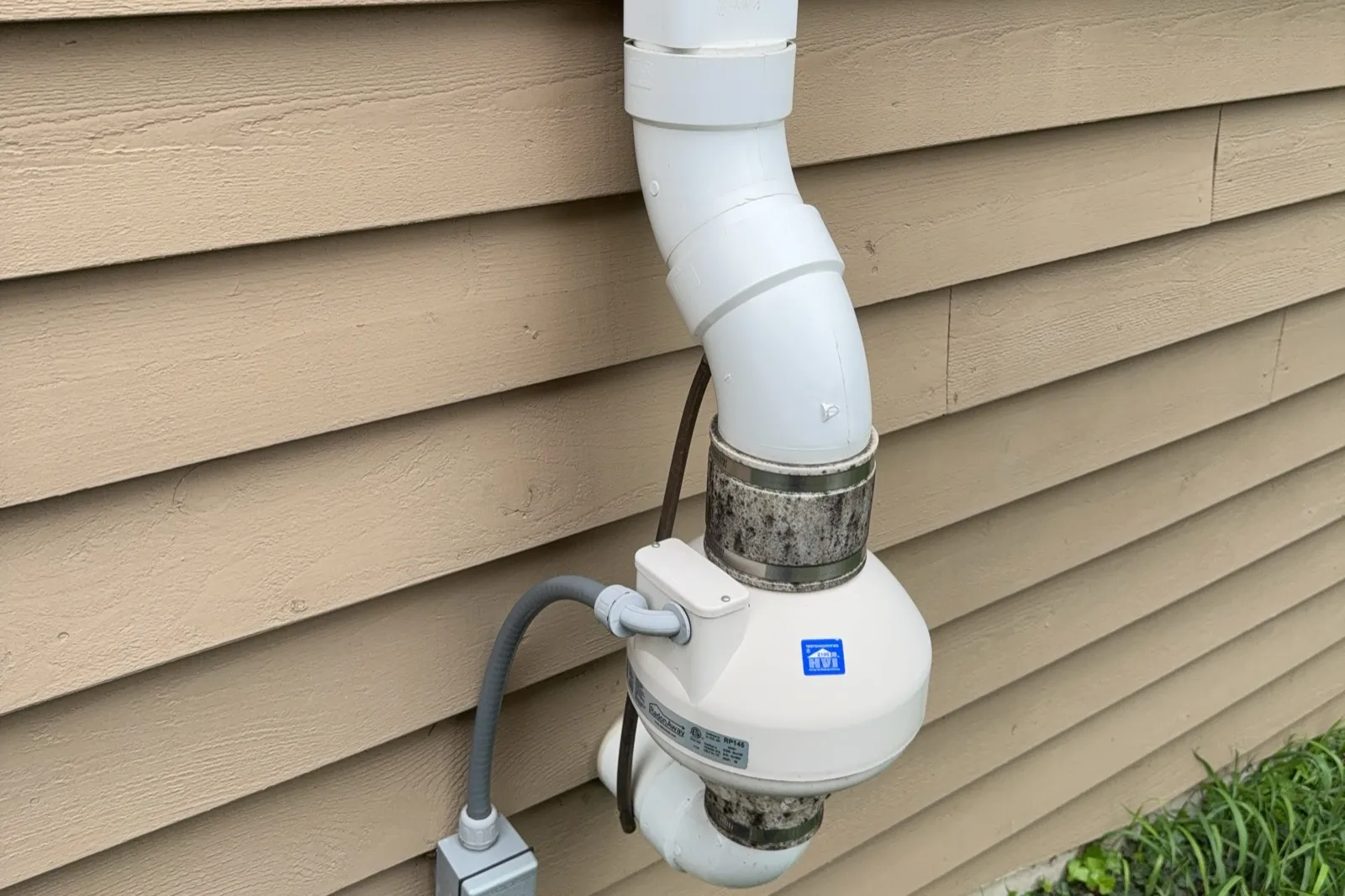
Table of Contents
- Who pays for radon mitigation, the buyer or the seller?
- Who is allowed to install a radon mitigation system in Illinois?
- When should the radon test after mitigation be done?
- Can the mitigation company run the post-mitigation radon test?
- What should a radon mitigation system look like?
- What we found on a radon system during a Chicago-area inspection
- What does a home inspection check on a radon system?
- What to ask for in writing if you are buying the house
- How we help
- Sources
- FAQ
Who pays for radon mitigation, the buyer or the seller?
Neither one has to, under Illinois law. The Illinois Radon Awareness Act requires the seller to hand you the IEMA radon pamphlet and a signed radon disclosure before you are bound by the contract, and it says outright that nothing in it creates “an obligation on the seller to conduct any radon testing or mitigation activities.”
So who pays is a negotiation. After a high test, the usual asks during attorney review are the two below, and each one leaves you with different things to check.
| What you ask for | Who picks the mitigator | What you have to verify before closing |
|---|---|---|
| Seller installs the system before closing | The seller | Licence, installation, documents and an independent post-mitigation test. Everything in this guide. |
| Credit or price reduction at closing | You, after closing | Only the amount. You hire the mitigator and schedule the follow-up test yourself once you own the house. |
If the seller installs, the work is done by someone you did not hire, on a schedule set by the closing date. That is the case this guide is about. Our post on what to do when the inspection finds problems covers the repair-versus-credit decision more generally.
One line on the disclosure form is worth a second look. A seller can initial that “prior elevated radon concentrations have been mitigated or remediated.” If you see that, the same form has a line for the seller to provide “the most current records and reports” on elevated radon. Ask for them.
Who is allowed to install a radon mitigation system in Illinois?
In most cases, someone licensed by the Illinois Emergency Management Agency (IEMA). The Radon Industry Licensing Act says no person may “perform a service to reduce the presence of radon” without an IEMA licence, and a general contractor or handyman is no exception. There is one exception that matters here. Illinois rules exempt a person mitigating “a dwelling in which the person resides,” so a seller who lives in the house can legally install a system themselves. That is why your written terms should name a licensed mitigator, not just say the seller will mitigate.
The licence number shows up in more than one place. The state rule requires it on the written proposal the seller signs, on the Illinois Mitigation System Tag fixed to the vent pipe, and in the information package the mitigator hands over at completion. Check the name and number against IEMA’s list of licensed radon professionals. The same habit applies to every trade in a repair request; our guide to checking a contractor’s licence before your repair request covers the rest.
When should the radon test after mitigation be done?
The test can start once the system has been running for at least 24 hours, and it must be done within 30 days of the system being switched on. IEMA’s measurement rule (32 Ill. Adm. Code 422.130) also says the system must run “normally and continuously during the entire measurement period.”
A real estate radon test runs at least 48 hours, and closed-building conditions have to start at least 12 hours before it begins. Our page on closed-building conditions for a radon test explains what that means for the seller. Put together, the earliest you can have a valid result is about three days after the fan starts.
| Step | Earliest | Rule |
|---|---|---|
| Fan switched on | Day 0 | Start of the 30-day window |
| Closed-building conditions begin | At least 12 hours before the test starts (can overlap the 24-hour wait) | 422.130(b) |
| Post-mitigation test starts | 24 hours after the fan is switched on | 422.130(i) |
| Test ends | At least 48 hours after it starts, about 72 hours after the fan is switched on | 422.130(c) |
| Last day to run the test | 30 days after the fan is switched on | 422.130(i) |
If the install is booked for the week of closing, there may be no room for a valid test before you sign. Weather can add delay too: the rule bars short-term tests under 96 hours “during severe storms or periods of sustained high winds (30 miles per hour or more).” Ask for an installation date that leaves time to test, read the result, and act on it if the number is still high.
Can the mitigation company run the post-mitigation radon test?
Ask for an independent test instead. The Illinois mitigation standard (32 Ill. Adm. Code 422.150) requires the mitigator to tell the client in writing that the test “may be conducted by an independent Radon Measurement licensee or by the resident of the dwelling.” IEMA’s own radon guidelines for real estate transactions are blunter: after a system is installed, “Perform an independent short-term test to ensure that the reduction system is effective.”
The installer has a stake in the result, and so does the seller who paid for the system. A licensed measurement professional you hire has neither. The same IEMA fact sheet says it is “not in the best interest of the buyer or seller to rely on a radon measurement performed by anyone other than a licensed measurement professional or technician.”
Installing a system does not promise a number either. The standard states that compliance “does not guarantee reduction of indoor radon concentrations to any specific level.” One of our own reports put it this way: these systems “do not guarantee that radon will remain below recommended limits at all times.” Instead, the mitigator’s proposal must either guarantee the average below 4.0 pCi/L, with conditions, or explain why there is no guarantee. Read which one the seller signed.
What should a radon mitigation system look like?
A compliant system has a monitor, a state tag and labels you can read without tools, and a fan and discharge in places the rule allows. These are the parts of 32 Ill. Adm. Code 422.150 that a buyer can check on a walk-through.
| What to look for | What the Illinois standard requires |
|---|---|
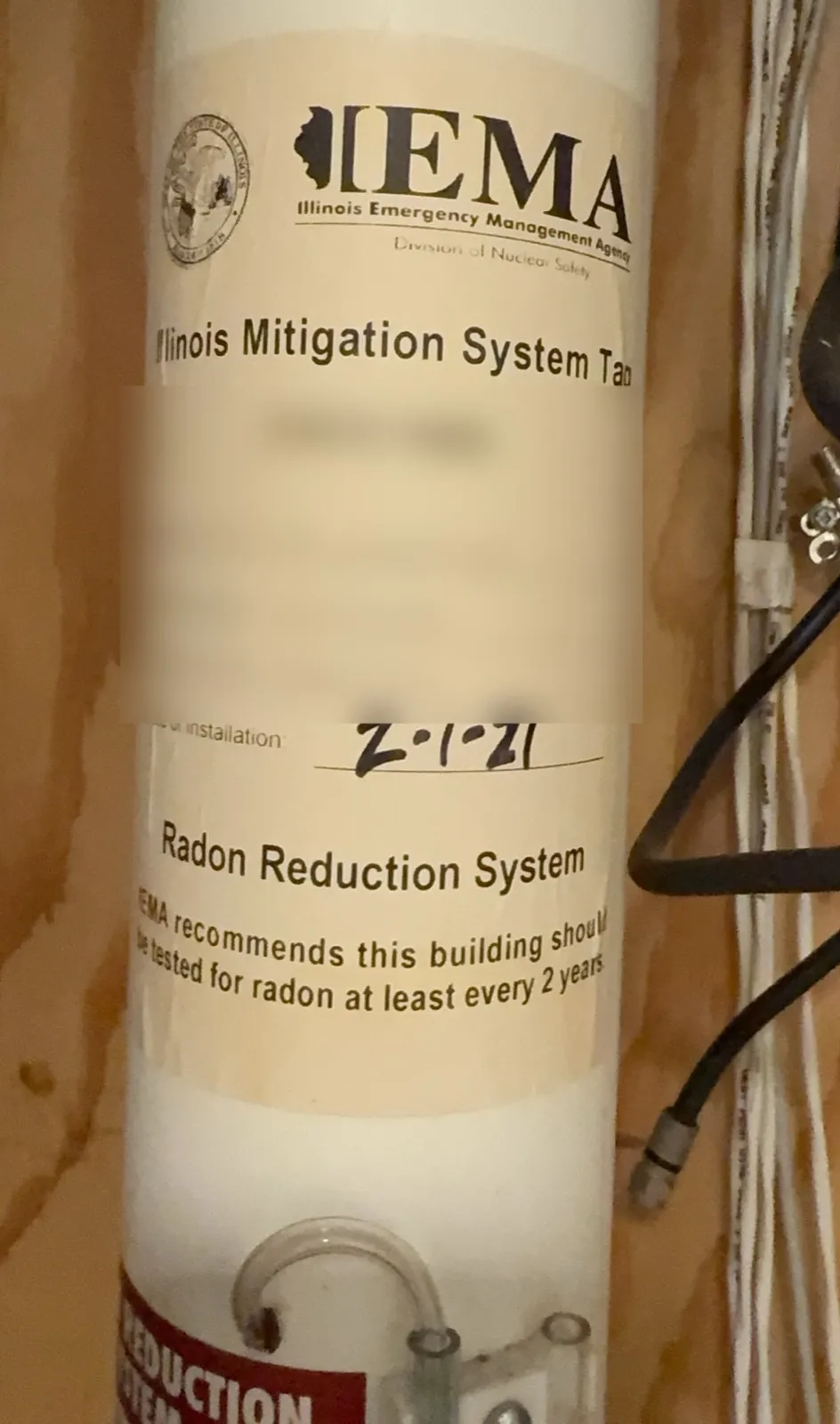
| Illinois Mitigation System Tag | On the vent pipe next to the monitor. Shows “Radon Reduction System”, the installer’s name, phone and Illinois licence number, the installation date, and advice to retest at least every 2 years. |
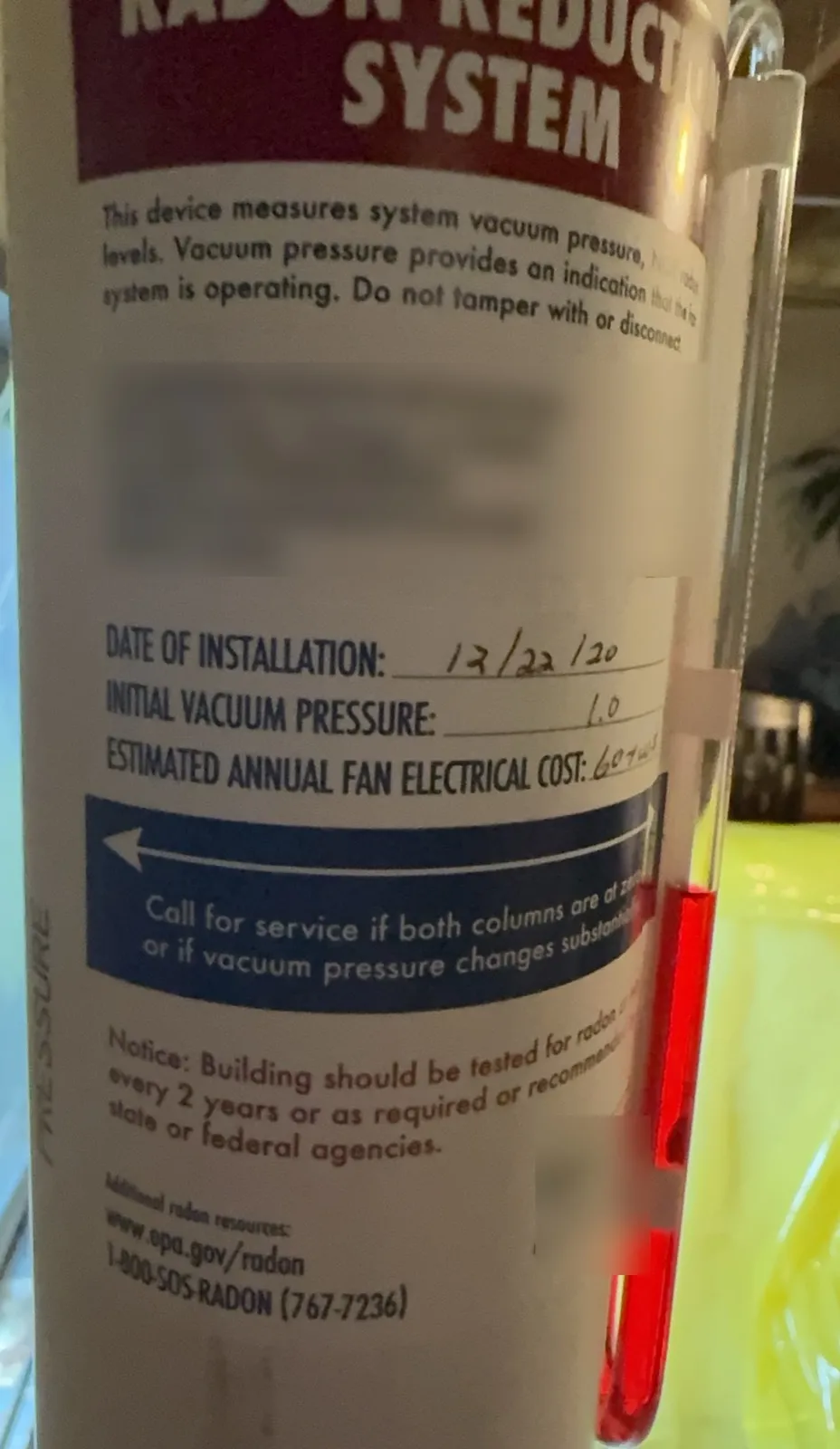
| A monitor | Every active system has one. A U-tube manometer must be marked with the reading at the time the system was switched on. An electrical alarm must be on a circuit that cannot be switched off. |
| “Radon Reduction System” labels | On interior vent pipe at least once on each floor, on an outdoor fan and exterior pipe, on the circuit breaker, and on a sump cover the system depends on. |
| Fan location | In an attic, in a garage that is not beneath living space, or outside. Never in a basement, crawlspace or living space. |
| Discharge | Above the highest eave of the roof (an attached-garage route has its own conditions), at least 10 feet above the ground, and at least 10 feet from windows, doors or other openings into living space that sit less than 2 feet below it, and at least 10 feet from any opening into a neighbouring building, which on a narrow lot can mean the neighbour’s window across the gangway. Pointed straight up with no rain cap. |
| Exterior downspout-style pipe | Every joint and connection permanently sealed. |
Reading the gauge. In our words from a report this summer: “an offset between the two fluid columns indicates the fan is drawing properly, while level columns indicate the fan has stopped.” Compare it with the mark or label showing the reading when the system was switched on.
What we found on a radon system during a Chicago-area inspection
On a February inspection, the radon vent ran up the outside of the house in rectangular downspout material, and one joint was open. We wrote it up as: “One of the exterior pipe junctions within the radon mitigation system is not properly sealed. This condition can allow radon-laden air to leak and discharge before reaching the intended termination point above the roof, which may reduce the effectiveness of the system.”
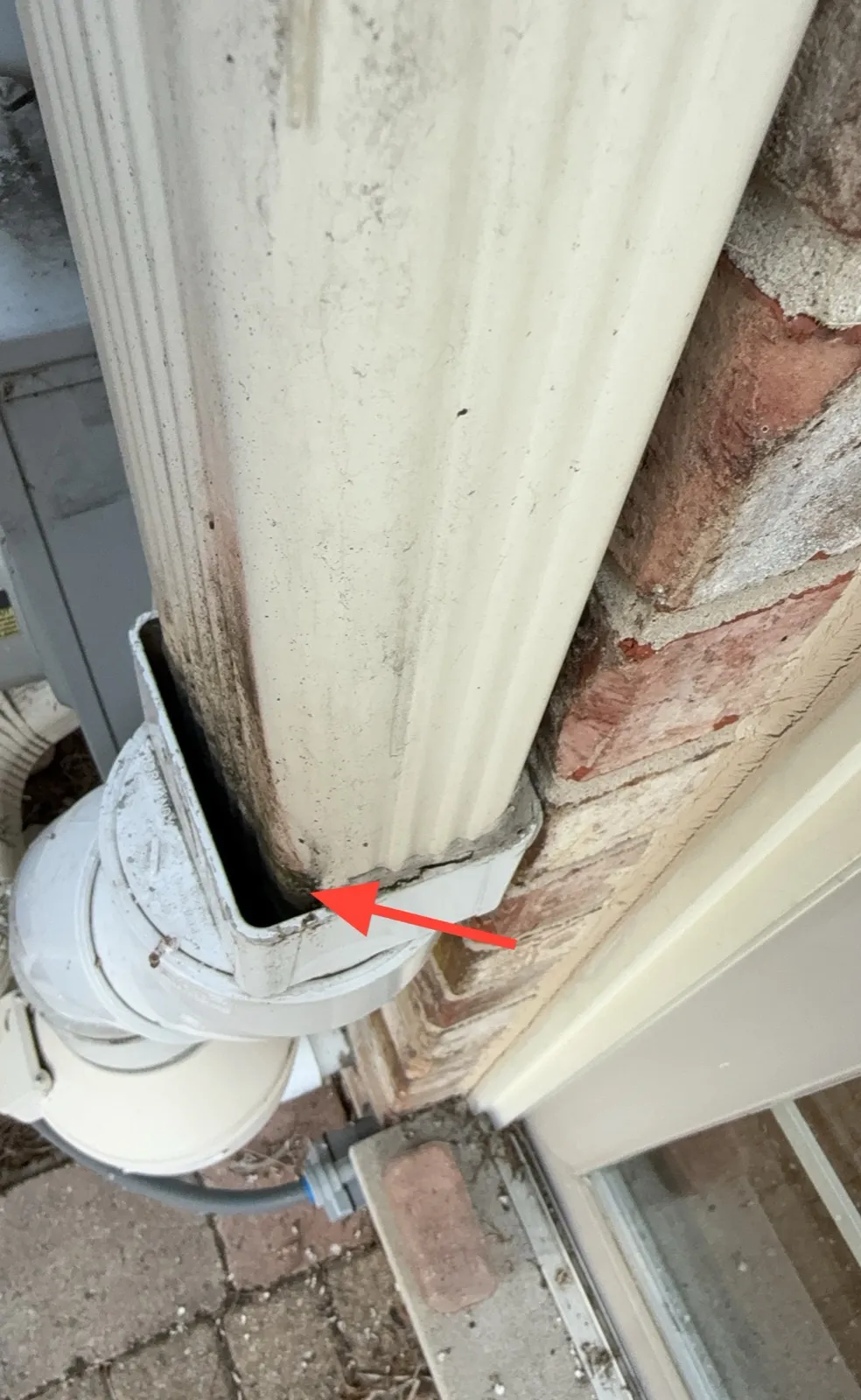
The Illinois standard addresses exactly this: joints in a system that uses 3-inch by 4-inch metal downspout on the outside of a building “shall be permanently sealed with appropriate sealants.” The tag and the gauge were in place. A system that looks finished from the basement can still leak outside.
The same house showed a second thing buyers do not expect. The sump pit cover was sealed as part of the radon system, so we could not lift it to run the sump pump. A sealed sump cover is normal on these systems, and Illinois requires it to carry a label telling you to call the installer before removing it.
What does a home inspection check on a radon system?
A home inspection looks at the parts of the system you can see: whether a system is present and running, the tag, the gauge reading, the labels, where the fan sits, visible joints and supports, and where the pipe discharges as far as it can be seen. It is visual and non-invasive, and our Chicago home inspection photo library shows the kind of conditions we document.
It does not check the design. The mitigator’s floor plan, diagnostic tests and suction readings sit in their own file, and the only measure of whether the system works is a radon test. For how these systems are built in general, see our overview of radon mitigation systems in Chicago homes.
| Question | Who answers it |
|---|---|
| Is a system installed, and is the fan running? | Home inspection |
| Are the tag, monitor, labels, fan and visible discharge where the rule puts them? | Home inspection, for the parts that can be seen |
| Was the system designed and installed to the full Illinois standard? | The licensed mitigator, from their records |
| Is the radon level now below 4.0 pCi/L? | A post-mitigation radon test by a licensed measurement professional |
What to ask for in writing if you are buying the house
Settle these during attorney review, before the contract terms are final. Your attorney writes the language; this is what it should cover.
- Who installs it. An IEMA-licensed radon mitigation professional, named, with the licence number, installing to 32 Ill. Adm. Code 422.150.
- When. A completion date that leaves at least three days for a valid test before closing, plus time to act on the result. If the seller is also completing HVAC or structural repairs, put the radon test after that work; the measurement rule bars radon tests during renovation.
- The paperwork. The signed proposal (licence number, scope, and the guarantee or no-guarantee statement), the information package the mitigator must leave at completion, the Illinois Mitigation System Tag number, and any warranty. Ask whether that warranty transfers to you.
- The test. An independent post-mitigation test by a licensed measurement professional you choose, started at least 24 hours after the fan is switched on and within 30 days, with the system running the whole time. The seller agrees in writing to give access, keep closed-building conditions, and sign the non-interference agreement the measurement rule requires. Agree who pays for the test.
- What happens if it is still high. IEMA’s real estate guidelines say to fix the home at 4 pCi/L or more. Agree in advance what happens if the post-mitigation result is still at that level: for example, the mitigator returns to adjust the system, under its guarantee if there is one, and you retest before closing.
- The walk-through. Check the fan is running and the gauge still shows the columns offset. Our pre-closing walk-through checklist lists the rest.
After closing, the mitigator’s file is yours to ask for. The standard requires them to keep it for five years or the length of any warranty, whichever is longer, and to make it available to the homeowner on request with proof of ownership. It includes the pre- and post-mitigation test data and the system drawing.
How we help
We are licensed by IEMA for radon measurement and test with continuous monitors. We can run the independent post-mitigation test as a separate radon test. You get the result the same business day we pick up the monitor. We do not recommend mitigation companies; we test their work. During a home inspection we also look over the visible parts of any system already in the house. Book it as a radon test when you schedule.
Sources
- 32 Ill. Adm. Code 422.150, Mitigation Standard for Existing Housing
- 32 Ill. Adm. Code 422.130, radon measurement requirements
- Radon Industry Licensing Act, 420 ILCS 44/25
- 32 Ill. Adm. Code 422.30, exemptions from licensing
- Illinois Radon Awareness Act, 420 ILCS 46/10
- IEMA, Radon Testing Guidelines for Real Estate Transactions
- IEMA licensed radon professionals search
FAQ
How often should you test for radon after mitigation?
At least every two years, and again after any significant alteration to the building. The Illinois standard requires the mitigator to give you that advice, and the same line is printed on the state tag.
Is radon testing required when you buy a house in Illinois?
No. The seller must disclose what they know and give you the IEMA pamphlet, but nothing requires a test. The state disclosure form says IEMA “strongly recommends ALL homebuyers have an indoor radon test performed prior to purchase or taking occupancy.”
Can I run the post-mitigation radon test myself?
The rule allows “the resident of the dwelling” to run it, and before closing that is not you. For a result you will rely on in a purchase, IEMA advises using a licensed measurement professional.
Does a radon mitigation system guarantee low radon?
No. The Illinois standard says compliance does not guarantee any specific level. Any guarantee is in the mitigator’s proposal, which must either guarantee an average below 4.0 pCi/L or explain why it does not.