


TL;DR: Yes. Under the Multi-Board Residential Real Estate Contract 8.0, the form behind nearly every Chicago-area resale, your attorney can declare the contract null and void by written Notice within five business days after the Date of Acceptance if the inspection makes the home unacceptable to you, and the earnest money comes back. Miss that window, or ask for the wrong kind of repairs, and the leverage flips to the seller.
Which contract am I actually under?
Almost every resale in Chicago and the suburbs is written on the Multi-Board Residential Real Estate Contract 8.0, approved by the Chicago Association of REALTORS, the Chicago Bar Association and the Illinois Real Estate Lawyers Association among others. Version 8.0 took effect February 1, 2025 and replaced 7.0, which sunset on March 1, 2025. If your deal was written before then you are probably on 7.0; the day counts below are the same in both.
Everything in this post comes from five paragraphs of that contract. Pull your signed copy up and find them:
- Paragraph 3 b), Earnest Money: who holds it and what happens to it if the contract dies.
- Paragraph 13, Attorney Review: the five-business-day window for your attorney to approve, disapprove or propose changes.
- Paragraph 14, As-Is Condition: what the seller is and is not promising when the listing says “as-is”.
- Paragraph 15, Inspections: you initial exactly one of a), b) or c), and which one you initialed decides what you are allowed to do with the report.
- Paragraphs 25 and 27: how business days are counted, and how the escrow agent releases the earnest money.
Some builders and a few brokerages use their own forms. If yours does not say “Multi-Board” at the top, hand it to your attorney and ask the same questions this post answers.
How many days do I have?
Five business days after the Date of Acceptance, for both attorney review and the inspection. The two windows run at the same time, not one after the other.
Paragraph 15 b) 2) says the buyer “shall serve Notice of any major component defects disclosed by any inspection for which Buyer requests resolution by Seller within five (5) Business Days” after the Date of Acceptance. A lead-based paint inspection gets ten calendar days instead. Paragraph 15 b) 3) and 15 c) use the same five business days for a straight termination. Paragraph 13 gives the attorneys the same five business days to approve, disapprove or propose modifications.
Business days are defined in Paragraph 25: Monday through Friday, excluding federal holidays. Acceptance on a Thursday means Notice is due by the following Thursday. If Labor Day or Thanksgiving falls inside the window, you get one more day. Notice is effective when it is transmitted during business hours, 8 a.m. to 6 p.m. Chicago time; something sent at 9 p.m. on day five is treated as received on day six.
Then there is a second deadline most buyers never hear about. Under 15 b) 2), if the parties have not reached written agreement on all inspection issues by ten business days after acceptance, either party may terminate. That cuts both ways: a seller who is tired of negotiating can walk on day eleven.
And 15 b) 4) is the trap: failing to inspect and notify within the time “operates as a waiver of Buyer’s rights to terminate this Contract under this Paragraph 15.” No Notice, no contingency.
What that means for scheduling: the report needs to be in your attorney’s hands by day three or four, and we deliver the report the next business day after the visit. So the inspection belongs on business day one, two or three. Our booking page shows real-time availability, including weekends, with the price on screen, so you can lock the slot the night the offer is accepted instead of trading voicemails.
If something outside your control blocks the inspection, snow on a flat roof, a tenant who refuses access, water shut off in a vacant house, have your attorney request an extension in writing before day five ends. An extension nobody signed is not an extension.
What does “as-is” mean on a Chicago listing?
On the Multi-Board form, “as-is” is Paragraph 14, initialed by both sides. It says the sale is of the property “in its AS IS condition as of the Date of Offer,” that the seller makes no representations about condition beyond the known defects already disclosed, and that the Paragraph 7 warranty language about systems being in operating condition at closing does not apply. Then the sentence that matters: “Buyer waives any inspection unless Paragraph 15 b) or c) is initialed.”
Read that twice. As-is does not mean no inspection. It means the seller is telling you in advance that repair requests will go nowhere. The correct response is to initial Paragraph 15 c), Right to Inspection with No Requests. You inspect, and if “the condition of the Real Estate is unacceptable to Buyer” and your attorney serves Notice within five business days, the contract is null and void and the earnest money is returned. What you cannot do under 15 c) is send a repair or credit request; the contract says a request “in violation of the terms of this subparagraph shall allow Seller to declare this Contract terminated.”
As-is also does not cancel the seller’s duty under the Illinois Residential Real Property Disclosure Act, 765 ILCS 77. Section 20 requires the seller to complete the written disclosure report and deliver it “before the signing of a contract.” Bring that report to the inspection. Every “no” on it that turns into a photo in our report is something your attorney will want to see.
In practice, “as-is” in Chicago usually shows up on estate sales, bank-owned two-flats, and tired rentals in Logan Square, Avondale and Albany Park where the seller has never lived in the building and honestly does not know what is behind the walls. Those are the properties where a full inspection plus a sewer scope earns its keep.
What are my three outcomes, and how is each one documented?
Once the report lands, you and your agent and attorney have one decision to make before day five: walk, take a credit, or require repairs. Each has its own paperwork.
1. Walk
Your attorney serves written Notice under 15 b) 3) or 15 c) that the condition is unacceptable and the contract is null and void. Two things buyers get wrong here. First, the Notice comes from the attorney, by one of the methods listed in the contract’s Notice paragraph, with a time stamp during business hours. A text to the listing agent is not Notice. Second, the contract says in capital letters that the buyer “SHALL NOT send any portion of the inspection report with the Notice” unless the seller or the seller’s attorney asks for it in writing. Your report is your document. Keep it, along with the Notice and the escrow release, in one folder.
2. Credit
A closing credit is negotiated attorney to attorney inside the ten-business-day window and recorded in a written modification to the contract. In Chicago it is common to ask for a credit rather than completed work, especially in spring and summer when contractors are booked out and a seller’s rushed repair the week before closing is the last thing you want. A credit means you choose the plumber. Two cautions: your lender limits how much seller credit can be applied at closing, so confirm the number with your loan officer before you agree to it, and a price reduction changes your loan amount while a credit changes your cash to close, which are not the same thing for every buyer.
3. Repair
Under 15 b) 1), a repair request “shall cover only the major components of the Real Estate,” which the contract lists: central heating and cooling, plumbing and well, electrical, roof, walls, windows, doors, ceilings, floors, appliances, and structural and mechanical components. A component counts as in operating condition, and therefore not defective, “if it does not constitute a current threat to health or safety, and performs the function for which it is intended, regardless of age or if it is near or at the end of its useful life.” Minor repairs, routine maintenance, painting, decorating and cosmetic items “no matter the cost to remedy same” are not defects and “shall not be a basis for the Buyer to cancel.” A request that crosses that line lets the seller terminate and return your earnest money, which is not the outcome you were going for.
So the request should quote the report’s wording for the defect, name the trade (licensed plumber, licensed electrician, roofing contractor), set a completion date before closing, and require the paid invoice to be delivered. Then book a repair verification visit: we return with the agreed written list, look at each item directly, and report what we could and could not observe. Work that is closed up behind drywall, or documented only by a receipt, gets logged as received, not verified. Vague commitments (“seller will address the furnace”) are how buyers end up owning a furnace that was “addressed.”
Do I get my earnest money back?
If the Notice went out in time, yes. Paragraph 3 b) puts the earnest money in trust with an escrowee, usually one of the two brokerages, and says that if the contract is declared null and void it is disbursed under Paragraph 27. Paragraph 27 reads a refund clause into every termination right in the contract: the money is “refunded upon the joint written direction by the Parties to Escrowee or upon an entry of an order by a court.”
Joint direction is the part to push on. Ask your attorney to send the release with the Notice, so the seller’s side signs both at once. If a seller refuses to sign, a brokerage escrowee can give both parties fourteen days’ written notice of how it intends to disburse; if nobody objects in writing, the money moves. If someone does object, it sits until there is an agreement or a court order. That is a fight you avoid by serving Notice on day four instead of day six.
One finding that justified walking, and one that did not
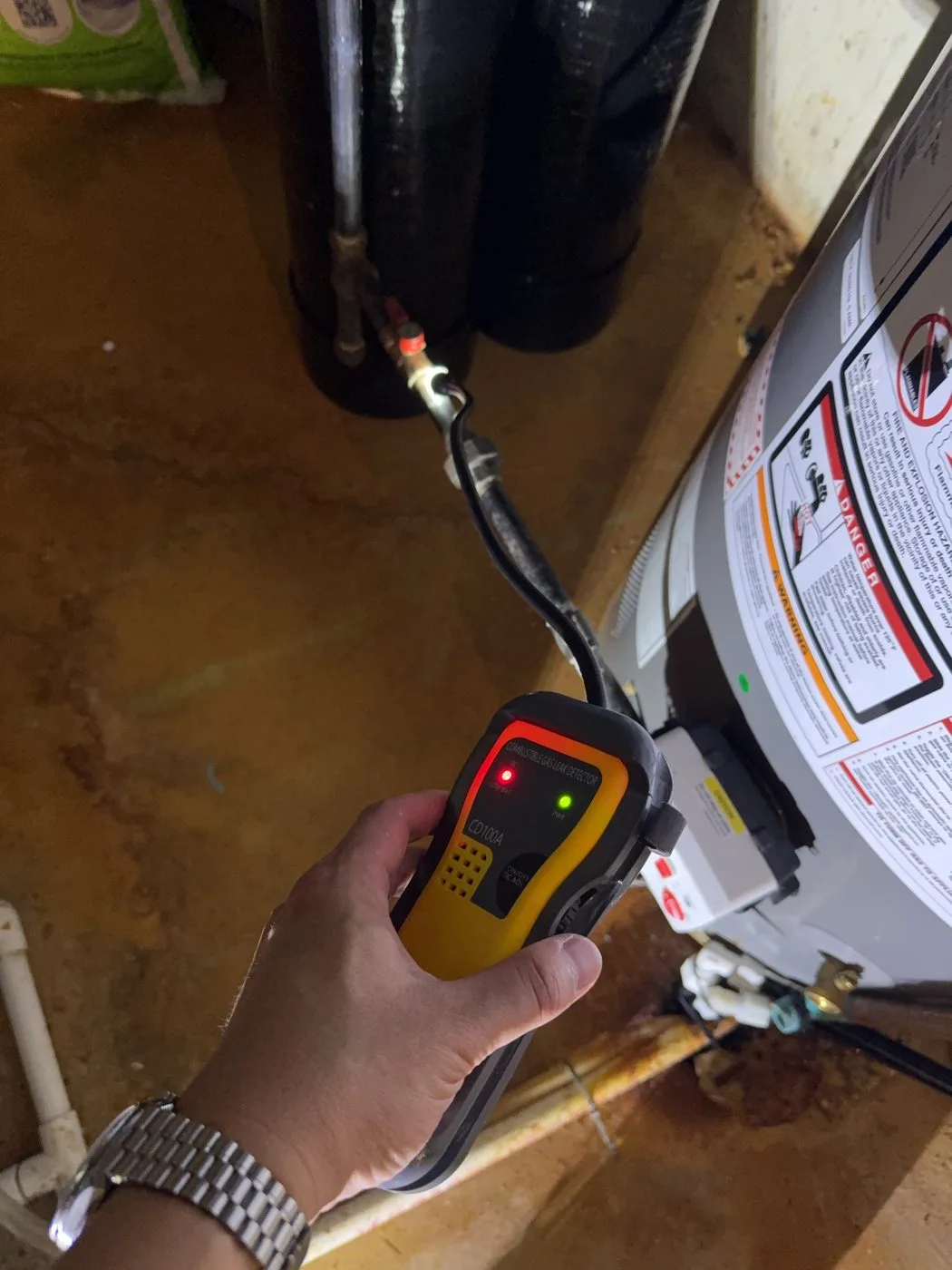
Justified: gas leaking at the range in both units of a two-flat. A Chicago two-flat, July 2026. The combustible gas detector we carry to every gas appliance read positive at the flexible connector behind the range in the front unit, and then again at the rear unit’s range. Neither range was fastened with an anti-tip device either. Under the contract’s own test this is a current threat to health or safety, so it is a major-component defect twice over, and it says something larger: nobody had been maintaining the gas appliances in either dwelling, and a two-flat buyer inherits the tenant’s safety along with the rent. A written request for a licensed plumber to replace both connectors, correct the leaks and prove it with a repair verification visit would have been defensible. So would walking, on a building where the first hour of the inspection turned up two gas leaks. What is not defensible is doing nothing because the listing said “updated kitchens.”
Not justified: a hairline crack in a basement slab. A crack in a basement floor that you cannot fit a dime into, with no vertical displacement between the two sides, no dampness along it, and nothing happening in the walls above, is concrete doing what concrete does as it cures and dries. It gets noted in the report so you know it is there and can watch it. It is not a structural defect, and a credit request for it under 15 b) is exactly the kind of “minor repair” the contract warns about. A horizontal crack in a foundation wall, a stepped crack through brick, or a slab crack with one side higher than the other is a different conversation and gets a structural engineer, not a Notice.
The pattern to take from both: the contract does not care how long the report is. It cares whether an item is a current threat to health or safety or a component that does not do its job. Sort the report that way before you decide anything: safety hazards first, then major systems that do not work, then water intrusion, then deferred maintenance that belongs on your own list after closing.
What should I do this week?
- Find your Date of Acceptance and count five business days forward, skipping federal holidays. Write that date down.
- Book the inspection for business day one, two or three. Add radon if there is a basement; add a sewer scope referral on any pre-1960 house.
- Send your attorney the inspection date so they know when the report arrives (the next business day).
- Read the summary first, then the whole report, with the seller’s disclosure next to it. Our sample report shows the format.
- Decide walk, credit or repair with your agent and attorney by day four. Only major components go in a request.
- Attorney serves Notice during business hours, no later than day five, with the earnest money release attached if you are walking.
- If repairs are agreed, get the written list to us and schedule the repair verification visit before closing.
For the negotiation itself, see what to do if the home inspection finds problems. Agents coordinating the timeline for a client can start at our page for agents.