
TL;DR:
- Buying lakefront property in Lake County requires eight specific inspections beyond a standard home check to uncover costly issues. These include shoreline, seawall, dock, drainage, septic, well, flood, mold, and sewer evaluations to ensure safety and code compliance. Coordinated inspections and thorough documentation help buyers negotiate effectively and protect long-term investment value.
Buying a lakefront or Chain of Lakes home in Lake County means ordering eight specific inspection actions before you commit. A standard home inspection alone will not catch the issues that cost the most money here. Here is the prioritized checklist:
- Shoreline and seawall assessment — movement, undermining, and missing permits can trigger costly county-mandated repairs.
- Dock and piling condition — rot, corrosion, and unpermitted structures become the buyer’s liability at closing.
- Drainage and grading review — poor grading pushes water toward the foundation and accelerates shoreline erosion.
- Septic system inspection — Lake County Health Department reviews check setbacks and visible components, but they do not excavate or pressure-test; a private inspection fills that gap.
- Private well testing — coliform, nitrates, and water quality lab tests are separate from the county’s visual review.
- Flood zone and elevation certificate check — FEMA flood map status directly affects mortgage requirements and insurance premiums.
- Mold and hidden moisture check — below-floor rot and mold behind baseboards are common in lakefront homes and fall outside standard inspection scope.
- Sewer line camera — applicable when the home connects to municipal sewer; older lines near lake-level soils shift and crack.
The Multi-Board Residential Real Estate Contract 8.0 allows buyers to request seller-paid well and septic inspections when the corresponding section is initialed. Even on “as-is” listings, local attorneys typically treat well and septic condition as non-negotiable health and safety items. Most of these fall outside the scope of a home inspection and are ordered separately from specialists. What we do and do not perform is set out below.
Table of Contents
- What does a lakefront inspection checklist actually cover?
- What does a standard inspection miss on a lakefront property?
- Which specialist inspections should you order for a Chain of Lakes property?
- What permits, riparian rights, and flood rules apply in Lake County?
- How much do lakefront inspection add-ons cost, and how long do they take?
- How do you choose the right inspector for a lakefront property?
- How Chicago Home Inspect LLC inspects lakefront properties
- Questions to ask your inspector and red flags to watch for
- How long do inspections and add-ons take?
- Our perspective on buying lakefront in Lake County
- Chicago Home Inspect LLC serves Lake County lakefront buyers
- Useful Lake County sources and local agencies to contact
What does a lakefront inspection checklist actually cover?
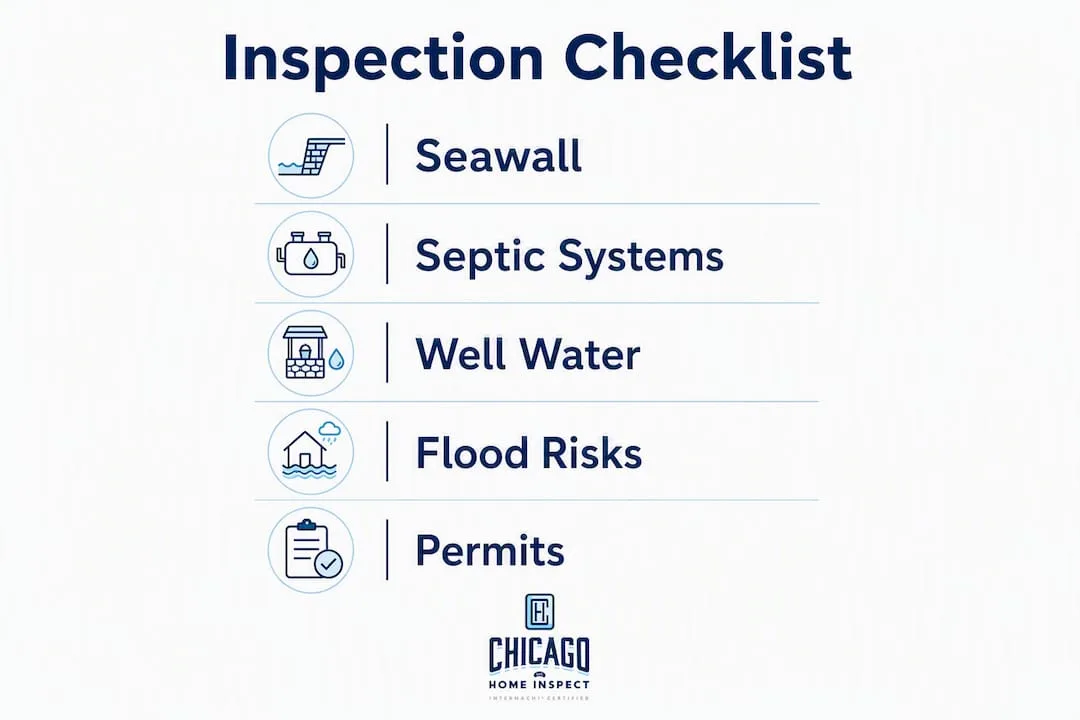
The table below maps each inspection area to what you are looking for, why it matters in Lake County, and what to photograph for negotiation and permit review.
| What to inspect | Signs to look for | Why it matters | Photos to capture |
|---|---|---|---|
| Seawall / bulkhead | Cracks, tilting, exposed anchors, soil undermining | Replacement costs can vary widely depending on the project size and specifics; consult a qualified engineer or contractor for an estimate; unpermitted work triggers county review | Full face of wall, base soil exposure, any visible anchor hardware |
| Dock and boathouse | Rot in decking/framing, corroded hardware, pile movement | Ownership and maintenance responsibility may not transfer clearly | Below-deck pilings at waterline, corroded connectors, deck surface |
| Shoreline vegetation buffer | Bare soil, erosion channels, invasive species | Vegetation loss accelerates bank erosion; Chain O’ Lakes’ lake levels fluctuate seasonally | Bare bank areas, waterline stain marks, erosion channels |
| Drainage and grading | Water pooling near foundation, downspout discharge toward lake | Drives moisture intrusion and shoreline erosion simultaneously | Standing water, soil settlement at foundation corners |
| Below-floor and crawl space | Rot, mold, high moisture readings | Lakefront crawl spaces trap humidity year-round; freeze-thaw cycles worsen wood decay | Moisture meter readings, discolored joists, visible mold growth |
| Dock/boathouse interior | Waterline stains, prior repair patches, soft framing | Stains indicate past flooding or wave action; patches hide structural damage | Waterline stain height, patched areas, framing condition |
Photographing for negotiation
Close-up photos of cracks and gaps in seawalls, undermined soil at the base, and below-deck pilings at the waterline are the most useful images in attorney review. Waterline stains inside a boathouse tell you exactly how high water has reached during past high-water events on Chain O’ Lakes, which ran at record levels in 2019 and again in 2020.

Pro Tip: Place a dated object in the frame — a phone screen showing the date, or a handwritten card — when photographing condition issues. That timestamp authenticates the photo if a seller later disputes when damage occurred.
When you photograph erosion channels or bare shoreline, capture the full bank from the water’s edge up to the lawn grade. That single image shows both the extent of erosion and the distance to the foundation, which is the number an engineer needs to scope a repair estimate.
What does a standard inspection miss on a lakefront property?
Illinois home inspectors are licensed under the Home Inspector License Act (225 ILCS 441) and follow a defined scope: structure, roof, mechanicals, visible plumbing and electrical. Standard inspections generally cost several hundred dollars and vary with the home’s size and age. That scope is appropriate for a typical suburban home. For a lakefront property, it leaves several high-cost items unexamined.
| Standard inspection scope | Lakefront gaps not covered |
|---|---|
| Roof, gutters, exterior cladding | Seawall / bulkhead structural condition |
| Foundation and visible structure | Dock pilings below waterline |
| HVAC, water heater, electrical panel | Septic drain field performance and remaining service life |
| Visible plumbing and fixtures | Private well pumping test and water quality lab results |
| Attic insulation and ventilation | Hidden below-floor rot in crawl spaces near water |
| Windows, doors, interior finishes | Shoreline drainage and erosion patterns |
The most expensive misses in lakefront transactions tend to be failing seawall drainage, hidden rot in crawl spaces that sit close to lake grade, and septic drain fields that pass a visual check but are within a few years of failure. Mold behind baseboards on the lake-facing wall is another recurring find — the wall faces prevailing winds off the water, and if the vapor barrier or flashing has failed, moisture accumulates for years before it becomes visible.
Pro Tip: Before you schedule an inspection, ask the inspector in writing which add-ons they will perform or coordinate: sewer camera, septic evaluation, well testing, and mold sampling. A verbal “we can do that” is not a scope commitment.
Which specialist inspections should you order for a Chain of Lakes property?
Standard inspections set the baseline. These specialist tests are what protect you on a lakefront or Chain of Lakes buy.
- Mold testing — air sampling and surface sampling in crawl spaces, below-floor areas, and lake-facing walls.
- Radon testing — Illinois sits in EPA Zone 1 and 2; radon is a real risk in Lake County homes regardless of proximity to water.
When to order each test
| Condition or transaction trigger | Tests to order |
|---|---|
| Visible shoreline movement or cracked seawall | Shoreline/seawall engineering review |
| Seller disclosure lists septic age over 20 years | Full septic inspection including drain field probe |
| Seller indicates private well | Well inspection + full water quality lab panel |
| Seller disclosure of prior flooding or water intrusion | Mold testing, elevation certificate review |
| “As-is” listing with buyer financing contingency | Septic, well, mold, and sewer camera — all of them |
| Musty odor or visible staining in crawl space | Mold testing, moisture mapping |
| Home built before 1980 | Radon testing, sewer camera |
Cost and complexity vary. Radon testing is low cost and low complexity, typically added to the inspection day. Mold sampling is moderate cost with a 3–5 day lab turnaround. A septic full inspection with drain field probing is moderate to high cost and may require scheduling a separate contractor. A seawall engineering review is the highest-cost specialist item and takes the longest to schedule, so order it early in the contingency period.
The Lake County Health Department’s review confirms minimum compliance — setbacks and visible components — but does not excavate septic systems or pressure-test components. Private inspections are what evaluate remaining service life and identify failure modes before they become your problem.
What permits, riparian rights, and flood rules apply in Lake County?
These are the local checks that buyers most often skip, and the ones that cause the most expensive surprises after closing.
Lake County agency contacts and what to request
| Agency | What to request | Why it matters |
|---|---|---|
| Lake County Health Department | Well registration records, septic permit history, prior evaluation reports | Confirms system age, location, and any prior violations |
| Lake County Building & Development Services | Permit history for seawalls, docks, additions, and shoreline work | Unpermitted structures become buyer liability |
| Lake County Recorder of Deeds | Recorded easements, riparian rights, and access agreements | Confirms legal lake access and any shared-use obligations |
| FEMA Flood Map Service Center | Flood zone designation and elevation certificate | Determines flood insurance requirement and premium tier |
FEMA flood maps and elevation certificates
Chain O’ Lakes properties and many other Lake County lakefront parcels fall in FEMA Special Flood Hazard Areas (SFHA), designated Zone AE or Zone A. A property in an SFHA requires flood insurance if the buyer uses a federally backed mortgage. The elevation certificate, prepared by a licensed surveyor, documents the lowest floor elevation relative to the Base Flood Elevation and is the document insurers use to set premiums. Request it from the seller; if none exists, budget for a surveyor to prepare one.
Riparian rights and lake access
Riparian rights in Illinois attach to ownership of land abutting a navigable waterway. What those rights actually allow — dock construction, mooring, shoreline modification — depends on recorded easements, homeowner association rules, and Illinois Department of Natural Resources permits for structures on navigable waters. Chain O’ Lakes is a navigable waterway under Illinois law, so any dock or boathouse there requires IDNR review. Confirm the status of existing structures before assuming they are legal and transferable.
The Multi-Board Residential Real Estate Contract 8.0 gives buyers the right to request well and septic inspections with seller participation when the appropriate section is initialed. Local real estate attorneys in Lake County routinely treat these as non-negotiable even on “as-is” listings because they are health and safety items, not cosmetic ones.
How much do lakefront inspection add-ons cost, and how long do they take?
Lead times, and which items to order first
Costs vary by property size, age, and how many samples a lab test requires, so ask each provider for a quote rather than working from a published range. Lead time is the part that actually constrains a contingency period:
| Inspection or test | Added timeline | Notes |
|---|---|---|
| Standard home inspection | 2–4 hours on-site | Report follows within 24–48 hours |
| Radon test | 48-hour closed-building period | Add to inspection day; closed-building prep required |
| Mold air sampling | 3–5 business days for lab results | Number of samples varies by property |
| Sewer line camera | 1–2 hours; report same day | Sewer scope is critical for older lines in lake-area soils |
| Septic full inspection | 1–2 days; report within 3 business days | Separate specialist; drain field probing adds time |
| Well water quality lab test | 3–7 business days for lab results | Separate specialist lab |
| Seawall/shoreline engineering review | 5–10 business days for written report | Longest lead item — engineers book out quickly, so order first |
Using findings in negotiation
Inspection reports are negotiation tools when they are photo-rich, prioritized, and specific. Here is how to convert findings into requests:
- Failing septic drain field — request seller credit equal to replacement cost estimate, or walk away if seller refuses and financing requires a functioning system.
- Unpermitted dock or seawall — request permit resolution before closing, or a credit that covers the cost of retroactive permitting or removal.
- Active shoreline erosion — request a credit based on an engineer’s written estimate; do not accept a verbal “we’ll fix it.”
- Mold in crawl space — request professional remediation with a clearance test before closing, not a seller DIY cleanup.
- Older but functional seawall with documented maintenance — a reasonable basis for a modest credit rather than a walk-away; shoreline condition is a top value driver in lakefront pricing.
- Radon above 4 pCi/L — request mitigation system installation before closing; this is a well-established, low-cost fix.
A failing septic system on a property that cannot connect to municipal sewer is one of the few findings that justifies walking away entirely. Replacement costs for a full mound system in Lake County can exceed $20,000, and county approval for a new system is not guaranteed on every lot. An older seawall with documented maintenance history and no active movement is a different situation — it supports a credit request, not a cancellation.
Timing matters. Most Lake County contracts give buyers 5–10 business days for the inspection contingency. Order specialist tests on day one, not day three, so lab results and engineer reports arrive before the contingency deadline.

How do you choose the right inspector for a lakefront property?
Not every licensed inspector has experience with waterfront conditions. Here is what to require and what to ask.
Credentials to require
- Illinois home inspector license (225 ILCS 441)
- InterNACHI or ASHI membership, which indicates adherence to published standards of practice
- Errors and omissions (E&O) insurance plus general liability coverage
- Documented experience with lakefront or waterfront properties in Lake County or the Chain O’ Lakes area
Questions to ask before you book
- Have you inspected properties on Chain O’ Lakes or other Lake County lakefront communities? How many in the past year?
- Do you use a moisture meter and thermal imaging camera as standard tools?
- Which add-ons do you perform directly, and which do you coordinate with specialists?
- What is your typical turnaround time for the full report?
- Can you share a sample lakefront inspection report?
That last question is the most revealing. An inspector who cannot produce a sample report with annotated photos, prioritized findings, and clear next-step language is not the right choice for a transaction this complex.
Red flags
- Refuses to recommend specialist inspections for shoreline, septic, or well systems
- No photo-rich sample report available
- Vague scope statement with no written list of what is and is not included
- No local references from Lake County or Chain O’ Lakes transactions
- Discourages buyer attendance at the inspection
Pro Tip: Attend the inspection in person. Being present on inspection day lets you ask questions in real time, see conditions firsthand, and understand the inspector’s findings before the written report arrives — which matters when you have a tight contingency window.
Buyers in Lake Villa and other Lake County communities who attend inspections consistently report better outcomes in negotiation because they understand the context behind each finding, not just the summary line in the report.
How Chicago Home Inspect LLC inspects lakefront properties
Our Lake County lakefront inspection is a full home inspection — structure, roof, mechanicals, visible plumbing and electrical — carried out with lake-adjacent moisture conditions in mind. We document grading and drainage patterns that push water toward the foundation or the bank, and we pay particular attention to crawl spaces and below-floor areas sitting close to lake grade, where rot and elevated moisture readings are common.
Add-ons we perform in house:
- Radon testing — IEMA-licensed, 48-hour continuous-monitor test with results delivered alongside the inspection report
- Mold testing — air and surface sampling in crawl spaces, below-floor areas, and lake-facing walls
- Sewer line camera — full scope with video and written findings
What we do not perform. Shoreline, seawall, dock, and piling assessment is marine and structural work that belongs to a licensed engineer, not a home inspector. Septic inspections and well water testing are separate specialist services we do not provide or coordinate. We will tell you when a property warrants them, but you arrange those directly — and the engineer is the one to book first, because it is the longest lead item in the list above.
We are licensed and insured in Illinois, InterNACHI certified, and BBB Accredited, and we carry errors and omissions coverage. Weekend appointments are available, which matters when your contingency window is tight and the property is occupied during the week. Review our sample inspection report to see the photo quality, annotation style, and report format before you book.
Questions to ask your inspector and red flags to watch for
The right questions separate a qualified waterfront inspector from a general-purpose one.
Ask these before booking:
- What is your specific experience with lakefront properties in Lake County?
- Do you carry E&O insurance, and can you provide proof?
- Which add-ons do you perform yourself versus subcontract?
- How do you handle findings that require a specialist — do you provide written referrals?
- What does your report look like? Can I see a sample from a lakefront property?
Ask these on inspection day:
- What is the single most significant finding you’ve seen today?
- Is this a monitor-and-maintain item or a fix-before-closing item?
- Which specialist would you call first if this were your purchase?
Red flags during the process:
- Inspector discourages ordering septic, well, or mold tests on a property that clearly warrants them
- Report arrives with no photos of the shoreline, dock, or crawl space
- Scope statement says “exterior” without specifying whether shoreline structures are included
- Inspector cannot explain the difference between a county health department review and a private septic inspection
- No written specialist referrals when findings clearly require follow-up
The common issues home inspectors find in Chicago-area homes — deferred mechanical maintenance, roof wear, plumbing and electrical items — apply to lakefront homes too. The difference is that lakefront properties layer shoreline, moisture, and septic risks on top of those standard findings.
How long do inspections and add-ons take?
A standard home inspection on a Lake County lakefront property runs 2–4 hours on-site, longer for larger homes or properties with multiple outbuildings and a boathouse. Plan for the full morning or afternoon; do not schedule anything immediately after.
Add-ons extend the timeline in two ways: some happen on inspection day (radon device placement, sewer camera, mold sampling), and some require lab or engineering turnaround time afterward.
- Radon test: device placed on inspection day, retrieved after 48 hours, results same day as retrieval
- Mold air sampling: samples collected on inspection day, lab results in 3–5 business days
- Sewer camera: performed on inspection day, written findings same day or next day
- Septic full inspection: separate appointment, report within 2–3 business days
- Well water quality lab test: sample collected during inspection or separately, lab results in 3–7 business days
- Seawall/shoreline engineering review: separate appointment, written report in 5–10 business days
The practical implication: if your contract gives you 10 business days for the inspection contingency, order the seawall engineer and the septic inspector on day one. Lab-dependent tests like well water quality and mold sampling need to be collected by day three at the latest to return results before your deadline. The inspection day timeline for Chicago-area buyers follows the same logic — front-load the long-lead items.
Ask each provider for a quote rather than budgeting from a published range — property size, age, and sample count all move the number. What matters for planning is sequence: order the specialist items with the longest lead times first.
Our perspective on buying lakefront in Lake County
Lakefront living on Chain O’ Lakes or the other Lake County communities is genuinely worth pursuing. The access, the setting, and the long-term value of waterfront property are real. What we see repeatedly, though, is buyers who treat the inspection as a formality rather than the most important due diligence step in the transaction.
The properties that cause the most post-closing regret are not the ones with obvious problems. They are the ones where a buyer skipped the septic inspection because the seller said it was “recently pumped,” or passed on the seawall engineer because the wall “looked fine.” Chicago-area freeze-thaw cycles are hard on shoreline structures. A seawall that looks intact in October may have drainage failures behind it that become visible in April after a hard winter. Seasonal lake level changes on Chain O’ Lakes add another variable that does not exist on a standard suburban lot.
Documented inspections do not kill deals. They clarify them. When buyers and sellers are both working from a complete, photo-rich report, negotiations move faster and surprises at closing drop sharply. The inspection is not an obstacle to buying — it is what makes the purchase defensible.
Chicago Home Inspect LLC serves Lake County lakefront buyers
Waterfront buyers have more to arrange than a standard transaction, and it helps to know which pieces are ours and which are not. We inspect the home itself and add radon, mold, and sewer camera work in house. Shoreline and seawall engineering, septic inspection, and well water testing are separate specialist orders you make directly.
We serve Lake County communities including Waukegan, Wauconda, Lake Villa, Antioch, Fox Lake, Gurnee, Libertyville, and Grayslake, along with McHenry County and northern Cook. Weekend appointments are available, which matters when you are working around a seller’s schedule and a 10-day contingency clock.
Review our sample inspection report before you book — it shows the photo quality, annotation style, and prioritized findings format your attorney will work from. We are licensed and insured in Illinois, InterNACHI certified, and BBB Accredited, with E&O coverage on every inspection.
Schedule your Lake County lakefront inspection at chicagohomeinspector.com/schedule.
Useful Lake County sources and local agencies to contact
These are the primary sources for permit history, well and septic records, flood maps, and easement verification. Pull these records before or during your inspection contingency period, not after closing.
- Lake County Health Department — Water Wells: Well registration records, water quality history, and guidance on private well testing requirements.
- Lake County Health Department — Well & Septic Evaluations: Procedural information on requesting county evaluations and understanding what the county will and will not inspect. Use this to understand the county’s scope, then hire a private inspector to fill the gaps.
- Lake County Building & Development Services: Request permit history for all shoreline structures, additions, and mechanical systems. Unpermitted work on seawalls, docks, and boathouses is common and transfers to the buyer.
- Lake County Recorder of Deeds: Request recorded easements, riparian rights documentation, and any access agreements tied to the parcel. This is where shared dock arrangements and lake access restrictions are recorded.
- FEMA Flood Map Service Center (msc.fema.gov): Look up the flood zone designation for the specific parcel. If the property is in a Special Flood Hazard Area, request the elevation certificate from the seller or budget for a licensed surveyor to prepare one.
- Illinois Department of Natural Resources (IDNR): For Chain O’ Lakes and other navigable waterways, IDNR issues permits for docks, boathouses, and shoreline structures. Confirm that existing structures have current IDNR permits.
Keep all inspection documentation — reports, lab results, engineer letters, and permit records — in a single file. That documentation reduces friction on future insurance renewals, supports your position if a neighbor or county disputes a structure’s status, and accelerates disclosure when you eventually sell.