

A 22.1 disclosure is the packet of association documents an Illinois condo seller must get from the board and make available to you on request. It is named after Section 22.1 of the Condominium Property Act. For a buyer, it answers what a unit inspection cannot: how much the building has in reserves, which capital projects the association expects this year and the next two, and what you would owe in assessments.
If your contract is the Multi-Board 8.0, the seller has to apply for these documents within ten business days of acceptance. Once you receive them you get five business days to void the contract if they show financial obligations you are not willing to take on. That clock runs separately from your inspection and attorney review deadlines, and it is easy to miss.
Table of Contents
- What is a 22.1 disclosure in Illinois?
- When do you get the 22.1 documents on the Multi-Board 8.0 contract?
- Can a buyer back out of a condo purchase because of the 22.1 documents?
- Who pays a special assessment when you buy a Chicago condo?
- How do Illinois condo boards approve special assessments?
- What should you ask for in a Chicago high-rise condo?
- What does a condo home inspection cover, and what does it hand to the association?
- What should you do if you are buying a condo?
- How we help
- Sources
- FAQ
What is a 22.1 disclosure in Illinois?
It is a set of nine items the seller must obtain from the board of managers and make available to a prospective buyer upon demand, whenever a unit is resold by anyone other than the developer. A tenth item, a copy of the association’s collection policy, is added by an amendment that takes effect on January 1, 2027. The association has to furnish the information within 10 business days of a written request.
| Item | What the statute requires | What to read it for |
|---|---|---|
| (1) | The declaration, by-laws, other condominium instruments, and any rules and regulations | Rental, pet and alteration rules, and which parts of the building are common elements |
| (2) | A statement of liens, including the unit’s account of unpaid assessments and other charges | Whether the seller is behind on what is owed for this unit |
| (3) | Capital expenditures the association anticipates in the current or next two fiscal years | Roof, masonry, window, porch or mechanical projects already on the board’s list |
| (4) | The status and amount of any reserve for replacement fund, and any part earmarked for a specific project | Whether the money for the projects in item (3) exists |
| (5) | The association’s statement of financial condition for the last fiscal year available | Income against expenses, and how the reserves have moved |
| (6) | The status of pending suits or judgments involving the association | Litigation that could end in a special assessment |
| (7) | What insurance coverage the association provides for all unit owners | Where the association’s policy stops, so your own policy can pick up from there |
| (8) | A statement that the prior owner’s improvements or alterations to the unit or its limited common elements are in good faith believed to comply with the condominium instruments | Work the seller did, such as a removed wall or a converted fireplace |
| (9) | The name and mailing address of the principal officer or designated agent | Who to direct questions to |
The association may charge the seller a fee for preparing the packet. Section 22.1 caps it at $375, adjusted each year for inflation, plus up to $100 for rush service completed within 72 hours. The statute allows that fee to be charged to the seller.
What the packet does not include matters too. Board minutes and a reserve study are not on the list. Section 9 of the Act lists an independent reserve study as something the board considers “which the association may obtain”, so an association may not have one. If you want minutes or a study, ask for them through the seller in writing; the statute does not require the association to hand them to a buyer.
When do you get the 22.1 documents on the Multi-Board 8.0 contract?
The documents can arrive after your inspection and attorney review deadlines have already passed. Paragraph 17 of the Multi-Board Residential Real Estate Contract 8.0 gives the seller ten business days after acceptance just to apply for them, and the association then has up to ten business days to respond. The inspection notice and attorney review windows are five business days each.
| Deadline | Clock starts | Source |
|---|---|---|
| Attorney review: approve, disapprove or propose changes | Five business days after Date of Acceptance | Multi-Board 8.0, Paragraph 13 |
| Inspection notice of major component defects to the seller | Five business days after Date of Acceptance | Multi-Board 8.0, Paragraph 15 b) |
| Seller applies for the 22.1 documents | Ten business days after Date of Acceptance | Multi-Board 8.0, Paragraph 17 d) |
| Association furnishes the documents | Ten business days after a written request | 765 ILCS 605/22.1(b) |
| Buyer may void over what the documents disclose | Five business days after the buyer receives them | Multi-Board 8.0, Paragraph 17 e) |
| Agreement on a newly proposed special assessment or assessment increase | Three business days after the seller’s notice | Multi-Board 8.0, Paragraph 17 c) |
So your inspection findings can be in hand well before the 22.1 packet is. Write down the date you receive the documents. The five-day clock in Paragraph 17 e) runs from that date, and if you do nothing the contract treats the contingency as waived.
Can a buyer back out of a condo purchase because of the 22.1 documents?
Yes, within limits. Under Paragraph 17 e) you may declare the contract null and void if the documents show that the unit violates existing rules or restrictions, that the terms would unreasonably restrict your use of the unit, or that they “would result in financial obligations unacceptable to Buyer”. You have to serve Notice within five business days after receiving the documents and list the deficiencies you find unacceptable.
This right is separate from the inspection contingency. Under Paragraph 15 a buyer’s repair request is limited to major components of the Real Estate, and the Act puts the care and replacement of the common elements on the board. A worn-out roof or a failing facade is not something the seller can fix for you.
Whether you can live with it is what the 22.1 review decides. Our guide to backing out after the inspection in Chicago covers the inspection side of the same question.
Who pays a special assessment when you buy a Chicago condo?
On the Multi-Board 8.0, the seller pays special assessments confirmed before the Date of Acceptance, and the parties negotiate any that are proposed between acceptance and closing. Paragraph 17 b) makes the seller responsible for regular assessments due before closing and for all special assessments confirmed before acceptance.
If a special assessment, or an increase in the regular assessment, is proposed after acceptance, Paragraph 17 c) requires the seller to notify you. The two of you then have three business days to agree on who pays. Without agreement, either side may declare the contract null and void.
The gap is narrower than Paragraph 17 alone suggests. An assessment that was proposed but not confirmed when you signed is not clearly covered by 17 b) or c), but Paragraph 24 k) covers it. The seller represents that they know of no “proposed, unconfirmed or pending special assessment” by the association, and that representation is re-made at closing. If one surfaces before closing and is not resolved, you may terminate.
What no paragraph covers is a project the board is still discussing that will not be proposed until after closing.
That is what item (3) of the packet, the anticipated capital expenditures, is for. If the board expects to replace the roof next year and the reserves in item (4) cannot cover it, the shortfall has to be covered some other way, and a special assessment, or a jump in regular assessments, is how the board covers it. After closing, you would be one of the owners paying it. Ask your attorney how to address it before the five-day window closes.
How do Illinois condo boards approve special assessments?
The board usually adopts them itself, and owners can force a vote only above a threshold. Section 18(a)(8) of the Act sets the rules the bylaws have to contain:
- Owners get notice of any board meeting held to adopt the budget or a separate (special) assessment.
- If the budget or a separate assessment would push the year’s total assessments above 115% of the previous year’s, owners holding 20% of the votes can petition within 21 days. The board then calls a meeting within 30 days, and the assessment stands unless a majority of the total votes rejects it.
- Separate assessments for emergencies, or for expenditures mandated by law, can be adopted by the board without owner approval. The Act defines an emergency as an immediate danger to the structural integrity of the common elements or to the life, health, safety or property of the owners.
- Additions and alterations to the common elements that are not in the budget need approval by two-thirds of the total votes.
- A separate assessment can be spread over more than one fiscal year.
Reserves come from Section 9(c). Budgets must provide for “reasonable reserves for capital expenditures and deferred maintenance” of the common elements. An association whose declaration has no reserve requirement can waive them by a two-thirds vote, but the waiver must then appear in bold print in its response to any 22.1 request. If you see that bold paragraph, read items (3) and (4) with extra care.
What should you ask for in a Chicago high-rise condo?
Ask for the building’s most recent exterior wall report. The city’s Exterior Wall Program requires high-rise owners to file reports on their facades with the Department of Buildings, each stamped by an architect or structural engineer. The 2026 short form rates the facade in one of three ways: safe condition; safe with a repair and maintenance program, which has to describe the work required and its time frame; or unsafe and imminently hazardous.
A report rated “safe with repair and maintenance program” is a list of facade work the building already knows it needs. Compare it with items (3) and (4) of the 22.1 packet. If the repairs are not among the anticipated capital expenditures, or the reserves cannot cover them, ask how the board plans to pay for them. The exterior wall report is not one of the 22.1 items, so request it through the seller.
In smaller vintage buildings, the same question applies to rear porches, roofs and masonry. Whether a porch, balcony or roof deck belongs to your unit, is a limited common element, or is a common element is set by the declaration.
That holds in newer small buildings too. One report we wrote this year, for a unit in a newer three-unit building, noted that “the private roof deck itself is a limited common element serving this unit,” so it was inspected with the unit.
Back in a vintage building, the wooden walkway outside the unit door “deflected underfoot and showed signs of deterioration”; the report treated it as a shared building component and recommended the association evaluate it.
The Act’s definitions treat balconies, terraces, patios and parking spaces reserved for one unit as limited common elements, which are still common elements unless the declaration says otherwise.
For porches, the 42-inch guard rule Chicago applies to porches and decks is a useful thing to check against any rebuild the association is planning.
What does a condo home inspection cover, and what does it hand to the association?
Our condo inspections in Chicago cover the unit and the components directly related to it, and every report says where that scope ends. The scope note reads: “Common areas, exterior walls, roofs, shared mechanical systems, elevators, fire protection systems, and other elements maintained by the condominium association are outside the scope of this inspection.” It then advises clients to review the association’s disclosure documents, bylaws, maintenance responsibilities, and any recent minutes or reserve studies.
The unit still shows what is happening in the building around it. In 9 of the 31 condo units we gave a full inspection from September 2025 to September 2026, the report referred a condition to the association because its cause or its repair sat with the building.
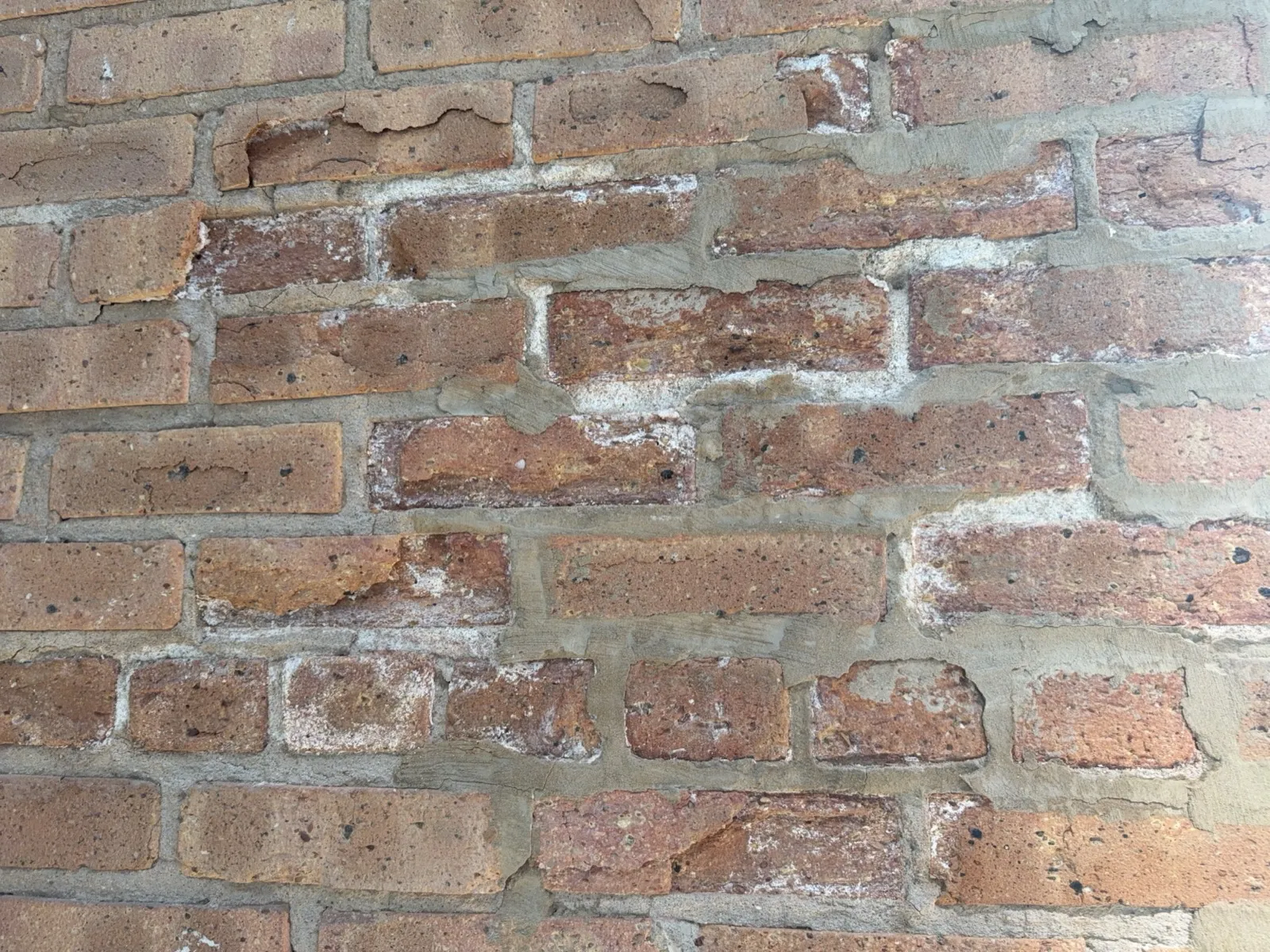
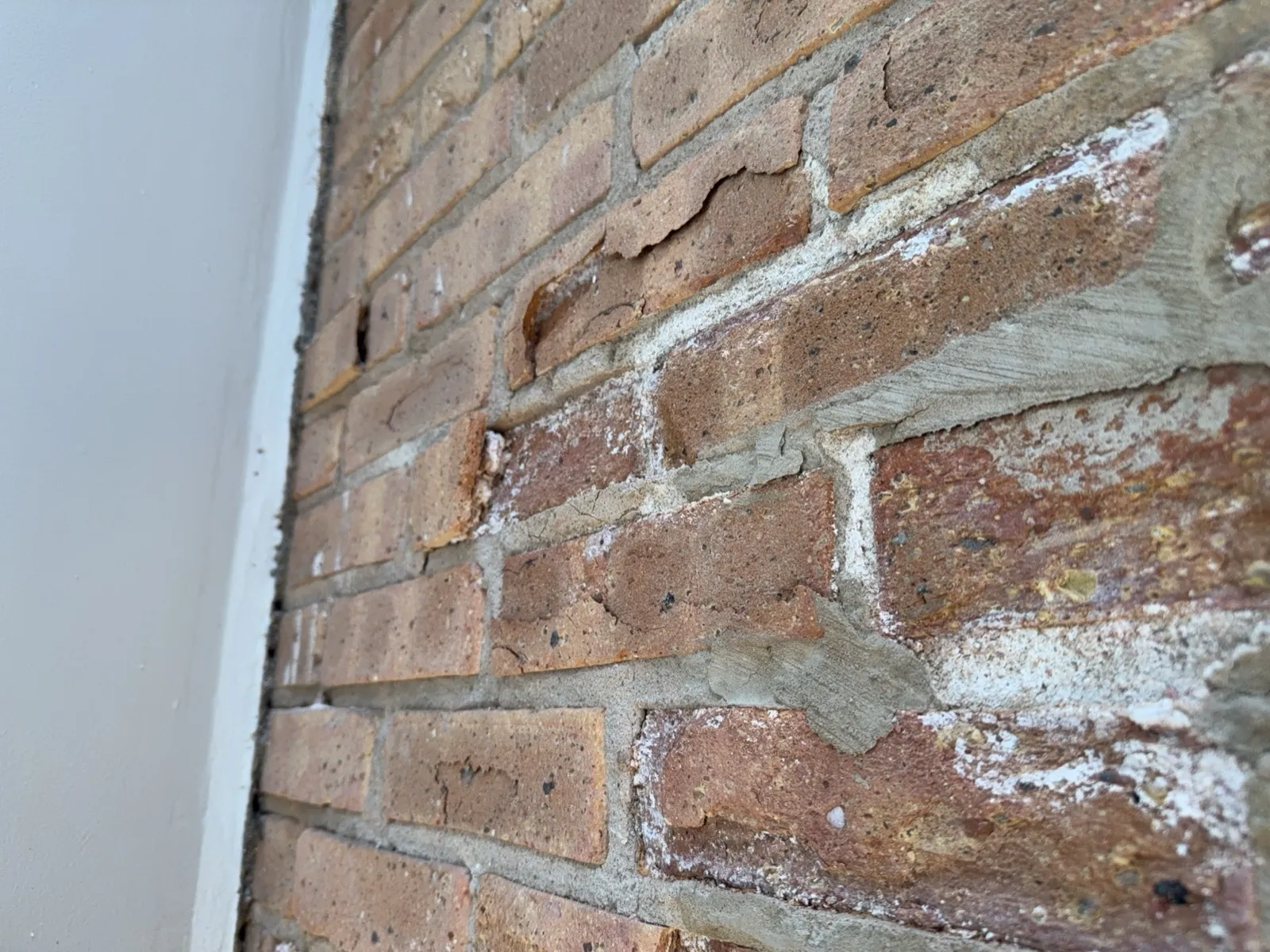
Moisture through an exposed brick wall. The report read: “Efflorescence and minor spalling were observed on the interior face of the exposed brick wall. These conditions indicate moisture migrating through the masonry.” The recommendation was a masonry contractor, “coordinating with building management as the exterior wall may be a common element.”
The same unit had dry water staining at the framing of its rooftop deck access. That is two building-side items in one unit, and exactly what item (3) of the 22.1 packet should address. More masonry conditions are in our exterior inspection photo gallery.
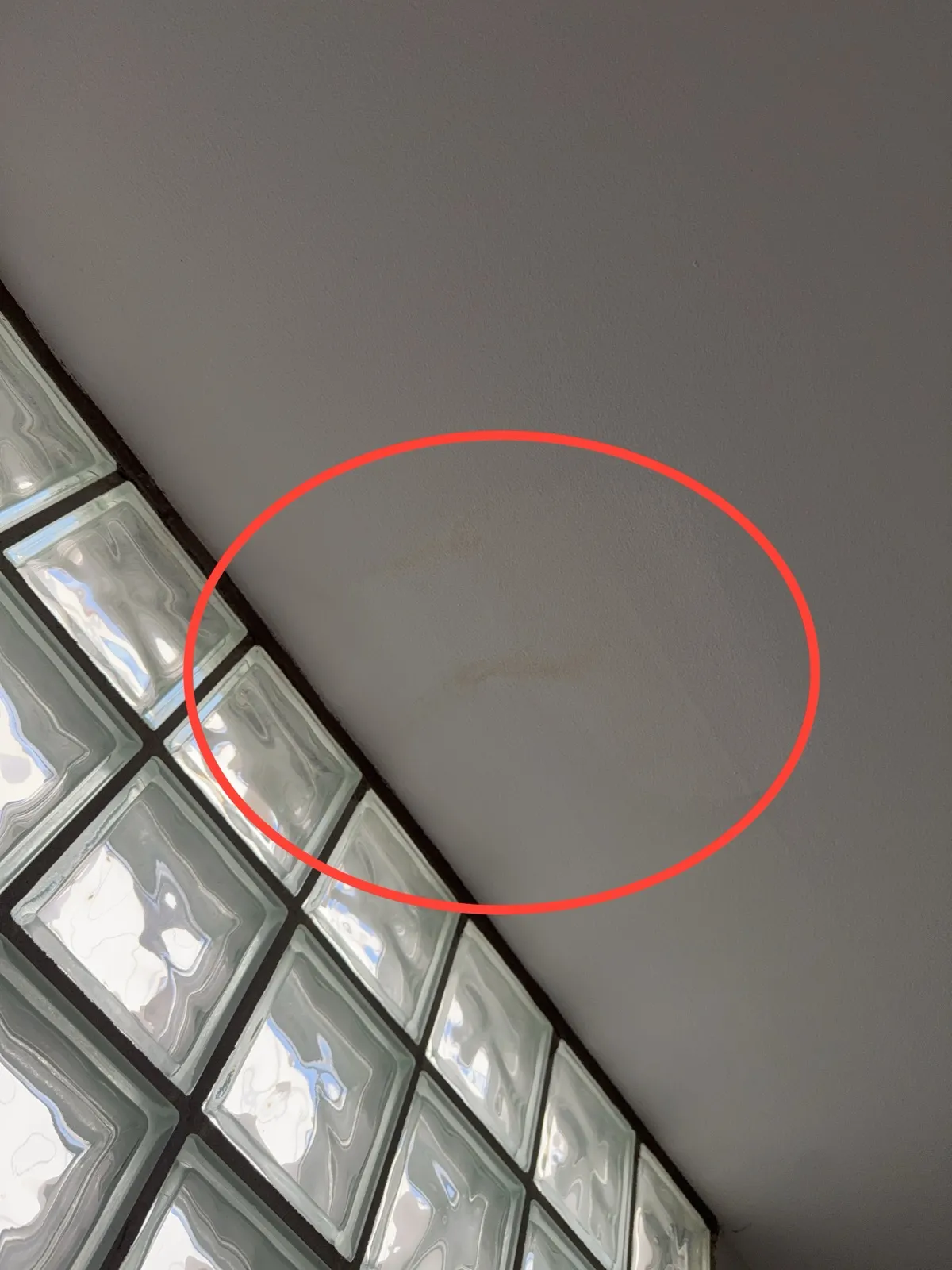
Water entry at a glass block window. Light staining beside the window read higher on the moisture meter than the surrounding wall, which “may indicate water entry at the surrounding wall assembly.” The repair needs the association wherever exterior wall components are involved, so the question for the buyer is whether the board knows about it.
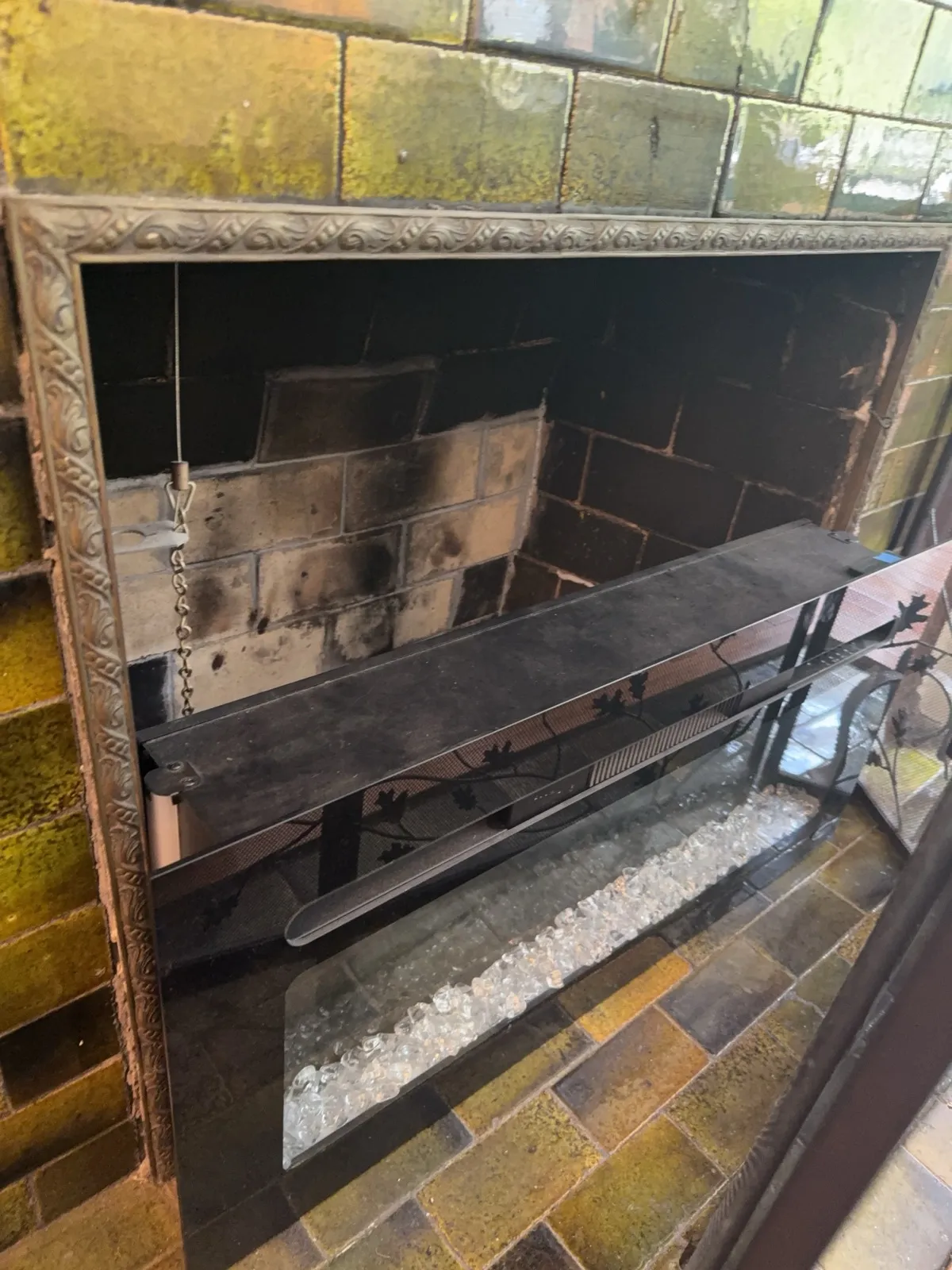
A flue repair pending through the HOA. In another unit, an electric insert sat in what had been a wood-burning fireplace. The occupant told us the flue had been professionally found unsafe, “with repairs pending through the HOA.” We recommended getting that prior evaluation in writing. A pending repair like this is something to look for in the capital expenditures statement and the reserves.
The other referrals were less visible. Elevated moisture in two bathroom ceilings pointed to possible leaks from the units above, which need the association’s help to reach. In two units the building-integrated kitchen and bath exhaust drew only weakly, and its maintenance sits with the building. One unit’s electrical panel needed replacement, and the report noted that coordination with the association may be required because service equipment is often a common element.
Other notes are about access and location rather than condition. In one unit the heating and cooling came from central equipment “owned and maintained by the HOA”, so its age and condition could not be evaluated. And in 20 of the 31 units, the main water shutoff was not found inside the unit, so reaching it in an emergency goes through the HOA or building management.
| What the inspection found | What to check in the documents |
|---|---|
| Moisture or damage at an exterior wall, window surround or roof deck | Item (3) capital expenditures, the latest exterior wall report for a high-rise, and who maintains it under the declaration |
| A repair the occupant says is “pending through the HOA” | Item (3) and item (4), and written documentation of the evaluation |
| Central heating or cooling owned by the association | Item (3) for planned replacement, and the declaration for what the unit owner maintains |
| A leak that appears to come from another unit | The declaration and rules on access and responsibility, and item (7) insurance |
| Alterations by the seller, such as a converted fireplace | Item (8), the seller’s compliance statement |
What should you do if you are buying a condo?
Run the inspection and the document review on two tracks, and do not let the second one lapse.
- At acceptance, ask your attorney to confirm the seller has requested the 22.1 packet. Paragraph 17 d) gives the seller ten business days to apply.
- Book the inspection right away. Repair requests for major components of the unit are due within five business days of acceptance under Paragraph 15 b).
- Send the building-side items from the inspection report to your attorney, not just the repair list. They are questions for the 22.1 review, not repairs the seller can make.
- Ask the seller, in writing, for the documents 22.1 does not cover: recent board minutes, any reserve study, and for a high-rise the latest exterior wall report.
- When the packet arrives, note the date and read items (3), (4) and (5) together. The five-business-day clock in Paragraph 17 e) has started.
- If a special assessment is proposed before closing, the seller must tell you, and you have three business days to agree on payment under Paragraph 17 c).
The 22.1 packet is separate from the seller’s own disclosure about the unit; our post on what to look for in Chicago seller disclosures covers that one. For the repair side, see what to do when the inspection finds problems.
How we help
Our condo inspection covers the unit and the components directly related to it, including the electrical subpanel, plumbing fixtures, appliances, heating and cooling equipment inside the unit, and the interior finishes. Where a finding traces back to a common element, the report says so and tells you who to ask, which gives you specific questions for the 22.1 review. Reports go out the next business day, so the findings are in hand inside your five-day windows, and weekend appointments are available. See our condo inspection service for what is included.
Sources
- Illinois Condominium Property Act, 765 ILCS 605/22.1 (resale disclosures)
- 765 ILCS 605/9 (budget and reserves)
- 765 ILCS 605/18 (bylaws, including separate assessments)
- 765 ILCS 605/18.4 (board duties for the common elements)
- 765 ILCS 605/2 (definitions, including limited common elements)
- Multi-Board Residential Real Estate Contract 8.0, Paragraphs 13, 15, 17 and 24
- City of Chicago, Required Reporting for Exterior Walls of High Rise Buildings
FAQ
Can I see the 22.1 documents before I make an offer?
Sometimes. Section 22.1 makes the documents available to a “prospective purchaser, upon demand” and does not tie that to a signed contract. But on the Multi-Board 8.0 the seller does not have to apply for them until ten business days after acceptance, so before an offer you depend on what the seller already has. Ask the listing agent whether a recent packet exists.
What if the association misses the 10-business-day deadline?
Section 22.1 sets the deadline but does not state a penalty for missing it. On the Multi-Board 8.0, the seller must still provide the documents no later than the period the law allows, and your five-business-day review window under Paragraph 17 e) does not start until you receive them. Your attorney decides how to press a late association.
Does Paragraph 17 apply to townhouses with an HOA?
Yes, if the property is subject to an association statute. Paragraph 17 of the Multi-Board 8.0 applies to property governed by the Condominium Property Act, the Common Interest Community Association Act, or other applicable state association law. The 22.1 list in this post is the condominium version; ask your attorney which disclosures apply to a townhouse association.