
TL;DR:
- Checking a home’s permit history involves reviewing official government records to verify approved construction and renovations. It helps buyers identify unpermitted work, open permits, or illegal additions that could cause legal or financial issues. Accurate permit research, combined with physical inspections, provides a complete understanding of a home’s condition and history.
Checking a home’s permit history is the process of accessing official government records to verify all approved construction and renovation work tied to a property. In Chicago, this means pulling data from the City of Chicago’s Inspection, Permitting & Licensing (IPI) portal and the Chicago Data Portal before you close. Knowing how to check a home’s permit history before you buy protects you from inheriting unpermitted electrical work, illegal additions, or open permits that become your legal and financial problem the moment you sign. Common permit categories tracked in Chicago include electrical, plumbing, roofing, and structural renovations. This guide walks you through every step, from finding the records to using them at the negotiating table.
How to check a home’s permit history in Chicago
The City of Chicago makes permit records publicly available through two free online tools: the IPI portal and the Chicago Data Portal. No registration is required, and the dataset is refreshed daily. That means you can run a full home permit history search on any address in the city before you ever schedule a showing.

The IPI portal lets you search by street address or permit number. Results include the project description, permit valuation, contractor name, and current permit status. The Chicago Data Portal covers a broader dataset and is useful for cross-referencing older records or pulling bulk data on a specific address over time.
For suburban buyers in Lake, McHenry, DuPage, or northern Cook County, the process differs by municipality. Each suburb maintains its own building department records. Most offer online searches, but some require a phone call or an in-person visit to the building department.
Pro Tip: If online records appear incomplete for an older Chicago bungalow or two-flat, file a Freedom of Information Act (FOIA) request with the Chicago Department of Buildings. Public records laws allow free or low-cost document requests, and a formal FOIA creates a paper trail that can support negotiations.
Here is what you need before starting a search:
- The full property address, including unit number for multi-unit buildings
- The approximate year of any visible renovations (helps narrow results)
- The permit number, if the seller has disclosed it
- A copy of the listing photos to cross-reference against permit records
What to look for in a property’s permit records
Permit status is the most critical field in any record. A “finaled” or “closed” permit means the city inspected the work and approved it. An open or expired permit means work started but was never officially closed. That distinction matters because an open permit can become the buyer’s obligation to complete or upgrade to current codes after closing.
The table below summarizes the four permit statuses you will encounter and what each means for a buyer:
| Permit status | What it means | Buyer risk level |
|---|---|---|
| Finaled / Closed | City inspected and approved the work | Low |
| Open / Active | Work started, inspection not yet passed | Medium to high |
| Expired | Permit issued but work never completed or inspected | High |
| No permit found | Work may have been done without city approval | High |
Beyond status, review the inspection history notes. These notes record what inspectors observed during site visits, including failed inspections and required corrections. A permit that passed on the third attempt after two failed electrical inspections tells a different story than one that closed on the first visit.
Pro Tip: Compare the permit record’s project description against the listing photos. A finished basement shown in listing photos with no corresponding permit is a red flag for unpermitted work. The same applies to added bathrooms, converted garages, and rear additions common in Chicago bungalows.
A clean permit history does not guarantee the home is code-compliant today. Permit records show the home’s maintenance story, but they do not reflect current physical condition. That is exactly why permit research and a professional home inspection must work together, not replace each other.
Step-by-step process to verify a property’s permits
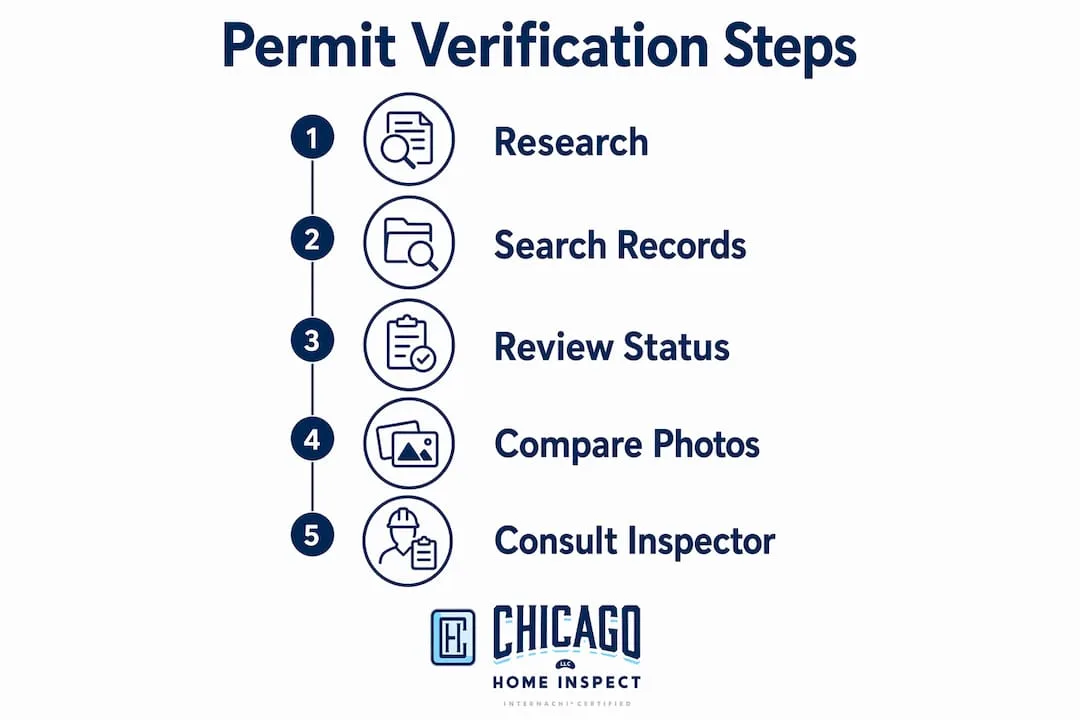
Follow these steps to conduct a thorough permit search on any Chicago property:
- Gather your information. Collect the full address, the listing photos, and any seller disclosures mentioning renovations.
- Search the IPI portal. Go to ipi.cityofchicago.org, enter the address, and review all permits listed. Note the status, date issued, and project description for each one.
- Cross-check on the Chicago Data Portal. Run the same address search to catch any records the IPI portal may not surface, particularly older permits from the 1990s and early 2000s.
- Document your findings. Screenshot or export each permit record. Note any open, expired, or missing permits relative to visible renovations.
- Compare records to listing photos. Flag any finished space, added room, or upgraded system that lacks a corresponding closed permit.
- Share findings with your inspector. Sharing permit records with inspectors helps them correlate documentation with physical condition and identify work that looks DIY or non-standard.
- Consult your real estate attorney. Open permits and unpermitted work are negotiable items. Your attorney can request that the seller close open permits or provide a price credit before closing.
If no permits appear for obvious renovations, do not assume the work is safe. Unpermitted structures sometimes require demolition or retroactive inspection at the buyer’s expense. That cost can run into thousands of dollars depending on the scope of the work.
For first-time buyers, our inspection tips for Chicago homes cover how to integrate permit research into your full due diligence process.
Lenders also scrutinize permit history. Unpermitted additions cannot factor into legal property value, which means your loan amount could be affected if the appraiser excludes unpermitted square footage.
Common mistakes when researching permit history
Most buyers make one of three errors when they research property permits: they search too late, they misread permit status, or they assume no record means no problem.
Avoid these specific mistakes:
- Searching after the inspection period ends. Permit research belongs in the first days of your due diligence period, not the last. Discoveries late in the process leave little time to negotiate or walk away cleanly.
- Confusing “no permit found” with “work is safe.” The absence of permit records does not prove work is legal or safe. It simply means the city has no record of approving it.
- Ignoring open permits. Buying a home with an open permit may obligate you to complete inspections or bring work up to current codes, often at considerable expense.
- Overlooking code changes over time. A permit finaled in 1988 approved work to 1988 code standards. Chicago has updated its building codes multiple times since then. Finaled does not mean currently compliant.
- Skipping the suburbs. Buyers purchasing in Waukegan, Crystal Lake, Wheaton, or other suburbs in our service area must check each municipality’s own building department. There is no single regional database.
Unpermitted work discovered during due diligence is a legitimate negotiating tool. Discovering unpermitted work often triggers price reductions or credits. Document everything and bring it to your agent and attorney before the inspection contingency deadline.
Exterior renovations carry their own risks. Understanding how exterior upgrades affect home value also means understanding that unpermitted exterior work can complicate both insurance and resale.
Our take on permit history and what it actually tells you
We have inspected thousands of homes across Chicago’s Northwest Side, Logan Square, Lincoln Park, and the collar counties. Permit history is one of the most underused tools buyers have, and most people look at it the wrong way.
The common assumption is that a long permit history means a well-maintained home. That is not always true. We have walked through graystones with extensive permit records where the physical condition told a completely different story. Permits confirm that someone filed paperwork and passed an inspection at a point in time. They do not tell you how the home has held up through 30 Chicago winters since then.
What permit records do exceptionally well is reveal what a seller is not disclosing. A finished basement with no permit, a third bathroom added without a plumbing permit, a rear addition with no structural permit. These are the findings that change the conversation. When we receive permit records before an inspection, we walk in knowing exactly where to look harder.
A clean permit history tells a partial story. Buyers who integrate permit findings with a thorough physical inspection get the full picture. Those who rely on one without the other are making a decision with incomplete information. Our pre-purchase inspections in Chicago are designed to work alongside your permit research, not instead of it.
The other thing buyers miss is timing. Permit research done on the day of the inspection is too late to be useful. Do it the day you go under contract. That gives you time to act on what you find.
— Chicago Home Inspect LLC
Chicago Home Inspect LLC can help you connect the dots
Permit records tell you what was approved. A professional inspection tells you what is actually there. Chicago Home Inspect LLC provides residential home inspection services across Lake, McHenry, DuPage, and northern Cook Counties, with weekends available to fit your due diligence timeline. We are InterNACHI Certified and BBB Accredited, and we know what unpermitted work looks like in Chicago’s bungalows, two-flats, and frame homes. Share your permit findings with us before the inspection and we will know exactly where to focus. Schedule your inspection before your contingency deadline so you have time to negotiate.
FAQ
What is a home permit history?
A home permit history is the official record of all building permits issued for a property, including the permit type, status, contractor, and inspection results. It documents every approved construction or renovation project tied to that address.
Where can Chicago buyers check property permits for free?
Chicago buyers can search permit records for free through the City of Chicago’s IPI portal and the Chicago Data Portal. Both tools are publicly accessible, require no registration, and are updated daily.
What does an open permit mean for a homebuyer?
An open permit means work was started but never inspected or officially closed by the city. Buying a home with an open permit may require the new owner to complete the inspection process or bring the work up to current building codes.
Can unpermitted work affect my mortgage or insurance?
Yes. Lenders may exclude unpermitted square footage from the appraised value, which can reduce your loan amount. Insurance companies often deny claims related to unpermitted areas, and unpermitted structures may require demolition or retroactive inspection.
How do I verify permits for a home in Chicago’s suburbs?
Each suburb in Lake, McHenry, DuPage, and Cook County maintains its own building department records. Contact the local building department directly or check the municipality’s website for an online permit search tool, as there is no single regional database covering all suburbs.