
TL;DR:
- A 20-minute pre-offer walk-through helps buyers identify major safety and high-cost issues to decide on full inspections or offers. Skilled inspectors focus on structural, roof, electrical, plumbing, and HVAC concerns, providing valuable insights for negotiation. However, visual checks can’t detect hidden problems like radon, mold, or sewer line issues, making full inspections essential for comprehensive assessment.
Twenty minutes sounds like nothing when you’re about to make a six-figure decision. But for a trained Chicago home inspector, it’s enough time to flag the issues that can cost you tens of thousands of dollars or derail the deal entirely. Pre-offer walk-throughs are not a replacement for a full home inspection, and that misconception trips up buyers across Wicker Park, Beverly, and Bridgeport every week. This guide breaks down exactly what a skilled inspector looks for in that window, and how you can use that knowledge to make smarter offers.
Table of Contents
- Pre-offer walk-throughs: what they actually are
- What a Chicago inspector prioritizes in 20 minutes
- How to make the most of a brief walk-through
- Pre-offer walk-through vs. full inspection: knowing the difference
- Blind spots every buyer should know about
- My take after years of Chicago inspections
- Work with inspectors who know Chicago’s housing stock
- FAQ
Pre-offer walk-throughs: what they actually are
Most buyers walk into a showing and look at countertops, ceiling height, and natural light. An inspector walks in and looks at the ceiling itself. That’s the fundamental difference between a buyer’s showing and a pre-offer walk-through with a professional.
A pre-offer walk-through is a condensed visual check performed before an offer is submitted. It is not a comprehensive home inspection. Full inspections take two to four hours, sometimes longer for larger or older properties. A 20-minute walk-through is focused entirely on visible, high-cost, and safety-related red flags that would affect whether you make an offer at all, and at what price.
In Chicago, this distinction matters more than in most markets. The city’s housing stock is old. Greystone two-flats from the 1920s, bungalows from the 1940s, and three-flats with decades of deferred maintenance are common across every neighborhood. The issues hiding inside those walls require a trained eye, not just a curious buyer.
Here’s what a pre-offer walk-through typically covers versus what it does not:
- Does cover: Visible foundation cracks, roof condition from grade or accessible attic, signs of water intrusion, electrical panel age and type, plumbing material identification, HVAC age and operation
- Does not cover: Radon levels, sewer line integrity, hidden mold behind walls, full electrical testing, detailed appliance checks
- Typical duration: 15 to 25 minutes on site
- Full inspection cost: set by square footage (see what we charge), with radon and sewer camera tests as paid add-ons
- Walk-through goal: Decide whether the property warrants a full inspection, a lower offer, or no offer at all
Pro Tip: Ask the inspector whether the pre-offer check will inform specific offer terms. A good inspector won’t just say “looks okay.” They’ll tell you which systems are approaching end of life and why that changes your negotiation position.
What a Chicago inspector prioritizes in 20 minutes
Experienced inspectors don’t walk through a home randomly. They follow a mental hierarchy based on what costs the most to fix and what puts people at risk. The “Big 6” focus areas are foundation, roof, electrical, plumbing and water intrusion, and HVAC. That list is your roadmap.
Foundation and structure
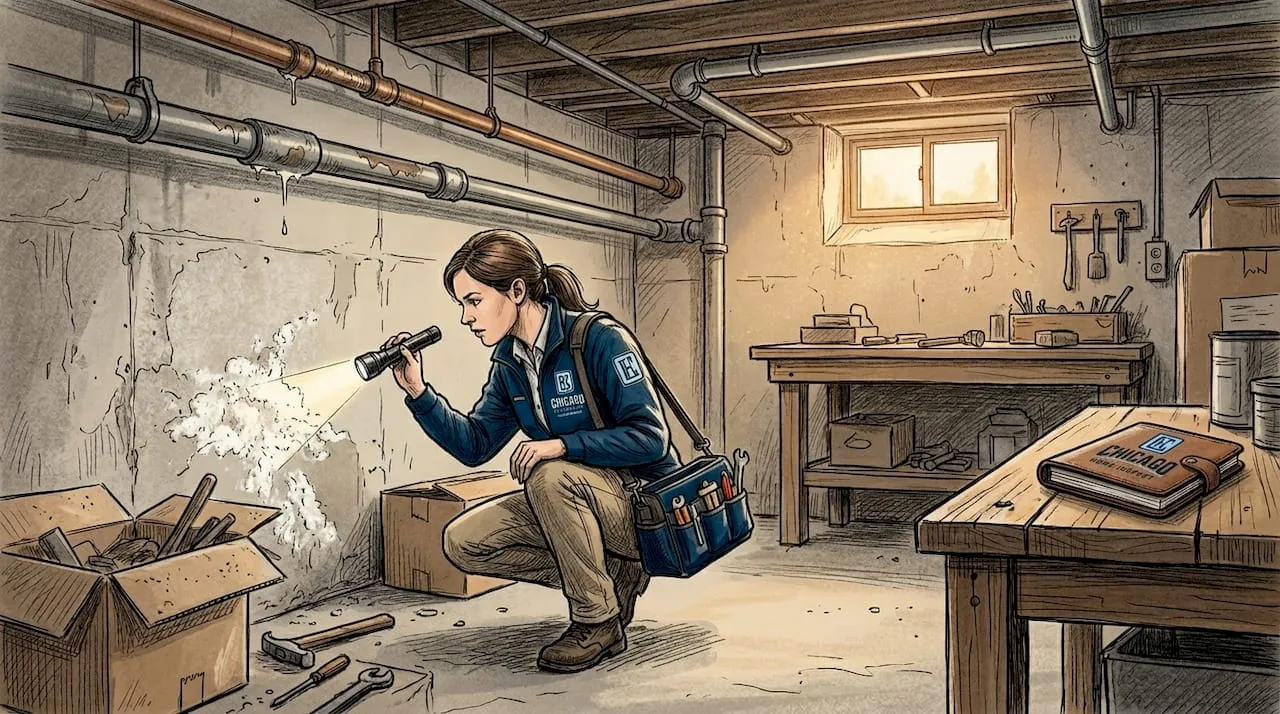
In Chicago, basement moisture is not a maybe. It’s a when. Inspectors look for efflorescence (white mineral deposits on concrete), horizontal cracks in block foundations, and bowed walls. A stair-step crack in brick mortar outside tells a story about settling. These are not cosmetic issues. A compromised foundation in a Logan Square greystones can run $15,000 to $40,000 to remediate.
Roof condition
Getting on the roof isn’t always possible in 20 minutes, but an inspector reads the ground-level story: missing or curling shingles, sagging fascia, granule loss on downspouts, and the age of visible vents and flashing. In older Chicago neighborhoods where flat roofs are common, ponding water and membrane bubbling are instant red flags.
Electrical systems
Federal Pacific and Zinsco electrical panels are known fire hazards and appear regularly in pre-1980s Chicago homes. An inspector checks panel type, looks for double-tapped breakers, and notes whether knob-and-tube wiring is still active. Any of these findings shifts the offer math significantly.
Plumbing and water intrusion
The inspector runs faucets, checks under sinks for staining or soft cabinet floors, and looks at the water heater’s age and condition. In older homes, galvanized steel pipes are a liability. Inspectors also check for signs of water damage on ceilings and around windows, which often indicates roof or flashing failures above.
HVAC systems
Testing basic operations like switching the furnace on and checking for airflow takes less than two minutes. But an inspector also reads the unit’s data plate for age and listens for irregular cycling or unusual sounds. A 25-year-old boiler in a two-flat isn’t grounds to walk away. It is grounds to factor $6,000 to $10,000 into your offer.
Pro Tip: Ask the inspector to estimate “time to failure” on any aging system they find. This single question turns a vague concern into a dollar figure you can negotiate with.
How to make the most of a brief walk-through
A pre-offer walk-through wastes everyone’s time if the buyer stays outside or stares at the kitchen tile while the inspector works. Your presence, attention, and questions directly affect what you walk away knowing.
- Show up and engage. Attending in person allows you to hear live explanations, ask follow-up questions, and see problems firsthand rather than reading about them in a report later.
- Ask for system demonstrations. Request that the inspector show you the main water shutoff, the electrical panel, and how to access the HVAC filter. Knowing where these are in an emergency is valuable beyond the transaction itself.
- Listen for severity language. Inspectors distinguish between safety-critical issues and maintenance items. When an inspector says “this needs immediate attention,” that’s different from “plan to replace this in five years.” Tune your ears to that distinction.
- Document everything visually. Take photos alongside the inspector’s notes. When you’re sitting at a table making an offer two days later, those images are far more useful than your memory of a dim basement.
- Separate cosmetic from structural. Peeling paint and dated fixtures are not negotiating chips. A cracked chimney crown or a failed sump pump is. Focus your concern on safety and wallet impacts, not aesthetics.
- Cross-reference with seller disclosures. Illinois requires sellers to disclose known material defects. Review what the seller has and has not disclosed, and use the walk-through findings to spot gaps in that disclosure.
Pro Tip: After the walk-through, ask the inspector one direct question: “If this were your money, what would you want to know before making an offer?” The answer is usually the most useful thing you’ll hear all day.
Pre-offer walk-through vs. full inspection: knowing the difference
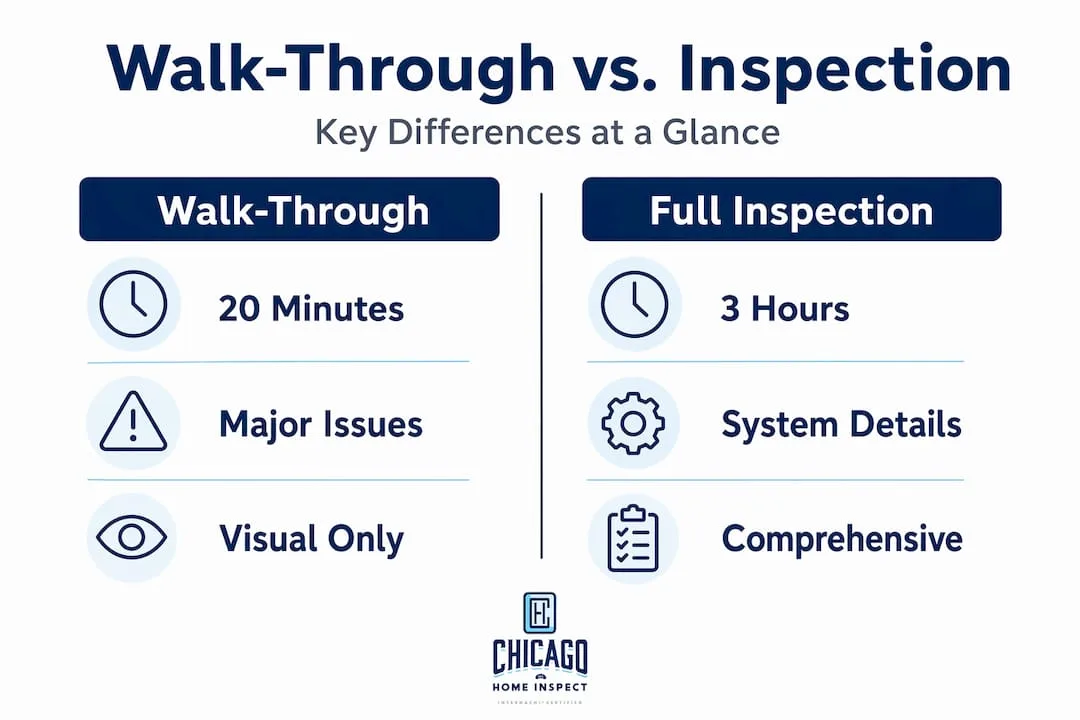
Understanding what these two evaluations can and cannot do is how buyers avoid costly assumptions. Here’s a direct comparison:
| Factor | Pre-offer walk-through | Full home inspection |
|---|---|---|
| Duration | 15 to 25 minutes | 2 to 4 hours or more |
| Scope | High-cost and safety red flags | All accessible systems and components |
| Written report | Usually not included | Detailed written report with photos |
| Radon testing | Not included | Add-on |
| Sewer camera | Not included | Add-on, quoted at booking |
| Mold testing | Not included | Add-on, lab fees vary |
| Best use | Decide whether to make an offer | Negotiate after offer is accepted |
| Cost | Often bundled or lower fee | Set by square footage |
Chicago’s older housing stock makes the case for full inspections stronger than in newer markets. A 1940s bungalow in Bridgeport or a Victorian in Hyde Park carries decades of layered repairs, additions, and deferred maintenance that a 20-minute check simply cannot uncover. The walk-through tells you whether to invest in a full inspection. The full inspection tells you whether to invest in the house.
Skilled realtors use the inspector’s assessment of safety-critical concerns and estimated system lifespans to shape initial offers and contingency language. That’s real leverage, built from a 20-minute conversation before a single dollar is committed.
Blind spots every buyer should know about
A pre-offer walk-through is a visual check. It cannot see through walls, below slabs, or inside drain lines. That limitation isn’t a failure of the inspector. It’s physics. But knowing what gets missed protects you from overconfidence.
- Radon: Chicago-area homes regularly test above the EPA action level of 4 pCi/L. You cannot detect radon visually. If you’re serious about a property, professional radon testing is a necessary follow-up, not optional.
- Mold behind finished walls: A musty smell in a basement is a signal. But finished drywall hides active mold growth completely. Mold testing requires sampling, not observation.
- Sewer line condition: Cast iron sewer lines in older Chicago homes deteriorate from the inside. A camera inspection is the only way to see root intrusion, bellied sections, or collapse. This add-on can save you from a $10,000 surprise.
- Foundation drainage systems: Interior drain tile systems are often buried and inaccessible. A visual inspection cannot confirm whether the system is functional or failed.
“As-is” sales in Illinois do not release sellers from disclosure obligations. Illinois law requires sellers to disclose known material defects even when the property is sold without repairs. If a disclosure form is thin on detail, that’s worth investigating, not ignoring.
For more on what consistently gets missed in quick visual checks, the inspection blind spots resource from Chicagohomeinspector is worth reading before your next showing.
My take after years of Chicago inspections
I’ve done pre-offer walk-throughs on properties from Evanston to Evergreen Park, in bungalows, greystones, coach houses, and new construction. And the single biggest mistake I see buyers make is treating a clean walk-through as a green light.
It isn’t. A clean 20-minute check means there are no obvious, immediate red flags that scream “walk away.” It does not mean there are no problems. It means the problems that exist aren’t visible from the surface in the time we had.
What I tell every buyer I work with: the walk-through is your filter, not your approval. Use it to decide whether to spend the time and money on a full inspection. Use the full inspection to decide whether to buy.
The negotiation value of this process is real. When I can tell a buyer “that furnace is 22 years old and needs replacement within two years,” they have a concrete number to put in an offer or an addendum. That’s not a guess. That’s an informed estimate from someone who reads data plates and listens to equipment every single day.
I also believe verifying inspector credentials matters more than most buyers realize. InterNACHI certification means the inspector is held to current standards and continuing education requirements. In a city with housing stock as variable as Chicago’s, that baseline matters.
Work with inspectors who know Chicago’s housing stock
If you’re buying in Chicago or the suburbs and want eyes on a property before you commit to an offer, Chicagohomeinspector offers pre-offer walk-throughs and full buyer inspections performed by InterNACHI-certified, BBB-accredited inspectors who work weekends. The team at Chicagohomeinspector is licensed, insured, and has spent years learning what Chicago homes hide. From the interior inspection details to radon and mold add-ons, every service is designed to protect your investment before you sign anything. Don’t walk into an offer without knowing what’s behind the walls.
FAQ
What does a pre-offer walk-through cover?
A pre-offer walk-through focuses on high-cost and safety-critical systems: foundation, roof, electrical, plumbing, and HVAC. It is a visual check only and does not include radon, mold, or sewer camera testing.
How is a walk-through different from a full home inspection?
A walk-through takes 15 to 25 minutes and identifies major red flags before an offer is made. A full home inspection takes two to four hours and produces a detailed written report covering all accessible systems.
Can a seller hide problems during a pre-offer walk-through?
Visual checks can miss concealed issues. However, Illinois seller disclosure law requires sellers to disclose known material defects even in as-is sales, so reviewing disclosures alongside inspection findings is critical.
Should I attend the pre-offer walk-through in person?
Yes. Being present lets you ask questions, see problems firsthand, and hear the inspector explain severity in real time. Buyers who attend in person consistently report better understanding of what they’re buying.
How much does a home inspection cost in Illinois?
Standard home inspection prices depend on size and property type; ours are in our home inspection price guide. Radon testing and sewer camera inspection are available as additional services. Pre-offer walk-throughs are often priced separately or bundled with a full inspection.