

TL;DR:
- Many Chicago homes suffer from seal failures and rotted sills that are often misdiagnosed or overlooked. Regular inspections, humidity control, and proper flashing installation can prevent costly damage and energy loss. Early detection and targeted repairs are crucial to maintaining window and door integrity in Chicago’s challenging climate.
If you’ve noticed foggy glass between your window panes or soft, crumbling wood around a door frame, you’re dealing with one of the most misdiagnosed problems in Chicago homes. Window and door inspection seal failures and rotted sills affect thousands of properties across neighborhoods like Lincoln Park, Wicker Park, and Bridgeport every year, often silently for months before homeowners catch on. The good news is that you don’t need to guess. With the right knowledge and a thorough inspection, you can tell the difference between a manageable fix and a repair that’s been waiting too long.
Table of Contents
- Window and door inspection: seal failures and what they really mean
- How to identify rotted window sills and door frame damage
- Preventing seal failures and sill rot in Chicago homes
- Repair and replacement options for Chicago homeowners
- What I’ve learned after years of Chicago window inspections
- Get a professional window and door inspection before it costs you more
- FAQ
Window and door inspection: seal failures and what they really mean
Most Chicago homeowners assume that any moisture on their windows means the window is failing. That’s not always the case. Condensation on interior glass typically signals a humidity problem inside your home, not a defective window. This is one of the most common and costly misinterpretations, because homeowners sometimes replace entire windows when better ventilation would have solved the problem for next to nothing.
A genuine window seal failure is something different. Your windows contain insulated glass units, or IGUs, which sandwich an insulating gas (usually argon or krypton) between two panes. That gas is held in by a seal. When that seal breaks down, the gas escapes and moisture intrudes. The result is permanent fogging between panes that you simply cannot wipe away. That foggy haze is your definitive indicator of failed window seals.
Here’s what makes Chicago homes especially vulnerable to seal failures:
- Temperature swings. Chicago endures some of the widest seasonal temperature ranges in the country. That thermal expansion and contraction puts constant stress on the seal material around your IGU.
- UV exposure. South and west-facing windows take the most sun damage, degrading the sealant material faster.
- Poor original installation. Windows that weren’t properly flashed or bedded during installation are prone to early failure, regardless of the brand.
- Age. Most IGU seals begin to degrade after 15 to 20 years, and many Chicago homes have windows pushing that range.
Beyond the foggy pane, failed window seals come with real consequences. That directly hits your heating bill in a Chicago winter. There’s also a moisture risk. Once water enters the frame cavity, you’re one season away from mold growth in the surrounding structure.
Pro Tip: Try the flashlight test before calling anyone. Shine a strong LED flashlight at a 45-degree angle along the glazing bead of your window sash. Early seal separation appears as a subtle reflective difference before any fogging becomes visible. It’s the simplest early warning tool you have.
How to identify rotted window sills and door frame damage
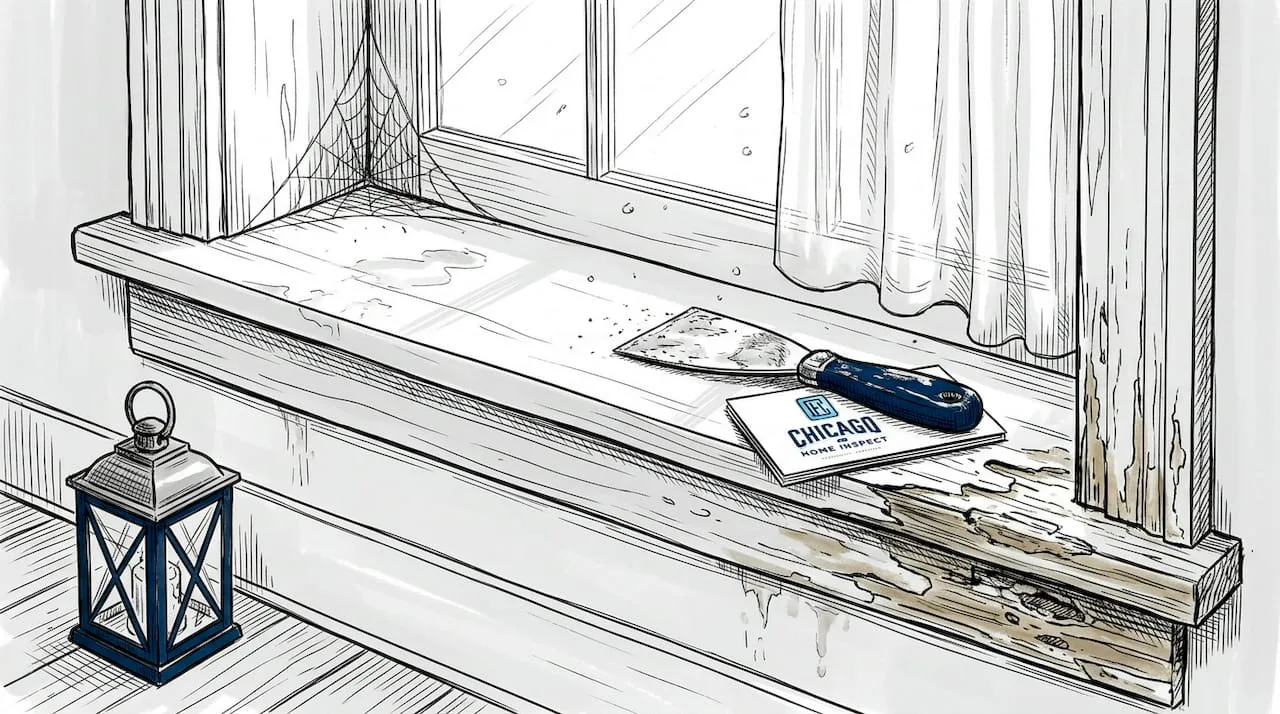
Rotted sills are a different problem from failed seals, but the two often appear together. Wood rot around windows and doors develops when moisture consistently contacts untreated or poorly maintained wood. In Chicago, this happens through failed caulking, cracked sill paint, inadequate flashing, and the freeze-thaw cycle that drives water into the smallest cracks.
Knowing the signs of rot in sills is straightforward once you know what to look for. Here’s how to run your own inspection:
- Look for discoloration. Dark brown or grayish staining along a window sill or door frame bottom is an early sign of moisture damage. Don’t confuse this with simple dirt.
- Check for soft or spongy texture. Press your finger firmly into the sill at several points. Sound wood is hard. Rotted wood compresses or crumbles under light pressure.
- Use a screwdriver probe test. Push the tip of a flathead screwdriver into the sill at a downward angle. Healthy wood resists penetration. If the screwdriver sinks in more than a quarter inch with minimal force, rot is present.
- Smell for mustiness. A musty or earthy odor near a window frame or threshold, especially after rain, is a reliable indicator of active fungal decay.
- Look up, not just at eye level. In Chicago’s brick bungalows and two-flats, failed shelf angle flashing above windows is a hidden moisture source. Rust staining or brick cracking above a window often means water is already migrating down toward the sill.
One thing homeowners frequently miss is the spread pattern of rot. Wood rot doesn’t stay contained. Once fungal decay takes hold in a sill, it moves laterally into the surrounding framing, the sub-sill, and eventually the wall structure. Neglecting sill rot turns what could be a $300 epoxy repair into a $2,000 framing replacement.
Pro Tip: Inspect your sills twice a year: once in early spring after the freeze-thaw season and once in late fall before temperatures drop. Catching rot while it’s still surface-level is the difference between an afternoon project and a contractor job.
Preventing seal failures and sill rot in Chicago homes
Prevention is where most homeowners leave money on the table. The strategies below are specific to Chicago’s climate and building types.
Control indoor humidity year-round. Indoor humidity between 30% and 50% prevents the conditions that drive both interior condensation and the moisture infiltration that rots sills. During Chicago winters, keep humidity below 40% to prevent condensation from forming on your cold glass and dripping down into the sill. A simple digital hygrometer costs under $20 and tells you exactly where you stand.
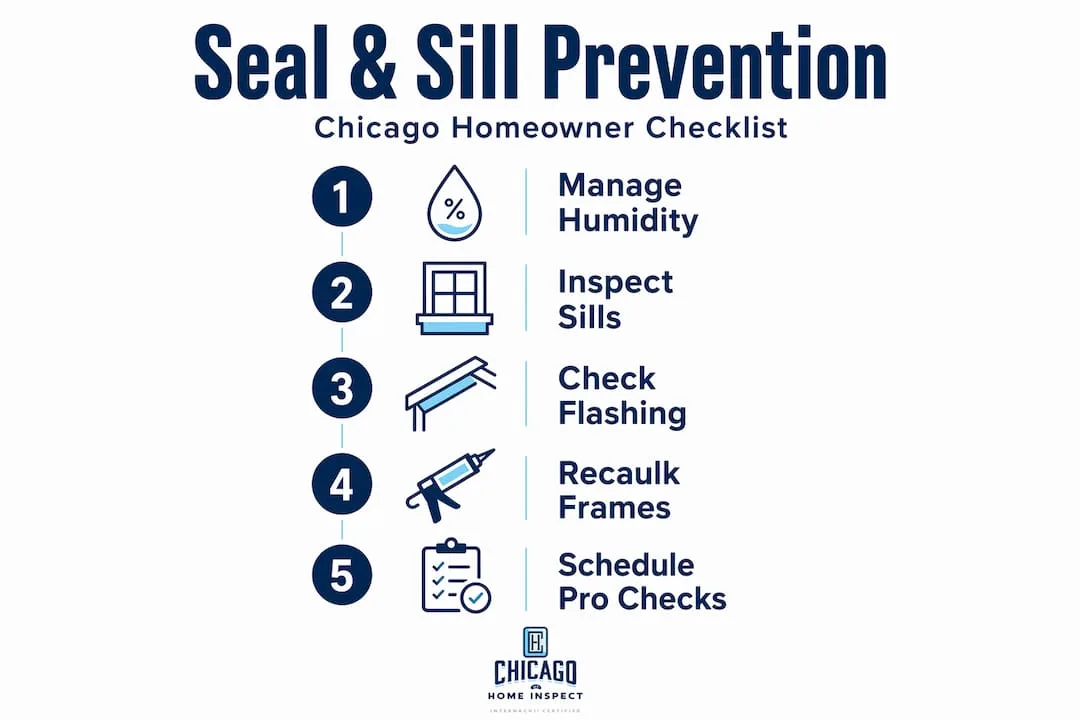
Get flashing done right. This is where improper installation quietly destroys Chicago homes. A shingle-lapped water management system including sill pans with upturned legs and flashing tape directs water outward rather than trapping it behind siding. If your windows were installed without proper sill pans and flashing tape, every rainstorm is pushing water toward your framing.
Here’s a quick comparison that clarifies when prevention strategies are enough versus when professional attention is needed:
| Situation | DIY Prevention Sufficient | Professional Inspection Needed |
|---|---|---|
| Light interior condensation on glass | Yes, humidity control helps | Not immediately |
| Fogging between panes | No | Yes, seal failure confirmed |
| Surface paint cracking on sill | Yes, recaulk and repaint | Monitor for soft wood |
| Soft or spongy sill wood | No | Yes, assess rot depth |
| Rust staining above window in brick | No | Yes, flashing issue likely |
| Musty odor near frame | No | Yes, possible mold risk |
Other prevention habits worth building into your annual home maintenance routine include recaulking windows and door frames every three to five years, keeping gutters clear so water doesn’t overflow onto frames, and making sure exterior grading slopes away from your foundation and exterior walls.
Repair and replacement options for Chicago homeowners
When prevention didn’t happen and you’re already dealing with damage, here’s how to think through your options.
- Epoxy consolidant repair for minor rot. Two-part epoxy consolidants chemically bond to wood fibers and restore structural integrity when decay covers less than 10% of the sill area. This is a legitimate fix when done correctly. Standard wood putty is not. Putty doesn’t bond to compromised wood and will fail within a season or two.
- Full sill replacement. When the screwdriver test reveals rot deeper than an inch, or when damage has spread to adjacent framing, the sill needs to come out entirely. New sills should be primed on all six sides before installation to prevent the same problem from repeating.
- IGU replacement vs. full window replacement. If your window frame is structurally sound and properly installed, replacing just the insulated glass unit is a reasonable, cost-effective option. If the frame itself is damaged, warped, or improperly flashed, full window replacement makes more sense.
- Defogging services. You may see ads for window defogging. This process drills small holes and attempts to clean the interior of the panes. It’s a temporary cosmetic fix. It does not restore the insulating gas or the seal, so your energy performance stays degraded.
Here’s a general cost reference for Chicago-area repairs in 2026:
| Repair Type | Estimated Cost Range | Notes |
|---|---|---|
| Epoxy sill repair | $150 to $400 per sill | DIY-viable with proper materials |
| Full sill replacement | $500 to $1,500 per window | Depends on material and labor |
| IGU-only replacement | $200 to $600 per unit | Saves frame when structurally sound |
| Full window replacement | $600 to $2,500 per window | Includes labor and flashing |
| Defogging service | $75 to $150 per window | Cosmetic only, not a real repair |
Timing matters in Chicago. Scheduling repairs in late summer or early fall gives sealants and epoxy time to cure before freezing temperatures arrive. Repairs done hastily before a Chicago winter often fail by spring.
What I’ve learned after years of Chicago window inspections
I’ve walked through hundreds of Chicago homes, from brick two-flats in Pilsen to frame houses in Norwood Park, and the pattern is almost always the same. Homeowners either ignored a problem that seemed minor or overcorrected and replaced windows when a targeted repair would have worked.
The thing I find most often overlooked is the moisture path, not the visible damage itself. People focus on the foggy pane or the soft spot on the sill, but those are symptoms. The real question is where the water is getting in. Inspecting the flashing, the caulking, the gutters, and the interior humidity all at once gives you the full picture. Fixing the sill without fixing the source means you’ll be repairing the same sill again in three years.
I’ve also seen homeowners spend significant money on mold testing when the better investment is fixing the moisture source. Once you control the water, you control the mold risk. Testing tells you what’s there but doesn’t tell you how to stop it from coming back.
My honest advice: don’t wait for the obvious signs. Schedule a professional window and door inspection before the damage announces itself. The cost of catching a failed seal or surface rot early is a fraction of what framing repair or full window replacement runs in this city.
Get a professional window and door inspection before it costs you more
If anything in this article sounds familiar, the smartest next step is a thorough professional inspection. Chicagohomeinspector is InterNACHI Certified, BBB Accredited, and available on weekends to work around your schedule. Our inspections cover windows, doors, exterior wood elements, flashing conditions, and moisture-related damage in detail. You can browse our exterior inspection photo gallery and interior inspection photos to see exactly how we document these issues. If moisture has already entered your framing or walls, we also offer professional mold testing services to identify what’s growing where your eyes can’t reach. Chicago’s climate doesn’t wait, and neither should your inspection.
FAQ
What is the most obvious sign of a window seal failure?
Condensation or fogging trapped between the two panes of glass that cannot be wiped away is the definitive sign of a failed IGU seal. This indicates the insulating gas has escaped and moisture has entered the unit.
How do I check door seals for failure?
Run your hand along the door frame edges on a cold or windy day to feel for drafts, and inspect the weatherstripping for gaps, tears, or compression failure. A flashlight held on one side of a closed door while you look from the other side in a darkened room will reveal daylight gaps instantly.
Can rotted window sills spread to other parts of my home?
Yes. Wood rot spreads through adjacent framing if the moisture source continues and the rot goes untreated. Catching it while it’s limited to the surface sill prevents much more extensive structural repairs.
Is defogging a real fix for failed window seals?
No. Defogging is a cosmetic service that clears the visible haze but does not restore the insulating gas layer or the broken seal. Your window will continue to underperform on energy efficiency even after defogging.
How often should Chicago homeowners inspect their windows and doors?
Inspecting twice a year, once in early spring and once in late fall, catches damage at its earliest stage. Chicago’s freeze-thaw cycles and humid summers create ongoing stress on seals, caulking, and wood sills throughout the year.