

TL;DR:
- Concrete settlement cracks that reach 1/4 inch become trip hazards immediately and require correction at 1/2 inch or more. In Chicago, clay soils and freeze-thaw cycles make repairs more complex, emphasizing thorough assessment and proper drainage. Repair options include grinding, polyurethane foam injection, and crack sealing, but addressing soil support and water flow is essential for lasting results.
Concrete settlement cracks that create vertical displacement are defined as trip hazards the moment they reach 1/4 inch, and they require corrective action at 1/2 inch or more per 2026 industry standards. In Chicago, the driveway and concrete settlement cracks trip hazard fix challenge is more demanding than in most regions because our clay soils shrink in dry summers and swell in wet springs, steadily pushing slabs out of alignment. Freeze-thaw cycles compound the damage every winter, widening cracks and lifting edges that were flush just months earlier. At Chicago Home Inspect LLC, we see these conditions regularly across Lake, McHenry, DuPage, and northern Cook Counties, and we know that the right repair starts with an honest assessment of what is actually happening beneath the slab.
How to assess driveway and concrete cracks for trip hazards
Accurate assessment determines whether you need a $50 tube of crack filler or a $1,500 polyurethane lift. Start by walking the full length of your driveway and looking for any slab edge that sits higher or lower than its neighbor. Run your foot across each joint. If you feel a bump, measure it.
Measuring displacement and crack width
Use a tape measure or a straightedge to check vertical offset at each joint. A gap of 1/4 inch is a potential trip hazard that warrants monitoring. At 1/2 inch, repair is no longer optional. Crack width matters too. Hairline cracks under 1/8 inch are typically cosmetic. Cracks wider than 1/4 inch signal structural movement.
Static vs. active cracks
Static cracks do not move seasonally and are cosmetic. Active cracks widen and narrow with temperature and moisture changes. Active cracks need flexible sealants and a drainage assessment, not just filler. Applying rigid patching compound to an active crack guarantees failure within one season.
Homeowners often apply the same fix to every crack they see. Recognizing the difference between static and active cracks is the single most important step in choosing a repair that actually holds.
Pro Tip: Photograph your cracks in march and again in august. If the width changes noticeably between photos, you have an active crack that needs a flexible repair approach.
The tools you need for a thorough assessment are simple: a tape measure, a flashlight, a screwdriver to probe for soft or hollow spots beneath slab edges, and a garden hose to test drainage direction. Soft spots under a slab edge confirm a soil void, which means the slab has lost support and will continue to settle without intervention.
- Check every slab joint for vertical offset
- Probe edges with a screwdriver to detect voids
- Measure crack widths at their widest point
- Note which direction water flows after rain
- Look for spalling, scaling, or surface deterioration alongside cracks
Chicago’s clay soil means conditions can shift dramatically between a dry july and a wet october. An assessment done in one season may look different three months later, so plan to re-check before committing to a repair method.
What repair methods fix concrete trip hazards?
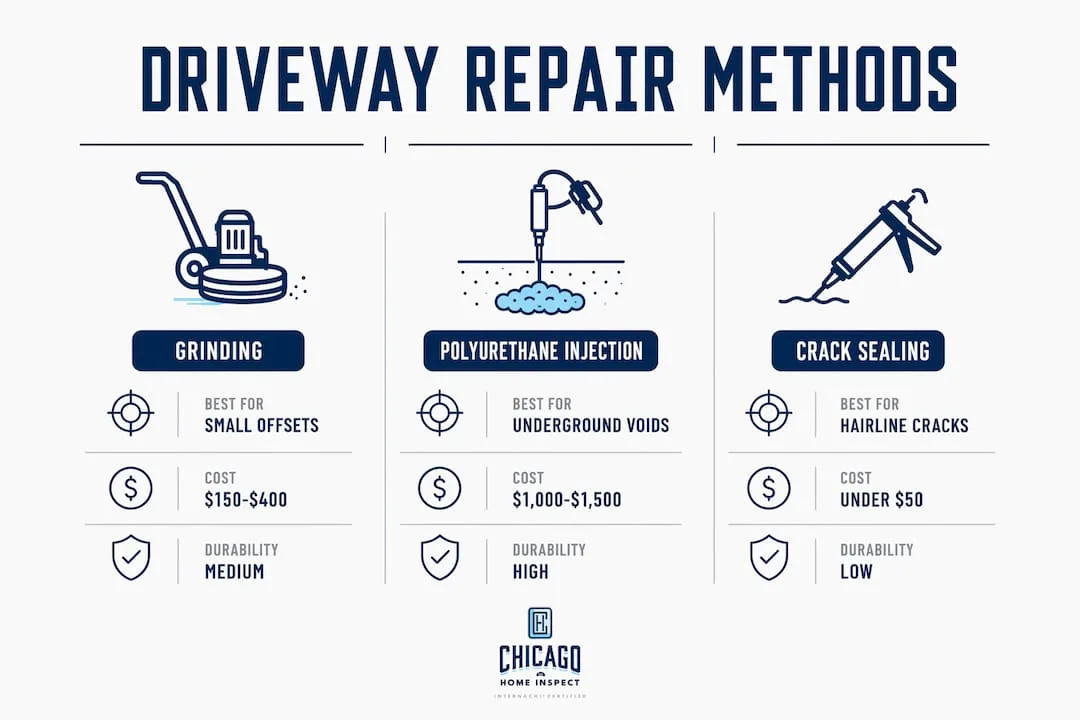
Three methods cover the vast majority of driveway trip hazard situations: grinding, polyurethane foam injection, and crack sealing. Each suits a different severity level and soil condition.
1. Grinding
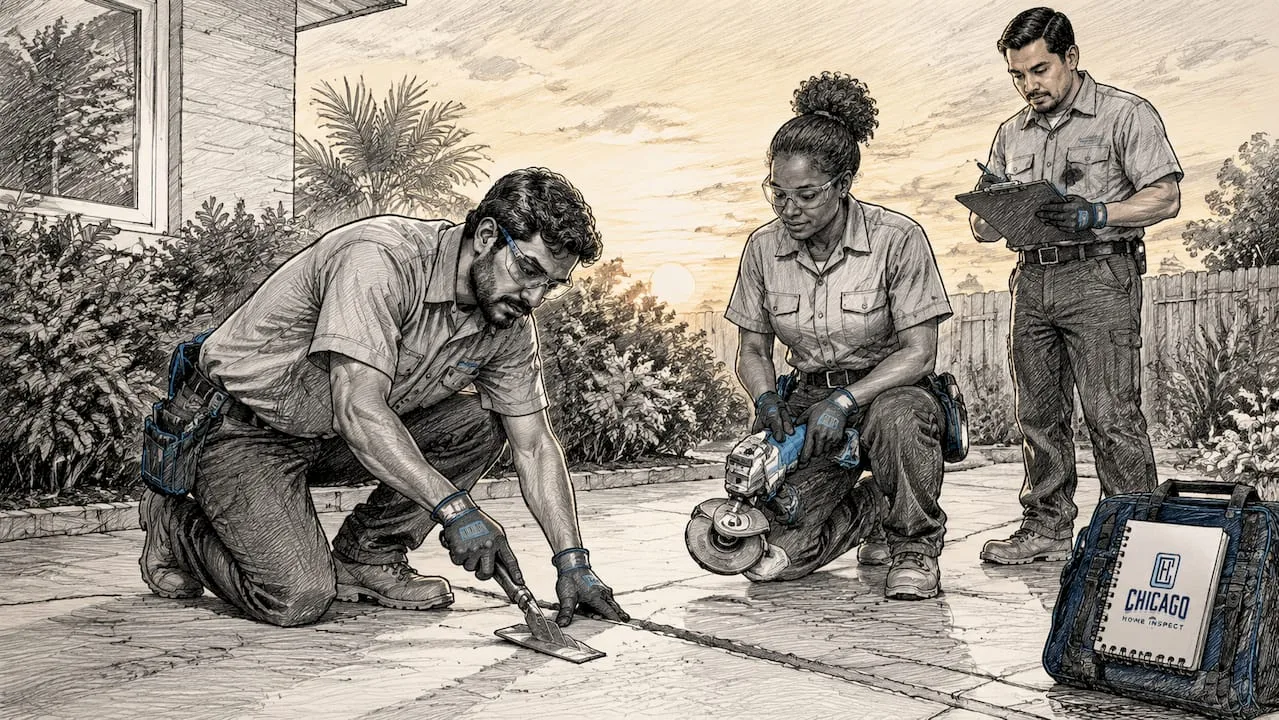
Grinding removes the raised edge of a settled slab by cutting it down flush with the adjacent surface. The process takes 15–30 minutes per lip and is cost-effective for minor vertical shifts. A concrete grinder or angle grinder with a diamond cup wheel handles most residential jobs.
Grinding works best when the offset is 1/2 inch or less and the slab is otherwise stable. The critical trade-off is that grinding removes the protective cream layer of the concrete surface, exposing the aggregate underneath. That exposed aggregate is more vulnerable to freeze-thaw damage, which matters a great deal in Chicago’s Climate Zone 5 winters. Grinding fixes the hazard immediately but may shorten the slab’s remaining life if left unsealed.
2. Polyurethane foam injection (polyjacking)
Polyjacking fills the void beneath a settled slab by injecting expanding polyurethane foam through small drilled holes. The foam expands, fills the cavity, and lifts the slab back toward its original position. Polyurethane injection costs $500–$1,500 per slab in the Chicago area, which is significantly less than full replacement.
Polyurethane is preferred over the older mudjacking method because it is lightweight, cures fast, and puts less stress on weak soils. Mudjacking slurry is heavy and can accelerate settlement in already compromised clay. Polyjacking allows same-day use of the driveway after the foam cures, typically within 15 minutes.
3. Crack sealing
Crack sealing addresses the crack itself rather than the displacement. For hairline cracks, DIY crack fillers cost under $200 and work well when applied to clean, dry surfaces. For active cracks, use a polyurethane or epoxy-based flexible sealant rather than rigid cement-based filler. Rigid fillers crack again within one freeze-thaw cycle.
Pro Tip: Clean the crack with a wire brush and compressed air before applying any sealant. Dirt and debris prevent bonding, and a failed bond means the filler pops out before winter ends.
| Method | Best for | Approximate cost | Durability | Chicago suitability |
|---|---|---|---|---|
| Grinding | Offsets up to 1/2 inch | Low | Moderate | Good for stable slabs |
| Polyjacking | Sunken slabs with voids | $500–$1,500 per slab | High | Excellent for clay soil |
| Crack sealing | Hairline to 1/4 inch cracks | Under $200 DIY | Moderate to high | Good with flexible sealant |
| Full replacement | Widespread damage | Highest | Highest | Best when 30–40% is damaged |
Avoid using basic hydraulic cement or sand-mix concrete as a crack filler on an active crack. These materials bond poorly to existing concrete and have no flexibility. They fail fast and leave the crack in worse shape for the next repair attempt.
What causes concrete settlement in Chicago driveways?
The main causes of concrete settlement in Illinois are poor soil compaction, water intrusion from downspouts, and clay soil shrink-swell cycles. Understanding these causes is what separates a repair that lasts from one that fails in two seasons.
Chicago’s clay soil has a “ratcheting effect.” It shrinks during dry periods, creating gaps beneath the slab. When rain or snowmelt arrives, the soil swells, but not always back to its original position. Over multiple cycles, the slab loses support incrementally and settles further each year. No surface repair addresses this without also managing the water that drives the cycle.
Preventing settlement through proper drainage costs less than repeated repairs and prolongs driveway life significantly. Downspout extensions that divert water 5–10 feet away from the foundation prevent the soil erosion that undermines concrete slabs from below.
Effective prevention requires attention to several factors:
- Extend downspouts at least 5–10 feet away from the driveway and foundation
- Regrade soil along driveway edges so water flows away from the slab
- Seal expansion joints annually to prevent water infiltration
- Avoid planting trees with aggressive root systems near the driveway
- Check that neighboring landscaping does not direct runoff toward your concrete
Grading and drainage problems are among the most common issues found during Chicago inspections. A driveway that drains poorly will settle repeatedly regardless of how many times you lift or patch it. Addressing grading and drainage issues before or alongside any repair is the only way to break the cycle.
Proper soil compaction during original installation also matters. Many older driveways in Chicago suburbs were poured over inadequately compacted fill. When that fill compresses over decades, the slab above has nowhere to go but down. If your driveway is more than 20 years old and has never had drainage improvements, the soil beneath it has almost certainly shifted.
Exterior home improvement projects like extending downspouts and regrading are low-cost steps that protect your concrete investment for years.
When should you replace rather than repair a driveway?
Repair makes sense when damage is localized. Replacement becomes the better investment when the damage is widespread. Full replacement is advisable when 30–40% or more of the driveway shows wide cracks, spalling, or settlement, or when multiple previous repairs have failed.
Signs that point toward replacement
- More than one-third of slabs have settled or show structural cracking
- Spalling affects large surface areas, not just isolated spots
- The driveway has been patched or lifted more than twice in ten years
- Water consistently pools on the surface after rain
- The original pour is more than 30 years old with no major repairs
Replacement costs more upfront but resets the driveway’s lifespan. It also gives you the opportunity to correct the grading and drainage problems that caused the original settlement. A repair cannot fix a slope that sends water toward your foundation. A new pour can.
| Decision factor | Repair | Replace |
|---|---|---|
| Damage extent | Under 30% of surface | 30–40% or more |
| Previous repairs | None or one | Two or more failures |
| Driveway age | Under 20 years | Over 25–30 years |
| Drainage correction needed | Minor | Significant regrading required |
| Budget | Lower short-term | Higher upfront, lower long-term |
ADA compliance and municipal liability are also factors. A vertical offset of 1/2 inch or more on a public-facing walkway or apron can expose a homeowner to liability if someone falls. Repairing that offset eliminates the hazard. Replacing a driveway that has repeated offsets across multiple slabs eliminates the pattern.
Schedule replacement in late spring or early fall in Chicago. Concrete needs temperatures consistently above 50°F to cure properly. Pouring in november or march risks freeze damage before the slab reaches full strength.
What we’ve learned about driveway trip hazard fixes in Chicago
We have inspected hundreds of driveways across the Chicago suburbs, and the pattern we see most often is this: a homeowner patches a crack, the patch fails, they patch it again, and two years later the slab has dropped another half inch. The surface was treated. The soil was not.
The freeze-thaw cycle here is unforgiving. A repair that works in Atlanta or Dallas will not necessarily survive a Chicago winter. Flexible sealants, proper drainage, and lightweight lifting methods like polyjacking are not optional upgrades. They are the baseline for any fix that will last more than one season.
We also see homeowners skip professional evaluation because the crack “doesn’t look that bad.” A 1/4-inch offset is easy to dismiss until someone catches a foot on it. The liability exposure from an unaddressed trip hazard on your property is real, and the cost of a professional assessment is a fraction of what a single injury claim can cost.
Our advice: address the soil and drainage first, choose the repair method second, and do not let a quick fix substitute for a thorough evaluation. A driveway that looks repaired but sits over a void will fail again. We have seen it happen on bungalows in Palatine, frame homes in Libertyville, and two-flats in Evanston. The concrete is not the problem. The ground beneath it is.
— Chicago Home Inspect LLC
How Chicago Home Inspect LLC can help with your driveway assessment
A cracked or uneven driveway is not just a cosmetic issue. It is a safety and liability concern that deserves a professional eye before you commit to any repair method. Chicago Home Inspect LLC provides thorough exterior inspections that include concrete condition assessments, trip hazard identification, and drainage evaluation across Lake, McHenry, DuPage, and northern Cook Counties. Our InterNACHI-certified inspectors document displacement measurements, crack types, and soil-related concerns in a clear written report. That report gives you the specific information you need to choose the right repair, get accurate contractor quotes, and protect your property’s value. Schedule a residential inspection to get a complete picture of your driveway’s condition and what it will take to fix it safely.
FAQ
What vertical offset makes a driveway crack a trip hazard?
A vertical displacement of 1/4 inch is considered a potential trip hazard, and 1/2 inch or more requires corrective action per 2026 industry standards.
Is polyjacking better than mudjacking for Chicago driveways?
Polyurethane injection is preferred over mudjacking because it is lightweight, cures within minutes, and puts less stress on Chicago’s weak clay soils.
Can I seal an active crack with standard concrete filler?
Standard rigid fillers fail on active cracks within one freeze-thaw cycle. Use a flexible polyurethane or epoxy-based sealant designed for moving concrete joints.
When does a driveway need full replacement instead of repair?
Full replacement is the better choice when 30–40% or more of the driveway shows widespread cracking, spalling, or repeated settlement after prior repairs.
How do I prevent my driveway from settling again after repair?
Extend downspouts 5–10 feet away from the slab, regrade soil so water drains away from the driveway, and seal expansion joints annually to limit water infiltration beneath the concrete.