

TL;DR:
- Most Chicago homeowners fail to realize that May rains reveal hidden grading and drainage problems that can threaten their foundation. These issues often develop gradually due to soil settlement, landscaping buildup, erosion, or raised planting beds, and are most visible when the soil is fully saturated. Proactive inspections during spring storms, including checking downspout discharges, grading slopes, and catch basins, can prevent costly repairs and ensure compliance with local stormwater regulations.
Most Chicago homeowners assume serious drainage problems only show up during major storms. That assumption is wrong, and it costs real money every spring. Grading and drainage: why May rains reveal hidden problems is not just a seasonal curiosity. It is a warning. Typical May rains, not epic downpours, are precisely what expose the grading issues in rain that stay invisible through a dry March or April. When the ground is fully saturated and rain keeps falling, water has nowhere to go except where your grading tells it to go. If that slope points toward your foundation, you are about to find out.
Table of Contents
- Why spring rains expose hidden grading and drainage problems
- Common grading and downspout discharge issues in Chicago homes
- What Chicago catch basin inspections reveal about hidden drainage failures
- How spring growth and debris worsen drainage problems in Chicago yards
- Chicago grading and drainage rules every homeowner should know
- Practical steps to protect your Chicago home from spring grading and drainage problems
- Why typical homeowner approaches to grading and drainage problems fall short
- Get professional grading and drainage inspection help in Chicago
- Frequently asked questions
Key Takeaways
| Point | Details |
|---|---|
| May rains reveal issues | Spring showers in Chicago expose grading and drainage problems hidden during dry periods, especially near foundations. |
| Positive grading is crucial | A minimum 6-inch decline over 10 feet from your foundation prevents water buildup and protects your home’s structure. |
| Downspouts must extend | Extensions should carry water at least 6 feet away onto a slope directing runoff away from your home to avoid pooling. |
| Catch basin health matters | Even cleaned basins can flood if their outlet pipes are collapsed or blocked, requiring professional inspection. |
| Spring debris worsens problems | Vegetation growth and organic debris in spring can block drainage paths, making early inspection essential. |
Why spring rains expose hidden grading and drainage problems
Water is the single biggest threat to your home’s foundation, and grading is your first line of defense. Grading refers to the slope of the soil around your home. When it works correctly, it pushes water away from the structure. When it fails, water flows toward your foundation walls, into window wells, and eventually into your basement.
The reason drainage problems during May show up so reliably is simple: soil saturation. After months of snow and freeze-thaw cycles, Chicago soil is waterlogged by the time May arrives. The ground cannot absorb much more. Even a moderate rain event sends water moving across the surface, and that movement reveals negative grading that dry weather hides completely.
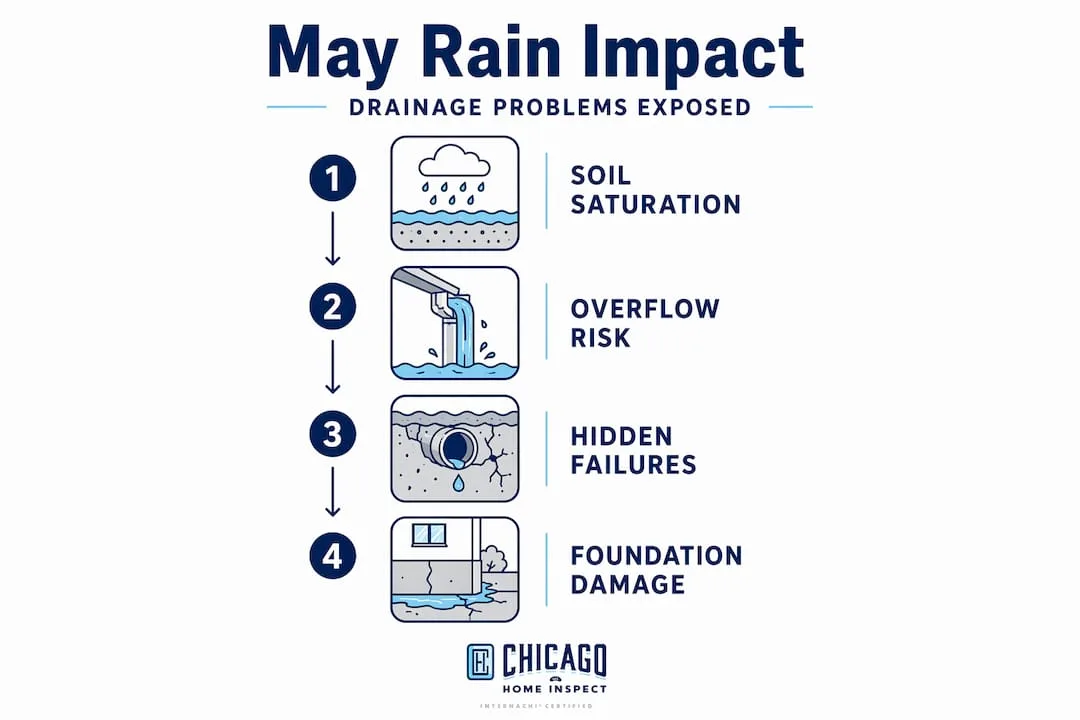
Chicago-area inspections confirm that spring rain commonly exposes negative grading and downspout discharge problems precisely because these issues are invisible in dry weather. Inspectors use a clear benchmark: the ground around your home should drop at least 6 inches within the first 10 feet from the foundation. That slope is what keeps rainwater moving outward.
Common reasons that slope disappears over time include:
- Soil settlement after original construction backfill compresses over years
- Landscaping buildup from mulch additions that gradually reverse grade slope
- Surface erosion from foot traffic, freeze-thaw cycles, and root activity
- Sod or planting beds that have been raised above foundation level
Grading failure is rarely dramatic. It happens gradually, one mulch top-off or one settling winter at a time, until the water has nowhere to go but down along your foundation wall.
Downspouts are part of this same system. Extensions should discharge water at least 6 feet from the foundation, landing on soil that continues to slope away. When that does not happen, even a correctly functioning gutter system delivers water right where you least want it.
Common grading and downspout discharge issues in Chicago homes
Chicago homes, especially bungalows and two-flats built in the mid-20th century, are particularly prone to settled backfill around the perimeter. The original grade was set at construction. Decades later, that grade has shifted.
Downspout extensions that discharge water too close to the foundation are one of the most frequently documented defects during spring inspections. The standard is clear: discharge at least 6 feet from the foundation onto a positive slope. Short extensions of 2 to 3 feet can look adequate on a dry day. After a May rain, you see exactly where that water ends up.
Here are the most common downspout and grading defects found in Chicago homes:
- No extension at all, water discharging at the elbow right against the foundation
- Short extensions that end on negative grade, directing water back toward the structure
- Discharge onto hardscape like concrete or pavers that channel water foundation-side
- Disconnected or damaged buried downspout lines with invisible failure points
- Clogged buried drain lines that back up during heavy rain and overflow at the foundation
Comparison of downspout extension setups:
| Setup | Distance from foundation | Grade at discharge | Risk level |
|---|---|---|---|
| No extension | 0 feet | Negative | Critical |
| Short extension | 2 to 3 feet | Negative | High |
| Short extension | 2 to 3 feet | Positive | Moderate |
| Proper extension | 6+ feet | Positive | Low |
| Buried line (functional) | 10+ feet | Draining away | Low |
| Buried line (clogged) | Varies | Unknown | High |
Swales (shallow channels graded into the yard to carry water away) and French drains (perforated pipes buried in gravel trenches) are legitimate stormwater drainage solutions, but they need maintenance. A swale blocked by leaves or a French drain with root intrusion provides false reassurance after installation.
Pro Tip: During any inspection, measure slope length and direction at every downspout discharge point, not just whether an extension is present. A 6-foot extension ending on negative grade is still a failed system.
What Chicago catch basin inspections reveal about hidden drainage failures
Catch basins are the grated drains you see in driveways, low yard areas, and along curb edges. Their job is to capture surface runoff and direct it underground through outlet pipes that eventually reach the storm sewer system. They look functional. They often are not.
Here is what a catch basin inspection actually checks, in order of what gets missed most often:
- Surface pavement or soil grade directing water toward the basin grate
- Grate and frame condition for damage, displacement, or settlement
- Basin sump depth and whether sediment has reached the outlet pipe invert
- Outlet pipe condition for collapse, offset joints, or visible root intrusion
- Basin structure for cracks, wall separation, or structural movement around the frame
The critical insight: Illinois catch basin inspections consistently find that collapsed outlet pipes, root intrusion, and joint separation cause flooding even when the basin itself has been recently cleaned. The problem is downstream of the basin, invisible from the surface.
A catch basin that drains slowly after cleaning is telling you something important. The restriction is not in the basin. It is in the pipe carrying water away from it.
Common hidden catch basin failures in Chicago yards include collapsed or offset outlet piping, mineral scale reducing pipe diameter, root intrusion from nearby trees, joint separation from soil movement, and pipes crushed by frost or vehicle loads.
Pro Tip: Settlement or visible tilt around a catch basin frame is a red flag for underground structural failure. Document it with photos before and after a rain event to show the problem clearly.
How spring growth and debris worsen drainage problems in Chicago yards
Root intrusion does not happen overnight. A small crack or slightly offset pipe joint is all a root needs. Over several spring seasons, that root mass grows inside the pipe, reducing flow capacity until a May storm pushes the compromised system past its limit and you see standing water where you have not seen it before.
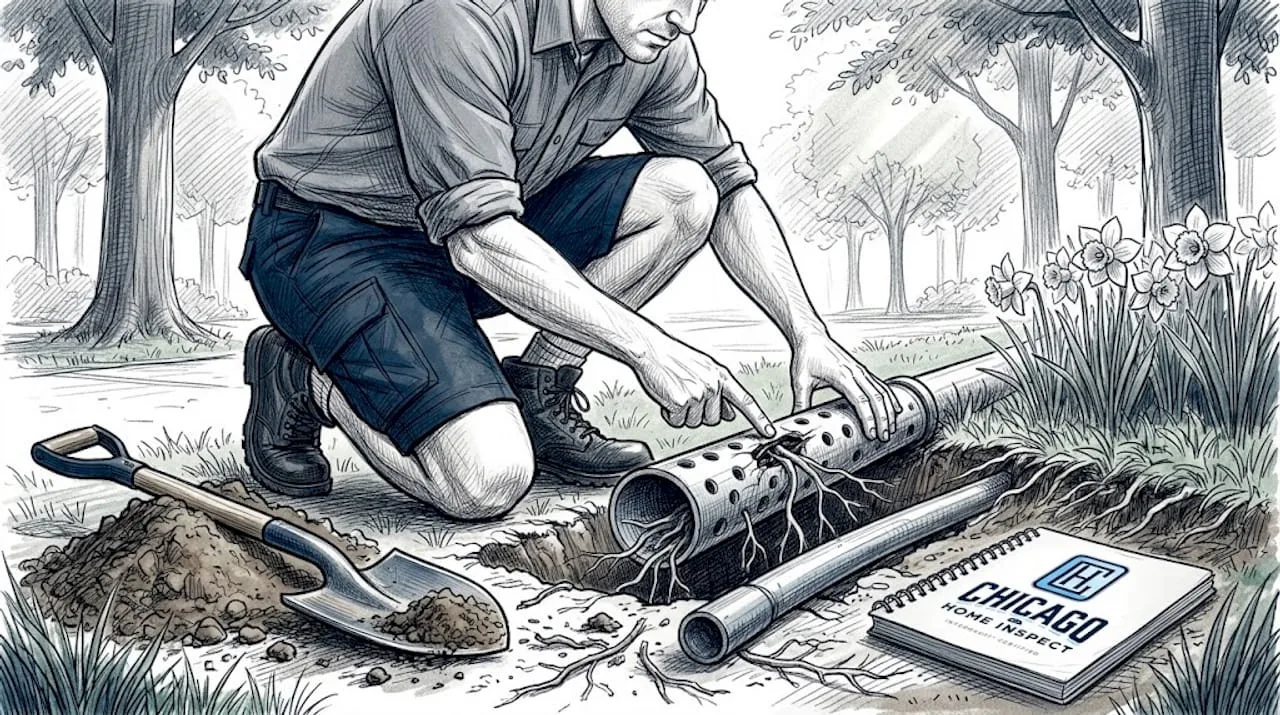
Surface drains and gullies fill up faster in spring than any other season. Spring drainage problems escalate after winter as vegetation growth and debris restrict drains and soakaways, turning what looked like minor maintenance needs into full blockages. Leaves, weed seeds, and decomposed mulch accumulate over winter and hit the drainage system exactly when it is working hardest.
Watch for these signs that your drainage system is losing capacity:
- Slow drainage after moderate rain, not just heavy storms
- Recurring wet spots in the same yard location every spring
- Standing water in gullies or low spots that holds longer than 24 hours
- Visible debris buildup around drain grates that returns quickly after clearing
- Soggy patches near the house that were not present in prior years
Back-to-back May storms are the real test. One storm might not overwhelm a partially blocked system. The second or third consecutive rain event will. Hidden drainage issues that survive a single storm often fail clearly during a wet week.
Pro Tip: Do not judge your drainage system from a single rain event. Observe performance through multiple events in a week. The pattern tells you far more than any single storm does.
Chicago grading and drainage rules every homeowner should know
Chicago’s building code is not ambiguous on this point. MCC 11-18 and the Stormwater Management Ordinance require positive drainage away from structures, prohibit increasing runoff onto neighboring properties, and discourage direct downspout connections to the combined sewer system.
Key requirements every Chicago homeowner should understand:
- Positive grading is required away from all building foundations under MCC 11-18
- Runoff to neighboring properties is prohibited; your drainage cannot solve your problem by creating a neighbor’s problem
- Direct sewer connections for downspouts are discouraged to prevent combined sewer overflow during heavy rain
- Permits may be required for regrading or drainage changes that affect stormwater runoff or adjacent lots
- Violations carry fines ranging from $200 to $1,000 per day until corrected
| Violation type | Fine range | Notes |
|---|---|---|
| Negative grading toward foundation | $200 to $500/day | Code MCC 11-18 |
| Runoff onto neighboring property | $200 to $1,000/day | Based on impact severity |
| Unpermitted regrading | $200 to $500/day | Permit required in many cases |
| Improper sewer connections | $500 to $1,000/day | Combined sewer protection |
The combined sewer point matters particularly in older Chicago neighborhoods. When downspouts feed directly into the city’s combined sewer, every heavy rain increases overflow risk. Disconnecting them and rerouting surface discharge properly is not just code-compliant; it protects your basement from backup too.
Practical steps to protect your Chicago home from spring grading and drainage problems
How rain affects landscaping is most visible in May. That makes May the best time to act. Use that visibility to document what is happening and build a clear picture before committing to any repair plan.
Follow these steps during the next spring rain event:
- Walk the perimeter during or immediately after a moderate rain and photograph every area where water pools, runs toward the house, or holds longer than expected
- Check every downspout discharge point and confirm water is traveling at least 6 feet from the foundation onto a slope that continues outward
- Inspect the grade visually for the 6-inch drop within 10 feet benchmark; a 4-foot level and tape measure work well
- Clear all drain grates, gutter outlets, and catch basin grates of debris before the next rain so you can observe true drainage capacity
- Monitor wet areas and water damage that appear near the foundation or in the basement after each rain event
- Schedule a professional inspection in early spring before the heaviest rain weeks arrive; spring basement moisture patterns often trace directly to exterior grading failures
Extending downspouts, confirming positive grading, monitoring for ponding near the foundation, and scheduling professional inspections during spring rain periods are consistently the most effective protective steps for homes in climates like Chicago’s.
Pro Tip: Repeat your observation walk after the second or third consecutive rain event in a week. Problems that hide during a single storm reveal themselves clearly when the soil is fully saturated and has no remaining absorption capacity.
Why typical homeowner approaches to grading and drainage problems fall short
Here is the honest truth about how most homeowners handle grading and drainage: they wait for a visible problem, address the symptom closest to the surface, and assume the issue is resolved. That approach is understandable, but it consistently leads to the same basement repair bill a few years later.
Water path issues are system problems involving roof water routing, surface slope, and outlet conveyance together. A storm reveals where the system fails, not just a single component. A homeowner who adds a longer downspout extension without checking whether it discharges onto positive grade has changed one variable in a failing system. The water finds the next weak point.
What we see repeatedly in rainy day inspection findings is that homeowners treat drainage as a landscaping issue. It is not. It is a structural protection issue. The grade around your home is a functional building system, the same as your roof or your foundation waterproofing. It degrades over time and needs professional assessment to catch failures before they become expensive.
The second mistake is assuming that a catch basin cleaning solves a drainage problem. It addresses one point in a larger system. If the outlet pipe downstream is compromised, the basin fills up during the next storm regardless of how clean the sump is. This is precisely why professional inspection goes beyond what is visible at the surface.
Our perspective: proactive spring inspection before the heavy rain weeks arrive is not a luxury. It is the difference between a $500 grading correction and a $15,000 basement waterproofing project. The problems that get expensive are the ones that go undetected for two or three springs in a row.
Get professional grading and drainage inspection help in Chicago
If May rains are showing you water pooling near your foundation, slow-draining yard areas, or damp basement walls, those are not coincidences. They are your home’s drainage system telling you something needs attention.
At Chicago Home Inspect LLC, our exterior home inspection services include photo-documented grading evaluation, downspout discharge assessment, catch basin condition reporting, and surface slope measurement against code benchmarks. We work across Chicago neighborhoods including bungalow districts and older subdivisions where settled backfill and aging drainage infrastructure are most common. Our pre-listing inspections also help sellers identify grading concerns that affect home value before buyers do. Book early in the spring season to catch what the rains are revealing. Schedule your inspection today and protect your foundation before the next storm decides for you.
Frequently asked questions
Why do grading and drainage problems become visible during May rains in Chicago?
May rains saturate soil that is already waterlogged from snowmelt, forcing water to move across the surface and exposing negative grading and failed discharge points that stay hidden during dry periods. Spring inspections confirm these are the hardest problems to see in dry weather.
What is the recommended downspout extension length for Chicago homes?
Extensions should discharge at least 6 feet from the foundation and land on soil that continues to slope away from the structure. Shorter extensions on negative grade deliver water directly back toward your foundation.
Why does a cleaned catch basin still cause flooding?
A clean basin with slow drainage means the restriction is downstream in the outlet pipe, not in the basin itself. Root intrusion or collapsed pipe sections beyond the basin are the most common causes.
How do spring-grown roots affect home drainage systems?
Roots enter small pipe cracks or joints and grow inside, gradually reducing flow until a wet week pushes the system past capacity. Root intrusion is a leading cause of hidden spring drainage failures that surface only after multiple rain events.
What Chicago ordinances apply to grading and drainage on residential properties?
MCC 11-18 and the Stormwater Management Ordinance require positive drainage away from foundations, prohibit runoff onto neighboring properties, and discourage downspout connections to the combined sewer, with daily fines for violations.