

TL;DR:
- Spring basement moisture in Chicago is mainly caused by condensation and soil-driven water pressure, not leaks.
- Diagnosing moisture sources involves weather tracking, surface testing, and monitoring dehumidifier effects.
- Preventative measures like early dehumidification, sealing cracks, and proper guttering can drastically reduce spring dampness.
Your basement is dry all winter, and then spring arrives without a single rainstorm and suddenly the walls feel damp, the floor looks wet, and you start wondering whether you have a serious leak. You are not imagining it, and you are definitely not alone. This is one of the most common calls we receive from Chicago and suburban homeowners every April and May. The culprit is rarely a crack in the foundation. More often, it comes down to condensation from warm humid air making contact with your cold basement surfaces. Understanding the actual cause saves you from expensive, unnecessary repairs and helps you protect one of your biggest investments.
Table of Contents
- Why spring triggers basement moisture—even without rain
- Diagnosing the source: condensation vs. leaks
- Common mistakes that worsen spring basement moisture
- Practical prevention and solutions for Chicago basements
- What most Chicago homeowners miss about spring basement moisture
- Protect your Chicago home with expert inspection and testing
- Frequently asked questions
Key Takeaways
| Point | Details |
|---|---|
| Spring moisture isn’t always about rain | Warm, humid air and soil water pressure cause basement moisture even in dry weather. |
| Condensation mimics leaks | Spring condensation can look like leaking but is triggered by air temperature and humidity differences. |
| Diagnosis is critical | Identifying the real cause—condensation vs. leak—saves time and money on repairs. |
| Prevention requires timely action | Early dehumidification, pipe insulation, and gutter checks protect your basement each spring. |
| Expert help prevents hidden damage | Persistent moisture or mold always warrants a professional inspection and testing. |
Why spring triggers basement moisture—even without rain
Now that we’ve confronted the common confusion, let’s examine what’s actually happening in your basement each spring.
When winter finally loosens its grip on the Chicago area, outdoor temperatures climb and the air picks up significant moisture from melting snow, thawing ground, and early spring humidity. That warm, moist air finds its way into your basement through gaps in windows, doors, utility penetrations, and even the porous concrete walls themselves. Once inside, that air hits cold concrete floors, uninsulated pipes, and cool block walls. The temperature difference causes warm spring air to release its moisture directly onto those surfaces, producing condensation that looks and behaves exactly like a water leak.
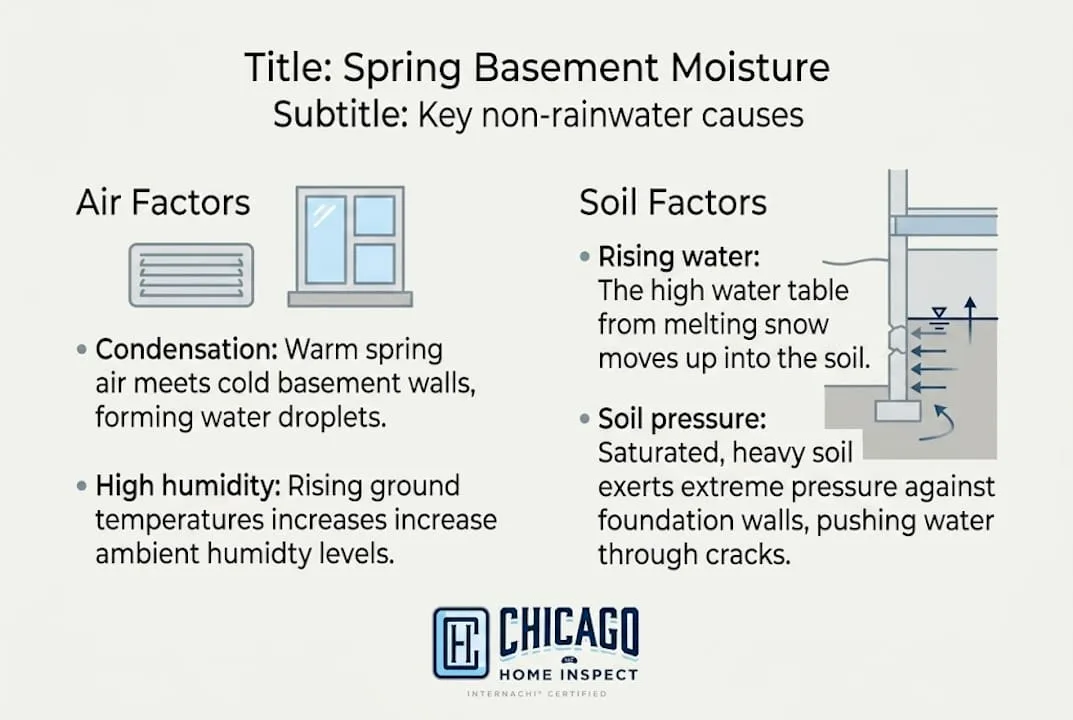
What makes Chicago particularly challenging is the soil. The region sits on dense clay soil that behaves more like a sponge than a filter. After a heavy snowmelt or a wet late-winter rain event, that clay absorbs and holds enormous volumes of water. Even when the sky is completely clear and dry for a week or two afterward, Chicago’s clay soil continues pushing moisture outward and upward through hydrostatic pressure, forcing dampness through basement walls and floor slabs. So even a perfectly “dry” spring week in Chicago can still deliver significant moisture to your basement.
Key spring moisture mechanisms to understand:
- Condensation: Warm humid outdoor air cools rapidly on cold basement surfaces, depositing moisture
- Hydrostatic pressure: Saturated clay soil pushes water through walls and slabs even days after rain stops
- Humidity spikes: Outdoor relative humidity regularly exceeds 70% in spring, accelerating condensation indoors
- Stack effect: Warm air rising through the home draws cool basement air upward, pulling in replacement humid air from outside
Many homeowners immediately assume a broken pipe, a cracked wall, or a failed waterproofing system when they see these moisture intrusion signs. That assumption leads to unnecessary waterproofing quotes and expensive excavation work when the actual fix might be as straightforward as running a dehumidifier and sealing a few gaps.
| Factor | Rain-driven leak | Spring condensation |
|---|---|---|
| Timing | Follows rain or snowmelt events | Follows warm, humid days |
| Location | Localized near cracks or joints | Spread across walls, pipes, floor |
| Pattern | Sudden, concentrated | Gradual, widespread |
| Stops when | Rain stops and soil drains | Humidity drops or air is excluded |
| Typical fix | Waterproofing, crack repair | Dehumidification, air sealing |
“Most homeowners dealing with a damp basement in spring assume a leak because moisture on concrete looks identical whether it came through the wall or condensed from the air. The difference lies entirely in the timing and conditions around it.” This is exactly the misread that leads to thousands of dollars in unnecessary repair bills every spring in the Chicago area.
For a broader view of what these issues look like during a professional walkthrough, our article on common home inspection issues covers what turns up most frequently in local homes. You can also review a humidity reduction guide that explains the underlying physics in a very practical format.
Diagnosing the source: condensation vs. leaks
Having clarified the two primary sources, let’s move to practical diagnosis so you can address the right problem.
The good news is that you can do a reliable first-pass diagnosis yourself before spending a single dollar on a contractor. The key is tracking the relationship between weather conditions and when moisture appears. Condensation follows warm and humid days and stops relatively quickly when you run a dehumidifier or prevent outdoor air from entering. A true water leak follows rain events, appears in a consistent, localized spot, and does not respond to dehumidification.
Step-by-step diagnosis for homeowners:
- Check the weather log. Note exactly when moisture appeared. Was it after rain, or after a stretch of warm, humid weather with no rain?
- Inspect the location. Is moisture spread broadly across the floor and lower walls, or concentrated near a specific crack, joint, or wall penetration?
- Run the tape test. Dry the affected area completely and tape a piece of aluminum foil or plastic sheeting firmly to the wall. Seal all four edges with waterproof tape. Leave it for 24 to 48 hours. If moisture appears on the outer surface of the foil, it is condensation from the air. If moisture appears behind the foil between the foil and the wall, it is coming through the wall.
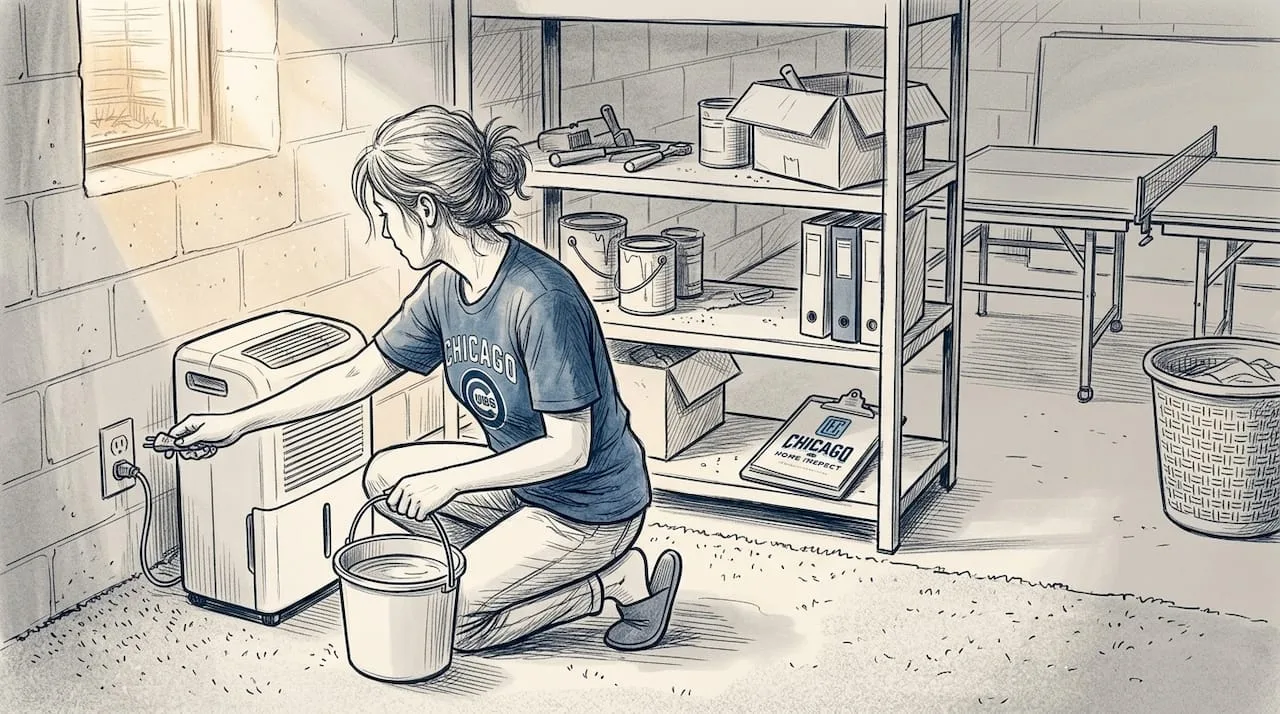
- Run a dehumidifier. Close all basement windows and doors, run a dehumidifier for 48 hours, and monitor the surface. Condensation problems typically resolve quickly. Leak-driven moisture will persist.
- Check exterior grading and gutters. Walk around the home after a rain and note whether water pools near the foundation. Poor grading or clogged gutters are often contributing to what you think is a spring moisture problem.
| Symptom | More likely condensation | More likely a leak |
|---|---|---|
| Appears after humid days (no rain) | ✓ | |
| Appears after rainfall or snowmelt | ✓ | |
| Covers broad areas, cold surfaces | ✓ | |
| Concentrated near cracks or joints | ✓ | |
| Moisture behind foil tape test | ✓ | |
| Moisture on outer foil surface | ✓ | |
| Improves with dehumidification | ✓ |
Pro Tip: Before calling a waterproofing contractor, run your dehumidifier for a full week with all basement entry points closed. If the moisture disappears, you have a condensation problem, not a structural leak. This one step saves many Chicago homeowners from paying for repairs they do not need.
You can also review water intrusion inspection steps to understand how professionals approach this process, and our overview of inspection red flags can help you recognize when the situation warrants more serious attention.
Common mistakes that worsen spring basement moisture
Once you know the cause, it is easy to misinterpret or accidentally make it worse. Here is what most homeowners do wrong.
The single most common mistake is opening basement windows on warm spring days for “fresh air.” It feels intuitive. It seems like the natural thing to do. But that warm outdoor air is loaded with humidity, and the moment it enters your cool basement, it introduces humid air to cold surfaces and triggers immediate condensation. You have not ventilated the problem away. You have made it significantly worse.
The second major mistake is waiting too long to run a dehumidifier. Many homeowners assume moisture is just a visual nuisance. But indoor humidity above 60% creates ideal conditions for mold growth, which can establish itself on drywall, wood framing, and stored belongings within 24 to 48 hours under the right conditions. By the time visible mold appears, it has often already spread behind walls and under flooring.
Common mistakes and what to do instead:
- Opening basement windows in spring: Keep them closed until outdoor dew point drops below 55°F, which typically happens in late May or June in Chicago
- Waiting to run the dehumidifier: Activate it in early April, not when you first see moisture, because prevention is far easier than remediation
- Blaming the foundation immediately: Most spring moisture is environmental, not structural, so diagnose before spending
- Ignoring gutters and grading: Clogged gutters and flat or negative grading direct water toward your foundation walls, combining with hydrostatic pressure from clay soil
- Skipping regular humidity checks: Without a monitor, you have no idea what is actually happening in the air your family breathes
Pro Tip: Buy an inexpensive digital hygrometer (under $15 at any hardware store) and mount it in your basement. Set a goal of keeping basement humidity between 30% and 50%. Check it weekly in spring. This simple habit catches problems early, long before moisture becomes mold.
It is also worth noting that 2026 has been a record-setting spring in Chicago. The city logged over 10.63 inches of rain in March and April combined, the wettest spring start in recorded history. That kind of saturation means the soil around virtually every Chicago-area home is holding far more water than normal, which amplifies every moisture mechanism described here. Reading about spring maintenance tips for Chicago homes is especially relevant this season, and reviewing humidity management strategies can give you a systematic approach to controlling indoor air quality.
Practical prevention and solutions for Chicago basements
To actively protect your investment, here is what you can do right now to keep your basement dry.
The most effective prevention strategy is timed intervention. Do not wait for moisture to appear. By early April in Chicago, the combination of rising outdoor temperatures, lingering saturated soil, and climbing humidity creates ideal conditions for basement condensation and pressure-driven moisture. Acting before symptoms appear is far cheaper and easier than reacting after mold has taken hold.
A 2026 spring that broke all historical precipitation records with over 10.63 inches of rain in just two months has left the clay soil around most Chicago-area homes in a prolonged state of saturation. The standard prevention steps for Chicago homeowners include activating your dehumidifier in early April, insulating cold water pipes to reduce surface condensation, inspecting and cleaning gutters before the spring thaw, and checking that the soil around your foundation slopes away from the house at a minimum grade of one inch per foot for the first six feet.
Spring basement moisture prevention checklist:
- Activate dehumidifier in early April, set to maintain 45% to 50% relative humidity
- Insulate cold water pipes with foam pipe insulation to prevent surface condensation
- Clean and extend downspouts to direct water at least six feet from the foundation
- Check grading around the perimeter and add soil if needed to slope water away
- Seal visible cracks in basement walls with hydraulic cement or epoxy injection
- Inspect window wells for debris buildup that can direct water toward the foundation
- Check sump pump function before peak season by pouring water into the pit
“In Chicago, even a single spring of neglected basement moisture management can create conditions that require professional mold remediation. The cost of a dehumidifier running from April through June is roughly $20 to $40 in electricity. The cost of mold remediation starts at $500 and commonly exceeds $3,000 for a typical basement.”
If moisture persists after following these steps, or if you notice staining, efflorescence (the white chalky deposits left by minerals in water), or visible mold growth, it is time for a professional assessment. Foundation problems in Chicago related to moisture can escalate quickly, and early identification through inspection costs a fraction of what structural repairs demand. If mold is suspected, professional mold testing identifies the exact species and extent of contamination before any remediation work begins. For exterior concerns, exterior mold prevention strategies can protect your home’s value and curb appeal as well.
What most Chicago homeowners miss about spring basement moisture
Stepping back from practical tips, let’s look at what sets Chicago basements apart and the vital truths every local homeowner should know.
After working with hundreds of Chicago-area homes, one pattern stands out clearly. Homeowners consistently overestimate the role of structural failure and underestimate the role of climate conditions in spring moisture problems. Chicago’s combination of clay soil, dramatic seasonal temperature swings, and high spring humidity creates a moisture environment that simply does not exist in most other parts of the country. The homes here are not built poorly. The environment is just exceptionally demanding.
The most expensive mistake we see is homeowners acting on the wrong diagnosis. A panicked call to a waterproofing contractor, a $7,000 interior drain tile system, and the moisture is back the following April because the problem was never a leak to begin with. Understanding how Chicago weather wears down homes changes how you interpret every symptom you see.
The truth is that your most powerful first tool is observation. Track moisture timing. Note the weather. Use a humidity sensor. Look at the overlooked defects in inspections that professionals catch but homeowners routinely miss. Bring in expert eyes before committing to major repairs. The data almost always tells a clear story once you know what questions to ask.
Protect your Chicago home with expert inspection and testing
If persistent moisture or uncertainty remains, here is how professional inspection and testing can safeguard your home.
Spring moisture issues can be difficult to fully assess on your own, especially when signs point in two directions at once. Our team at Chicago Home Inspector Services is InterNACHI Certified, BBB Accredited, and has spent years evaluating exactly these conditions across Chicago and the suburbs. Whether you are concerned about mold, foundation integrity, or simply want clarity before making repair decisions, our mold testing services provide lab-confirmed results that remove all guesswork. If you are preparing to sell, our pre-listing inspections identify moisture issues before buyers do. We are available weekdays and weekends to fit your schedule.
Frequently asked questions
Is basement moisture a problem even if it doesn’t rain?
Yes, spring moisture is caused by warm humid air and soil-driven water pressure, not just direct rainfall. Chicago’s clay soil stays saturated for weeks after any precipitation event.
How can I tell if my basement moisture is from condensation or a leak?
Condensation appears after warm humid days and improves with dehumidification, while leaks usually follow rain or snowmelt and appear in a consistent localized spot.
What humidity level is safe for my basement in spring?
Keep basement humidity between 30% and 50%. Indoor humidity above 60% creates ideal mold growth conditions that can establish quickly on organic materials.
Should I open basement windows in spring for ventilation?
No. Opening windows in spring introduces warm humid outdoor air to cold basement surfaces, which worsens condensation rather than improving air quality.
When should I call a professional for basement moisture?
If moisture persists after running a dehumidifier and sealing entry points, or if visible mold appears, seek professional assessment right away to avoid escalating structural or health risks.