

A good home inspection report delivers a clear summary of material defects, narrative descriptions for every significant finding, timestamped photos tied to those narratives, a defined scope and limitations statement, and specific recommendations for next steps or specialist referrals. That is the standard. Everything else is detail.
Before you read another page of any report, run it through this checklist:
- Summary page present — major defects listed up front, not buried on page 40
- Narrative descriptions — full sentences explaining what was observed, where, and why it matters (not just checkboxes)
- Photos for every defect — and context photos of working systems too
- “At the time of inspection” language — anchors observations to a specific date and scope
- Scope and limitations statement — names what was and was not inspected, and why
- Specialist referrals — recommends a licensed electrician, structural engineer, or roofer when warranted
- Inspector credentials and contact info — license number, certification body, and a way to follow up
Here is what a strong finding summary looks like in practice:
That sentence names the location, describes what was seen, explains the implication, and hands off to the right specialist. That is the bar.
For a complete home inspection report example you can open right now, view our sample report from Chicago Home Inspect LLC. The InterNACHI sample report library also hosts multiple downloadable files across formats.
Table of Contents
- Sample home inspection reports you can view and download
- What every section of a good report should contain
- How to read a report and decide what to do next
- What good inspectors actually do when writing a report
- Which report software and templates produce the best results
- Our annotated sample report and what it shows
- What standards require inspectors to include in every report
- Why report quality matters more than most buyers realize
- Chicago Home Inspect LLC home inspections for buyers who need a clear report
- Authority sources and sample reports for deeper reading
Sample home inspection reports you can view and download
The table below lists the most useful publicly available sample reports, what each one demonstrates, and the format you will receive.
| Sample Source | Format | What It Demonstrates | Best Use Case |
|---|---|---|---|
| InterNACHI Sample Reports | PDF + Web | Full narrative structure, photo placement, summary page, scope statement | Buyer education, agent reference |
| Chicago Home Inspect LLC Sample | Web/PDF | Local Chicago context, annotated findings, defensible language | Negotiation prep, specialist referral |
| HomeGauge-style report | Interactive web | Photo-narrative pairing, clickable summary, export to PDF | Contractor referral, legal documentation |
| HomeTeam example | Checkbox + narrative hybrid, color-coded severity | Quick buyer scan, maintenance planning | |
| InterNACHI Narrative Template | Pure narrative format, no checkboxes, detailed scope | Inspector training, agent comparison |
How to preview any sample quickly: Open the last two pages first (scope/limitations and inspector credentials), then jump to the summary page. Those three sections tell you whether the report is worth reading in full. If the summary is missing or the scope statement is a single boilerplate sentence, that is a red flag about the report itself.
A few things to look for as you browse:
- Does each defect entry include a photo reference number?
- Are recommendations specific (“licensed electrician”) rather than vague (“have it looked at”)?
- Does the report distinguish between safety hazards, material defects, and maintenance items?
- Is there a clear statement of what was not inspected and why?
PDF reports are easier to share with attorneys and lenders. Interactive web reports, like those produced by HomeGauge, let buyers click through findings by system and are often easier to navigate during negotiations. Both formats are acceptable; the content quality is what separates a useful report from a liability.
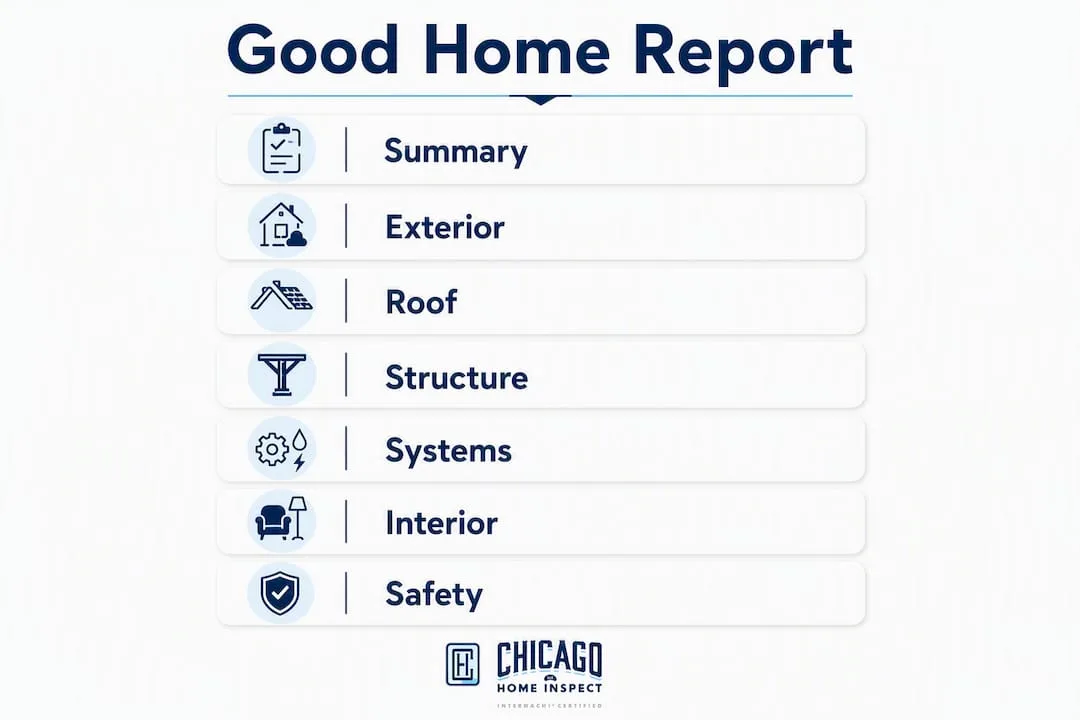
What every section of a good report should contain
Standards of Practice from ASHI require that a report describe readily accessible, visually observable systems, identify material defects, and state recommendations for repair, replacement, or further evaluation. Here is what that looks like, system by system.
Summary page
Lists every material defect and safety concern in one place. Every report should start here because many buyers and agents read only this page. If a report buries the summary at the end, that is a structural problem.
Exterior
Covers siding, trim, grading, drainage, driveways, walkways, and vegetation contact. In Chicago, this section should note any efflorescence on masonry, spalling brick, or mortar deterioration common in older graystones and two-flats. Freeze-thaw cycles in Climate Zone 5 accelerate masonry damage faster than most buyers expect.

Roof
Describes roofing material, estimated age if determinable, visible damage, flashing condition, gutters, and downspouts. A good report notes whether the roof was walked or observed from ground level with binoculars or a drone, and why. That distinction matters for scope.
Structure and foundation
Documents visible foundation type, any cracks (with location, orientation, and approximate width), and evidence of movement or settlement. Horizontal cracks in block foundations are a different concern than hairline vertical cracks in poured concrete. A good report says which is which.
Attic and insulation
Notes insulation type and approximate depth, ventilation adequacy, visible sheathing condition, and any signs of moisture or pest activity. In older Chicago bungalows, the attic is often the first place active roof leaks show up.
Plumbing
Covers supply and drain materials, water heater age and condition, visible supply and drain lines, and functional flow. Good reports note galvanized steel supply lines (common in pre-1960 Chicago homes) as a material concern given their corrosion history.
Electrical
Documents panel type, breaker condition, visible wiring, and outlet testing. Double-tapped breakers, aluminum branch wiring, and Federal Pacific or Zinsco panels are material defects that warrant a licensed electrician referral. A good report names the panel brand and amperage, not just “electrical panel inspected.”
HVAC
States equipment type, approximate age, last-service evidence if visible, and functional test results. In Chicago, a furnace operating in January is tested under real load. A report written in summer should note that the heating system was tested but not under peak-demand conditions.
Interior
Covers walls, ceilings, floors, windows, and doors. Notes staining, cracks, and operational deficiencies. Staining on ceilings gets a photo and a note about whether it appeared active or historic.
Appliances
Tests built-in appliances for basic operation. Notes age if visible on data plates.
Safety items
Smoke detectors, carbon monoxide detectors, GFCI protection, and handrail conditions are called out separately in most strong reports because they are immediate life-safety concerns.
Photos
Photographing systems that are working well is as important as photographing defects. Context photos prove the inspector accessed an area; defect photos document what was found. Every defect entry should reference at least one photo. Multiple angles for significant findings are standard practice.
Scope and limitations
Names what was not inspected and why — a locked door, standing water blocking access, finished ceiling concealing structure. This section protects both the client and the inspector.
Pro Tip: When reviewing any report, go straight to the summary page and count the specialist referrals. A report with zero referrals on a 1960s Chicago two-flat is almost certainly incomplete. Older homes generate legitimate referrals; their absence suggests the inspector either missed something or avoided the conversation.
How to read a report and decide what to do next
Not every finding in a home inspection report demands the same response. The skill is sorting material defects from maintenance items, then building a response plan.
Material defects are conditions that significantly affect the value, habitability, or safety of the home. Foundation movement, active moisture intrusion, hazardous wiring, and major roof damage fall here. InterNACHI guidance places structural concerns, active moisture, and electrical hazards at the top of the priority list because they carry the highest cost and risk if ignored.
Maintenance items are conditions that need attention but do not threaten safety or structural integrity. A worn caulk joint at a tub surround, a slow-draining sink, or a missing downspout extension are real findings but not negotiation leverage.
Here is a practical response framework:
- Immediate action (before closing): Active gas leaks, open electrical panels, structural instability, evidence of sewage backup. These require a licensed contractor evaluation and written clearance before you proceed.
- Within 30 days of closing: Roof repairs, HVAC servicing, plumbing leak repairs. Get two contractor estimates during the inspection contingency window if possible.
- Within 90 days: Deferred maintenance items, minor drainage corrections, weatherstripping, and caulking.
- Monitor over time: Hairline cracks in poured concrete foundations, minor settlement in older homes, and cosmetic wear.
For specialist referrals, the report should name the trade. “Recommend evaluation by a licensed structural engineer” is specific. “Recommend further evaluation” is not. When writing a contingency request, quote the report’s exact language and attach the relevant pages.
Our guide to home inspection red flags covers the most common high-priority findings we document in the Chicago area, with photos and negotiation notes.
What good inspectors actually do when writing a report
Narrative reports are safer and more useful than checkbox-only formats because narrative gives context. A checkbox that says “deficient” tells a buyer nothing. A sentence that says “double-tapped 15-amp breaker observed at position 12 in the main panel; recommend evaluation by a licensed electrician” tells them exactly what was found, where, and what to do.
Here is the field-to-report workflow that produces defensible reports:
- Write the scope statement first. Define what was and was not inspected before you write a single finding. This anchors the entire document.
- Use location-specific language for every finding. “North wall, basement utility room, approximately 3 feet from the floor” is defensible. “Basement wall” is not.
- Tie every photo to its narrative. Reference photo numbers in the text. A photo without a narrative is decoration; a narrative without a photo is an assertion.
- Recommend specialists, never diagnose. Identify the observed condition and hand off. “Evidence consistent with prior pest activity; recommend evaluation by a licensed pest control operator” is the right call. Prescribing the treatment is not.
- Document access limitations with a photo. If a crawl space hatch was blocked by stored items, photograph the blockage. That image is your legal defense if a buyer later claims you missed something behind it.
- Anchor every observation to “at the time of inspection.” Clients sometimes treat reports as guarantees. Repeating this phrase throughout the report sets accurate expectations and limits liability.
Sentence templates inspectors should keep on hand:
- “Evidence of moisture intrusion observed at [location]; staining and efflorescence present. Recommend evaluation by a licensed waterproofing contractor.”
- “Double-tapped breaker observed at [position] in the [panel location]. Recommend evaluation and correction by a licensed electrician.”
- “Horizontal crack observed in block foundation wall, [location], approximately [width] wide and [length] long. Recommend evaluation by a licensed structural engineer prior to closing.”
Five practical steps reduce liability in report writing: think before writing, keep language simple, avoid jargon, document limitations, and recommend specialists rather than diagnosing. That last point is the one most inspectors violate when they feel pressure to give buyers a definitive answer.
Pro Tip: Treat the report as a document a contractor, attorney, or judge might read two years from now. Write every finding as if you are explaining it to someone who was not there and has no context. Vague language protects no one.
Which report software and templates produce the best results
The format a report is delivered in matters less than the content inside it, but the right software makes strong content easier to produce consistently. Here is how the major options compare:
| Platform / Template | Format Output | Key Strengths | Best For |
|---|---|---|---|
| InterNACHI templates | PDF, narrative | Free for members, narrative-first, scope-statement built in | New inspectors, standardized language |
| HomeGauge | Interactive web + PDF | Photo-narrative pairing, clickable summary, client portal | Agents sharing with buyers, contractor referrals |
| HomeTeam | Consistent structure, color-coded severity, franchise-standard | High-volume inspections, quick buyer scans | |
| Spectora | Web + PDF | Modern UI, mobile field entry, fast turnaround | Tech-forward inspectors, same-day delivery |
| ReportWalk | Narrative focus, liability-aware templates | Inspectors prioritizing defensibility |
The features that actually matter in any system:
- Narrative flexibility — can the inspector write full sentences, or is it checkbox-only?
- Photo placement — do photos appear next to their findings, or in a separate appendix?
- Summary page — is it auto-generated from flagged items, or does the inspector build it manually?
- Export options — can the client download a PDF and share it with a lender or attorney?
- Scope/limitations integration — is the scope statement a built-in field, or an afterthought?
Software templates help consistency, but inspectors must adapt them to each property. A boilerplate sentence that describes a generic attic does not serve a buyer purchasing a 1920s Chicago bungalow with knee-wall storage and no ridge vent. The template is a starting point, not a substitute for observation.
For agents deciding which format to share with clients: interactive web reports work well during negotiation because buyers can filter by severity. PDF reports are better for attorneys, lenders, and long-term documentation. When in doubt, provide both.
Our annotated sample report and what it shows
Our Chicago Home Inspect LLC sample report is a complete example of what we deliver to every client. Here is what to look for as you review it:
- Inspector credentials: — License number, InterNACHI certification, and contact information appear on the cover page and the final page.
Chicago-specific context shows up throughout the report. Freeze-thaw effects on masonry, the age and condition of cast-iron drain stacks common in pre-1960 two-flats, and the flat-roof drainage issues we see regularly in Logan Square and Pilsen all get specific narrative treatment. A finding that reads “minor efflorescence on north foundation wall” in a generic template becomes “efflorescence and staining on the north foundation wall consistent with seasonal moisture intrusion; common in masonry construction of this era and Climate Zone 5 conditions; recommend monitoring and evaluation by a licensed waterproofing contractor” in our reports.
For buyers and agents using the sample in negotiations: the finding narratives are written to be quoted directly in contingency requests. The specialist referral language is specific enough to hand to a contractor for a scope-of-work estimate. That is intentional.
Our interior inspection photos and exterior inspection photos pages show additional examples of how we document findings across both accessible and hard-to-reach areas.
What standards require inspectors to include in every report
The two primary standards governing home inspection reports in the United States are the InterNACHI Standards of Practice and the ASHI Standards of Practice. Both define the minimum scope of a residential inspection and what the written report must contain.
Under ASHI’s Standard, a report must:
- Describe the readily accessible, visually observable installed systems and components
- State the condition of systems that are not functioning properly, significantly deficient, unsafe, or near the end of their useful life
- State recommendations to repair, replace, or obtain further evaluation from a qualified professional
Under InterNACHI’s Standard, the requirements are substantially similar, with additional emphasis on identifying material defects and recommending specialist referrals when findings exceed the inspector’s scope.
Scope and limitation language that belongs in every report:
- “This inspection was performed on [date] and reflects conditions observed at the time of inspection only.”
- “The following areas were not inspected due to [specific reason]: [list areas].”
- “This report does not include evaluation of environmental hazards including but not limited to radon, mold, asbestos, or lead paint. Separate testing by a qualified professional is recommended.”
Disclaimers are more effective when integrated throughout the report rather than confined to a single boilerplate paragraph at the end. A limitation statement placed next to the finding it applies to is clearer and more defensible than a generic disclaimer buried in the appendix.
Environmental testing — radon, mold, sewer scope, air quality — falls outside the standard scope of a visual home inspection. When a report identifies moisture concerns, it should recommend mold testing or radon testing as a separate service, not attempt to diagnose or quantify those conditions within the inspection report itself.
Standards compliance is a floor, not a ceiling. A report that meets minimum standards is not necessarily a good report. The difference between a compliant report and a useful one is specificity, photographic depth, and the quality of the narrative.
Why report quality matters more than most buyers realize
Most buyers focus on what the inspection finds. We focus on how it is documented. Those are not the same thing.
A finding that says “roof near end of useful life” is technically compliant. A finding that says “asphalt shingle roof, estimated age 18–22 years based on visible wear and granule loss, multiple areas of lifted flashing at the chimney base, recommend evaluation by a licensed roofing contractor prior to closing” is useful. One gives you a vague concern. The other gives you a contractor call, a negotiation point, and a documented record if the roof fails six months after closing.
We write every report at Chicago Home Inspect LLC as if it will be read by an attorney two years from now, because sometimes it is. That means specific locations, measurable details where possible, photos from multiple angles, and recommendations that name the right trade. It also means being honest about what we could not see and why.
In Chicago’s older housing stock — the bungalows on the Northwest Side, the two-flats in Logan Square, the graystones in Lincoln Park — there is almost always something worth documenting carefully. Aging cast-iron stacks, knob-and-tube wiring in attics, tuckpointing that has not kept pace with freeze-thaw cycles, flat roofs with inadequate drainage. These are not surprises to us. They are the reason the report has to be good.
Buyers who receive a clear, specific report close faster, negotiate more confidently, and have fewer disputes after closing. Agents who work with inspectors who write strong reports spend less time managing post-closing calls. The report is not a formality. It is the product.
Chicago Home Inspect LLC home inspections for buyers who need a clear report
Buyers under contract in Lake, McHenry, DuPage, or northern Cook County get a complete narrative report with photos, a clear summary page, and specific specialist referrals when warranted. No checkboxes. No vague language. A report you can hand to a contractor, an attorney, or a lender and have it hold up.
We are licensed, insured, InterNACHI-certified, and BBB-accredited. Weekend appointments are available. When a report identifies moisture concerns, we can add mold testing or a sewer line inspection to the same visit so you have a complete picture before your contingency deadline.
Schedule your inspection or view our sample report to see exactly what you will receive.
Authority sources and sample reports for deeper reading
These are the most useful primary sources for standards, sample reports, and report-writing guidance:
- InterNACHI Sample Report Library — Multiple downloadable PDF and web-report samples; the best starting point for buyers who want to compare formats before their inspection.
- ASHI Standards of Practice (2026) — The full text of what a compliant report must include; useful for agents and buyers who want to know the minimum standard.
- InterNACHI — What to Expect in Home Inspection Reports — Plain-language explanation of report structure and narrative best practices.
- ASHI Reporter — Inspection Reports: Writing Dos and Don’ts — Practical liability-reduction guidance for inspectors; useful for agents evaluating report quality.
- InspectorPro Insurance — Report Writing Best Practices — Insurance-industry perspective on what makes a report defensible; worth reading before you sign a purchase agreement contingent on an inspection.
- Chicago Home Inspect LLC Sample Report — A complete local example with Chicago-specific findings and annotated narrative language.
When reviewing any of these samples, open the summary page and the scope/limitations section first. Those two sections tell you more about report quality than any other part of the document.