
TL;DR:
- Flat and low-slope roofs in Chicago have a pitch below 3:12 and face unique risks from freeze-thaw cycles. Regular professional inspections, infrared moisture scans, and permit record checks are essential for proper maintenance and legal compliance. TPO, EPDM, and modified bitumen are common materials, each suited to specific conditions and cost considerations.
Flat and low-slope roofs are defined by a pitch below 3:12, meaning the roof rises less than 3 inches for every 12 inches of horizontal run. In Chicago, these roofs appear on two-flats in Logan Square, bungalow rear additions on the Northwest Side, and commercial-style mixed-use buildings throughout northern Cook County. Understanding flat and low-slope roofs in Chicago is not optional for buyers. The city’s freeze-thaw cycles, local building codes, and the specific failure patterns of membrane roofing create risks that a standard walkthrough will never reveal. Chicago Home Inspect LLC sees these issues regularly, and this guide covers what every buyer and investor must know before closing.
What are the key maintenance and inspection considerations for Chicago flat roofs?
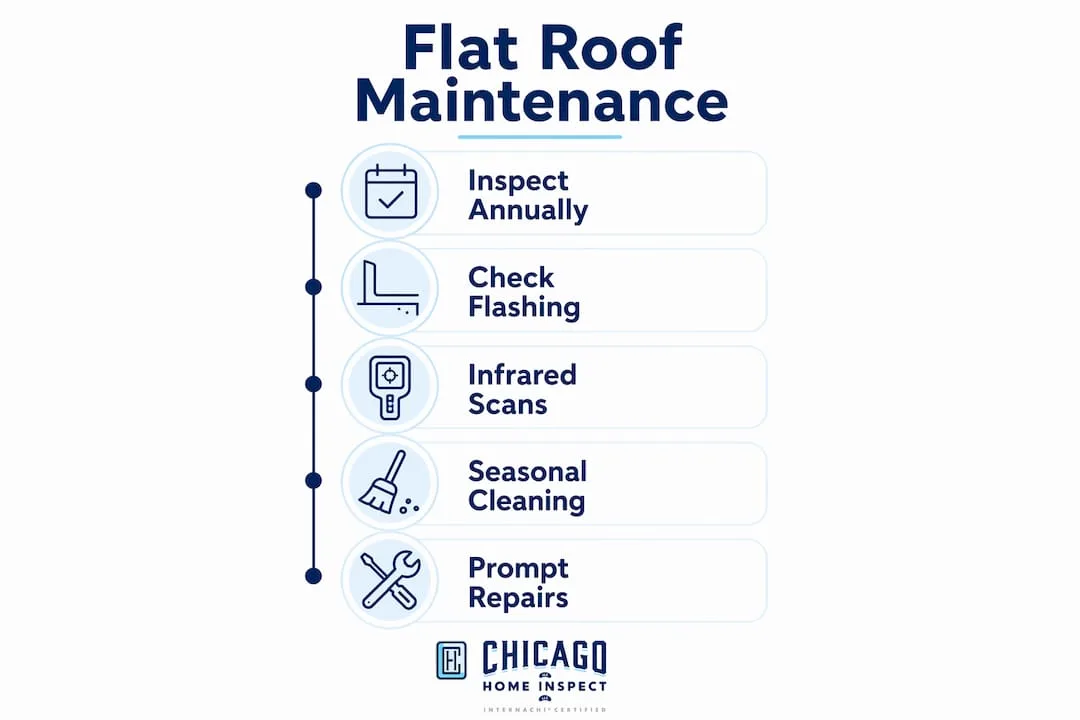
Professional inspections are recommended at least once annually, ideally in spring or fall. Spring inspections catch damage from the winter freeze-thaw cycle before it worsens. Fall inspections confirm the roof is sealed and draining properly before the first hard freeze.
Chicago’s Climate Zone 5 conditions are particularly punishing for flat roofs. Repeated freeze-thaw cycles force water into small membrane cracks, expanding them with each cycle. Blisters, surface cracking, and flashing separation are all direct results of this process.
Ponding water is the most visible warning sign on any flat or low-slope roof. Water persisting longer than 48 hours after rain signals a fundamental drainage failure. That failure shortens roof lifespan and creates the conditions for structural deck damage.
Common issues to watch for include:
- Ponding water at low points or blocked drains
- Membrane blisters caused by trapped moisture or poor adhesion
- Flashing deterioration at parapet walls, curbs, and penetrations
- Debris accumulation blocking interior drains or scuppers
- Surface cracking from UV exposure and thermal movement
Pro Tip: Inspect flashing and parapet seals separately from the membrane field. These transition points fail first and are the most common source of interior leaks, yet they are the easiest areas to overlook during a quick visual check.
Infrared moisture scans add a critical layer of detection. Infrared scans detect trapped moisture under membranes where hidden insulation damage is already underway. This technology reveals problems that look fine from the surface but are actively decaying the roof deck below.
For a broader view of seasonal upkeep, the Chicago winter maintenance checklist covers flat roof preparation alongside other cold-weather priorities.
How do Chicago building codes and permit requirements affect roof replacements?
Chicago building code mandates a permit for all flat or low-slope roof work, with one narrow exception. Repairs covering more than 25% of the total roof surface require a permit. Any full replacement, regardless of building height or occupancy type, requires one as well.
Buyers often underestimate how much unpermitted roofing work affects a purchase. The risks are concrete and serious:
- Insurance claim denial. An insurer can deny a claim if the roof was replaced without a permit, leaving the buyer with no coverage for a subsequent leak or collapse.
- Disclosure liability. Sellers who fail to disclose unpermitted work expose buyers to code compliance costs after closing.
- Forced tear-off. The city can require removal of unpermitted work to inspect the underlying deck, adding significant cost.
- Resale complications. Future buyers and their lenders will find the permit gap in city records.
Unpermitted roofing work creates major liability risks for buyers, including insurance claim denials and costly code compliance requirements that fall entirely on the new owner after closing.
Permit records are publicly accessible through the City of Chicago’s Build portal. Buyers and inspectors can search by address before closing to confirm whether prior roof work was permitted and inspected. We check this routinely at Chicago Home Inspect LLC as part of our pre-purchase process. For older properties, the century homes inspection guide explains how to interpret incomplete permit histories on aging Chicago buildings.
What roofing materials are best suited for low-slope roofs in Chicago?
Material choice for Chicago flat roofs must prioritize freeze-thaw durability and local climate performance over initial cost. Three membrane types dominate the Chicago market: TPO, EPDM, and modified bitumen. Each performs differently under Chicago conditions.
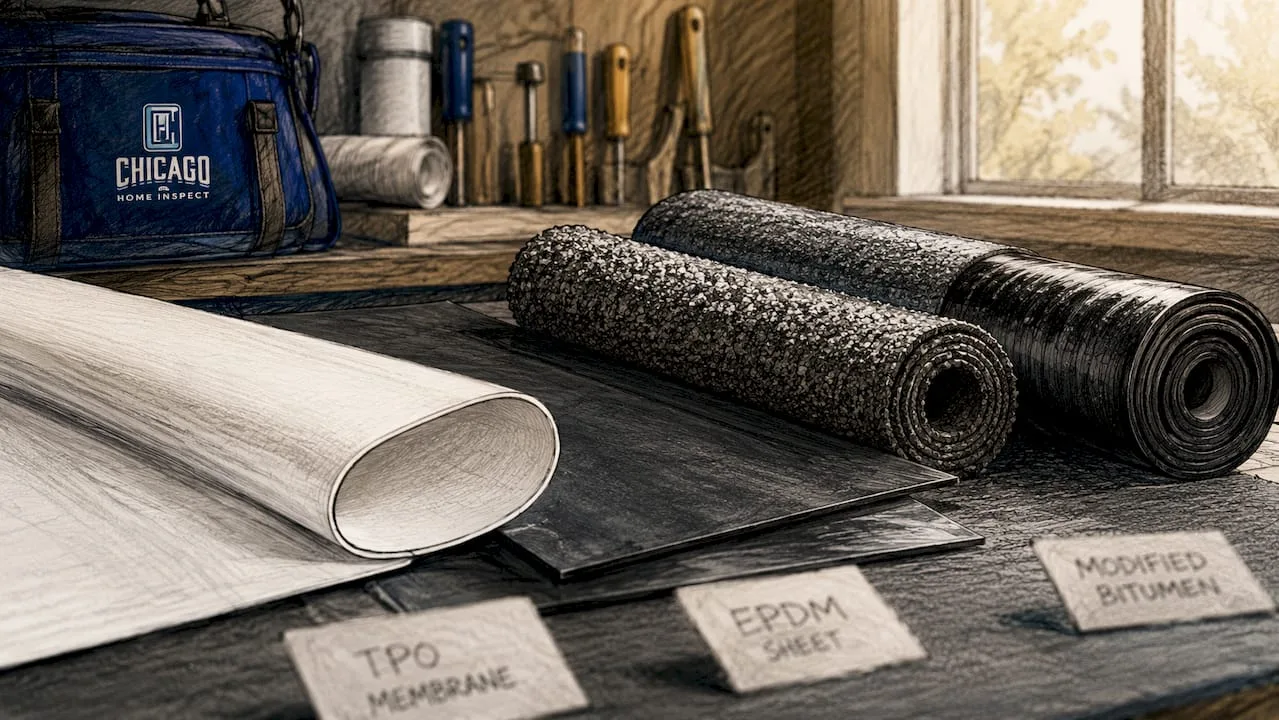
TPO membranes offer UV and heat resistance with a typical lifespan exceeding 20 years when properly installed. The white reflective surface reduces cooling loads in summer, which matters for Chicago’s hot, humid July and August. TPO is heat-welded at seams, creating a strong bond that resists wind uplift.
EPDM is a synthetic rubber membrane favored for its flexibility in cold temperatures. It remains pliable well below freezing, which makes it resistant to cracking during Chicago winters. EPDM is typically black, which absorbs heat and can accelerate summer surface aging, but its track record in cold climates is strong.
Modified bitumen performs well around roof penetrations and withstands foot traffic better than single-ply membranes. It is a common choice for Chicago two-flats and bungalow additions where HVAC equipment or water heater vents penetrate the roof surface. Modified bitumen is typically applied in multiple layers, which adds redundancy.
| Material | Lifespan | Cold-weather performance | Energy efficiency | Relative cost |
|---|---|---|---|---|
| TPO | 20+ years | Good | High (reflective) | Moderate |
| EPDM | 15–25 years | Excellent | Low (dark surface) | Moderate |
| Modified bitumen | 15–20 years | Good | Moderate | Moderate to high |
Professional flat roof replacement in Chicago runs $10–$20 per square foot. That range reflects material choice, roof access, and whether existing layers must be removed. Buyers should budget toward the higher end when a full tear-off is required.
Pro Tip: Ask for the manufacturer’s warranty documentation on any membrane roof. A properly installed TPO or EPDM system carries a manufacturer warranty of 10–20 years. No documentation often means the installation was not registered, which voids the warranty entirely.
For buyers comparing service providers, roofing replacement cost factors vary by contractor experience, material grade, and local labor rates in the Chicago market.
What should buyers look for when inspecting a Chicago flat roof?
A flat roof inspection requires a different checklist than a sloped roof. The field membrane is only part of the picture. The most critical zones are the transition points where different materials or planes meet.
Key inspection areas include:
- Flashings at parapet walls. Flat roofs fail first at transition points such as membrane seals at parapet walls. Cracks or separation here allow water to travel behind the membrane and into the wall assembly.
- Roof penetrations. Pipes, vents, HVAC curbs, and conduit penetrations are each a potential leak point. Check the roof pipe flashing for cracks, gaps, or missing sealant.
- Interior drains and scuppers. Clogged drains cause ponding. Ponding accelerates membrane degradation and adds structural load.
- Seam integrity. Lifted or open seams in TPO or EPDM allow water infiltration that is invisible from inside the building until significant damage has occurred.
- Multiple membrane layers. More than two layers without a permit record is a red flag. Each added layer traps moisture and adds weight the deck may not be rated to carry.
Surface condition tells only part of the story. A membrane can look intact while the insulation below is saturated. Infrared moisture scanning is the only reliable way to detect this condition without destructive testing. Chicago Home Inspect LLC uses infrared technology to identify wet insulation zones that visual inspection cannot reveal.
Buyers should also review the most overlooked defects in Chicago inspections to understand how flat roof issues connect to broader building defects that appear during a full inspection.
Our perspective on flat roofs and Chicago home purchases
We have inspected hundreds of flat-roofed properties across Logan Square, Wicker Park, Avondale, and the northern suburbs. The pattern we see most often is not dramatic failure. It is slow, hidden deterioration that sellers did not know about and buyers did not think to ask about.
The most costly situations we encounter involve unpermitted roof replacements. A buyer closes on a two-flat, the roof leaks within a year, and the insurance company denies the claim because the prior replacement was never permitted. The buyer then faces both a repair bill and a code compliance process. This is entirely preventable with a permit check before closing.
We also see buyers focus too much on surface condition and not enough on drainage. A clean-looking membrane with blocked drains and standing water is a worse situation than a weathered membrane with perfect drainage. Water management is the single most important performance factor on any flat roof.
The advice we give every buyer is straightforward: get an infrared scan, pull the permit history, and do not accept “it looks fine” as a roof assessment. Flat roofs reward diligence and punish assumptions.
— Chicago Home Inspect LLC
Chicago Home Inspect LLC flat roof inspections for buyers
Chicago Home Inspect LLC provides thorough flat and low-slope roof inspections for buyers across Lake, McHenry, DuPage, and northern Cook Counties. Our inspections include visual membrane assessment, flashing and penetration review, drainage evaluation, and infrared moisture scanning where conditions allow. We also check permit records as part of our pre-purchase process so buyers know exactly what work was done and whether it was done legally. Our sample inspection report shows the level of detail we document on every roof system. We are InterNACHI Certified, BBB Accredited, and available on weekends. Contact Chicago Home Inspect LLC before you close on any Chicago property with a flat or low-slope roof.
FAQ
What is the difference between a flat roof and a low-slope roof?
A flat roof has a pitch of less than 1:12, while a low-slope roof falls between 1:12 and 3:12. Both require membrane-style waterproofing rather than the shingles used on steep-slope roofs.
How often should a flat roof in Chicago be inspected?
Professional inspections are recommended at least once per year, with spring and fall being the most effective seasons given Chicago’s freeze-thaw cycle.
Does replacing a flat roof in Chicago require a permit?
Yes. Chicago building code requires a permit for any flat roof replacement and for repairs covering more than 25% of the roof surface. Unpermitted work can result in insurance claim denial and forced removal.
How much does flat roof replacement cost in Chicago?
Chicago flat roof replacement costs $10–$20 per square foot for professional installation. The final cost depends on material choice, roof size, and whether existing layers require removal.
What is the best roofing material for a flat roof in Chicago?
No single material suits every flat roof. TPO offers the best energy efficiency and a 20-plus-year lifespan. EPDM performs best in cold temperatures. Modified bitumen is the strongest choice around penetrations and for roofs with foot traffic.