
TL;DR:
- The refrigerant R-454B replaces R-410A in all new US residential air conditioning systems starting January 1, 2025, due to its lower global warming potential. Existing R-410A units cannot be converted to R-454B and must be replaced with compatible systems, which require special safety-trained technicians. Homeowners should get professional diagnoses for repairs, avoid unnecessary replacements, and seek utility rebates while considering the system’s age and condition.
R-454B is the refrigerant now required in all new residential air conditioning systems sold in the United States, mandated under the EPA’s AIM Act starting january 1, 2025. If your AC fails this summer and you have an older R-410A system, the R-454B refrigerant switch changes your repair and replacement options in ways most homeowners don’t expect. Your existing unit cannot be converted to use R-454B. That single fact drives every decision you’ll face when your system stops cooling on a 95-degree Chicago afternoon. Understanding the switch now, before a breakdown, puts you in a far stronger position.
Why is R-454B replacing R-410A?
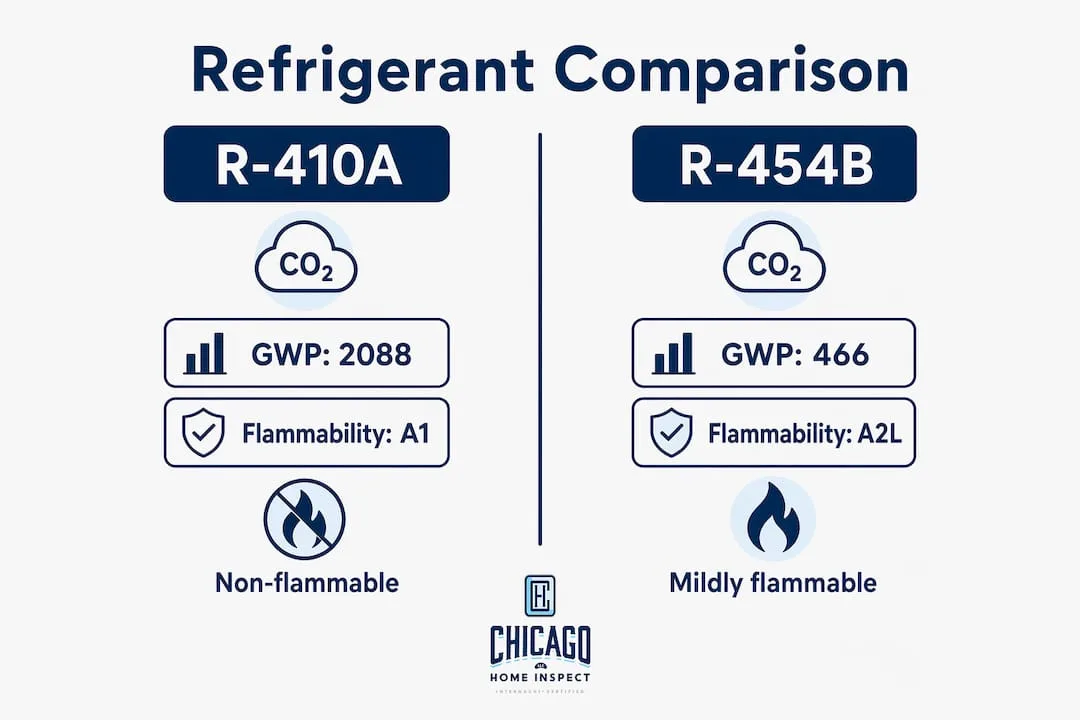
The EPA mandated R-454B under the AIM Act because R-410A carries a Global Warming Potential of 2,088. R-454B’s GWP is 466, a reduction of roughly 78%. That gap is why regulators acted.
The two refrigerants are not interchangeable. R-410A is classified A1, meaning non-flammable. R-454B is classified A2L, meaning mildly flammable. That difference requires new compressors, leak detectors, and electrical components rated for A2L use. The operating pressures also differ, so the internal components of an R-410A system cannot safely handle R-454B.
| Feature | R-410A | R-454B |
|---|---|---|
| Global Warming Potential | 2,088 | 466 |
| Flammability class | A1 (non-flammable) | A2L (mildly flammable) |
| Mandated for new equipment | No (phased out) | Yes, since jan 1, 2025 |
| Drop-in replacement | N/A | No |
| Requires A2L-rated components | No | Yes |
R-454B has been used safely in Europe and Asia for over a decade. The technology is proven. The transition is about reducing greenhouse gas emissions from the roughly 100 million residential AC systems operating across the country.
Pro Tip: If a contractor tells you they can “convert” your R-410A unit to R-454B, walk away. No such retrofit exists for residential systems. Mixing refrigerants voids your warranty and violates EPA Section 608.
What should you do if your R-410A AC dies this summer?
The first step is an accurate diagnosis. Not every breakdown means replacement. A capacitor failure, a clogged drain line, or a dirty evaporator coil can all shut down a system that has years of useful life remaining.
Here is how to approach the decision:
- Call a licensed HVAC technician for a full diagnosis. Get a written assessment of what failed and what it will cost to repair. Do not agree to replacement before you have that document.
- Ask whether reclaimed R-410A refrigerant is available. Servicing your existing R-410A system with reclaimed refrigerant remains legal and safe. No government mandate forces you to replace a working or repairable unit.
- Weigh repair cost against system age. A system under 10 years old with a repairable fault is usually worth fixing. A system over 15 years old with a compressor failure is usually not.
- If replacement is needed, buy R-454B-compatible equipment. All new residential AC units sold since january 1, 2025 use R-454B. You are not choosing between old and new refrigerant. You are choosing between repair and replacement.
- Avoid pressure tactics. Some contractors use the refrigerant phase-out to push unnecessary replacements. Your R-410A unit does not need to be replaced simply because R-454B exists.
Chicago homeowners face a specific timing challenge. Our summers arrive fast, and a system that limped through last july may not survive this one. Scheduling a spring diagnostic before temperatures climb gives you options. A mid-July breakdown in a Logan Square two-flat or a Northwest Side bungalow leaves you negotiating from desperation.
Pro Tip: Ask your technician whether the repair cost exceeds 50% of the replacement cost. If it does, and your unit is over 12 years old, replacement is almost always the better financial decision.
How does the refrigerant switch affect safety and technician qualifications?
R-454B’s A2L classification sounds alarming. It is not, in practice, a meaningful danger to homeowners with properly installed systems.
Here is what A2L actually means in a residential setting:
- R-454B flames spread slowly and cannot sustain combustion under normal conditions. The concentration required to ignite is far higher than any realistic leak scenario in a home.
- New R-454B systems include leak detection sensors that activate ventilation automatically if refrigerant is detected.
- The real safety concern is improper installation. A technician without A2L training using standard R-410A tools and procedures creates risk that a trained technician does not.
- A2L-specific training completed within the last 24 months is the standard for technicians working on R-454B systems. Ask your contractor directly.
- Warranties on new R-454B equipment are voided by improper refrigerant handling. This is both a safety and a financial issue.
The practical takeaway for Chicago homeowners is straightforward. Verify that any technician working on a new R-454B system holds current A2L certification. For your existing R-410A system, standard EPA Section 608 certification remains the requirement. The safety engineering built into R-454B equipment makes these systems no more dangerous than what you already have, provided the installation is done correctly.
What financial incentives exist for 2026 AC replacements?
The federal Section 25C tax credit for residential AC equipment expired december 31, 2025. Homeowners replacing systems in 2026 cannot claim that federal benefit.
Local utility rebates remain active and are worth pursuing:
- ComEd and Nicor Gas both offer rebate programs for high-efficiency equipment. Rebates typically range from $500 to $1,200 for units rated at SEER2 17 or higher.
- Eligibility varies by utility territory. Homeowners in Lake, McHenry, DuPage, and northern Cook Counties should check their utility provider’s current program before purchasing.
- Rebates require documentation. Keep your purchase receipt, equipment model number, and contractor invoice. Most programs require submission within 90 days of installation.
- High-efficiency R-454B units cost more upfront than entry-level replacements. The operating cost savings over a 15-year lifespan typically offset that gap, particularly in Chicago’s Climate Zone 5 where cooling loads run high from june through september.
- R-454B refrigerant pricing in 2026 is higher than R-410A was at peak availability. Factor service costs into your long-term budget when comparing equipment tiers.
Statistic to know: Utility rebates of $500 to $1,200 are available for SEER2 17+ units through many local programs. That range can meaningfully reduce the out-of-pocket cost of a new system.
How can you maintain your AC to prevent failure this summer?
Most summer AC failures have nothing to do with refrigerant. Neglected maintenance causes the majority of breakdowns: dirty filters, clogged coils, failed capacitors, and blocked condenser fins. The refrigerant switch gives contractors a convenient explanation, but the real culprit is usually deferred upkeep.
A spring maintenance checklist for Chicago homeowners should include:
- Filter replacement. A clogged filter restricts airflow and forces the system to work harder. Replace filters every 30–90 days during cooling season.
- Coil cleaning. Dirty evaporator and condenser coils reduce heat transfer efficiency. A technician should clean both annually.
- Condenser fin inspection. Bent or blocked fins on the outdoor unit restrict airflow. A fin comb straightens them in minutes.
- Capacitor check. Capacitors fail more often in older systems and are a leading cause of no-start failures on hot days. A technician can test capacitor health during a tune-up.
- Airflow audit. Closed vents, blocked returns, and duct leaks all reduce system performance. Walk through your home and confirm every supply vent is open and unobstructed.
Chicago’s freeze-thaw cycles are hard on outdoor condenser units. Ice expansion can bend fins and loosen electrical connections over winter. A spring startup inspection specific to Chicago conditions catches those issues before the first heat wave. Our annual maintenance checklist covers the full scope of what Climate Zone 5 homes need before summer.
Pro Tip: Schedule your AC tune-up in april or early may. HVAC contractors book up fast once temperatures climb. A june appointment often means a two-week wait during the hottest stretch of the year.
Our take on the refrigerant transition for Chicago homeowners
We have inspected HVAC systems in Chicago bungalows, Lincoln Park graystones, and suburban frame homes across Lake, McHenry, DuPage, and northern Cook Counties. The refrigerant transition generates more homeowner anxiety than it deserves, and that anxiety gets exploited.
The most important thing we tell homeowners is this: do not replace a functioning or repairable system because a contractor tells you R-410A is “illegal” or “banned.” It is neither. Your existing system is legal to operate and service. The mandate applies to new equipment production, not your current unit.
What we do recommend is honest assessment. If your system is 14 years old and has already needed two repairs, the refrigerant transition is a reasonable prompt to plan for replacement before a crisis forces your hand. If your system is 7 years old and failed because of a dirty filter, clean the filter and move on.
The A2L safety question is real but manageable. Chicago residences are not at elevated risk from R-454B systems. The engineered safety features in new equipment are well-designed, and the flammability risk under normal operating conditions is extremely low. What matters is that your contractor is trained and certified for A2L work.
We also encourage homeowners to act on utility rebates now. The window for $500 to $1,200 in rebates on high-efficiency equipment is open, but program funding is not unlimited. If replacement is in your near-term plan, this summer is a reasonable time to act.
— Chicago Home Inspect LLC
How Chicago Home Inspect LLC can help with your AC system
When your AC fails and you are not sure whether to repair or replace, an independent inspection gives you a clear picture before you commit to a major expense. Chicago Home Inspect LLC provides thorough HVAC system inspections with detailed photos and written reports covering equipment condition, age, and visible deficiencies. We serve Lake, McHenry, DuPage, and northern Cook Counties, with weekend availability for homeowners who cannot take a weekday off. Our InterNACHI-certified inspectors are not selling you a new system. We give you the facts so you can make the decision that is right for your home and your budget. If you want a second opinion before signing a replacement contract, we are the call to make first.
FAQ
Can I still use my R-410A AC system in 2026?
Yes. Existing R-410A systems are legal to operate and service with reclaimed refrigerant. No mandate requires replacement until the unit fails or becomes impractical to repair.
Can R-454B be added to an R-410A system?
No. Mixing refrigerants voids the warranty, violates EPA Section 608, and creates safety hazards. R-410A systems require R-410A only.
Is R-454B dangerous in a home?
R-454B is mildly flammable (A2L), but engineered safety features including leak sensors and automatic ventilation make the real-world risk extremely low in properly installed residential systems.
Are there rebates for replacing my AC in 2026?
The federal Section 25C tax credit expired december 31, 2025, but many local utilities still offer rebates of $500 to $1,200 for SEER2 17+ units. Check with your utility provider for current eligibility.
What should I ask an HVAC technician before hiring them for R-454B work?
Ask whether they have completed A2L-specific training within the last 24 months. That certification is the current standard for technicians installing or servicing R-454B equipment.