
TL;DR:
- Trees near Chicago properties can cause serious structural and safety issues that often go unnoticed until inspection.
- Proper maintenance, yearly inspections, and expert evaluations help manage tree-related risks and support informed real estate decisions.
Trees are one of the most underestimated risks on a Chicago property. Most buyers and homeowners treat them as a landscaping detail, something to think about after closing. But a mature oak or silver maple growing close to your foundation, sewer line, or public sidewalk can create serious problems that show up directly in an inspection report, affect your negotiating position, and even trigger city code violations. Chicago has specific trimming requirements that govern how limbs must be maintained over public ways, and the city’s heavy clay soil creates underground conditions that amplify root-related damage. This guide explains exactly what inspectors look for and what you can do about it.
Table of Contents
- Why tree roots and limbs matter in Chicago home inspections
- Tree limb clearance, inspection, and safety hazards
- Hidden dangers of tree roots: Plumbing, foundation, and inspection issues
- When tree-related findings impact negotiations and next steps
- The truth most Chicago homeowners miss about tree roots and limbs
- Protect your Chicago home: Inspection resources and next steps
- Frequently asked questions
Key Takeaways
| Point | Details |
|---|---|
| Code compliance matters | Chicago has strict limb clearance rules and ignoring them risks citations. |
| Root problems are often hidden | Tree roots can damage plumbing and foundations without obvious surface signs. |
| Evidence beats assumptions | Not all cracks or moisture issues are caused by tree roots—get expert evaluations. |
| Negotiation power with facts | Documented tree-related findings can strengthen inspection negotiations. |
| Regular checks prevent surprises | Routine inspections and maintenance minimize risk from roots and limbs. |
Why tree roots and limbs matter in Chicago home inspections
When buyers and sellers think about home inspections, they usually focus on roofs, HVAC systems, and electrical panels. Trees rarely make the list. That’s a mistake, especially in Chicago, where Chicago home inspection essentials consistently point to tree-related issues as a recurring and often costly finding.
Chicago’s municipal code requires that tree limbs be trimmed to maintain clearance above sidewalks and public ways, and this trimming guidance is part of local compliance that can affect both sellers and buyers at the time of inspection. A limb hanging too low over a city sidewalk isn’t just an eyesore. It’s a liability and a potential code violation that could delay a closing or reduce your home’s value in a buyer’s eyes.
Below ground, the risks are equally serious. Tree roots follow moisture and nutrients, which means they naturally move toward your plumbing, foundation drain tile, and sewer lines. Chicago’s clay-rich soil makes this worse. Clay expands when wet and contracts when dry, which puts pipes under repeated mechanical stress and creates gaps that roots exploit over time.
Key reasons tree issues appear in Chicago inspection reports:
- Low-hanging limbs over sidewalks or public ways violating municipal clearance requirements
- Root intrusion into aging clay or cast iron sewer laterals
- Surface root activity lifting sidewalks, driveways, or patio slabs
- Dead or structurally compromised branches posing storm damage risk
- Foundation cracks or drainage issues linked to root activity near the building
Stat to know: Chicago has more than 3.5 million trees citywide, and many of the most popular species, including silver maples and cottonwoods, are known for aggressive, shallow root systems that spread far beyond the tree’s canopy.
Inspectors trained to work in Chicago understand these local dynamics. A generic national inspection checklist won’t flag all the tree-specific risks that come with Chicago’s older neighborhoods, mature tree canopy, and aging infrastructure.
Tree limb clearance, inspection, and safety hazards
Limbs are the more visible part of the tree risk equation, and they’re easier to address than roots. But many homeowners let limb issues go unattended for years, not realizing that limbs must be trimmed so none extend below 6 feet over sidewalks or public ways under Chicago’s municipal rules.
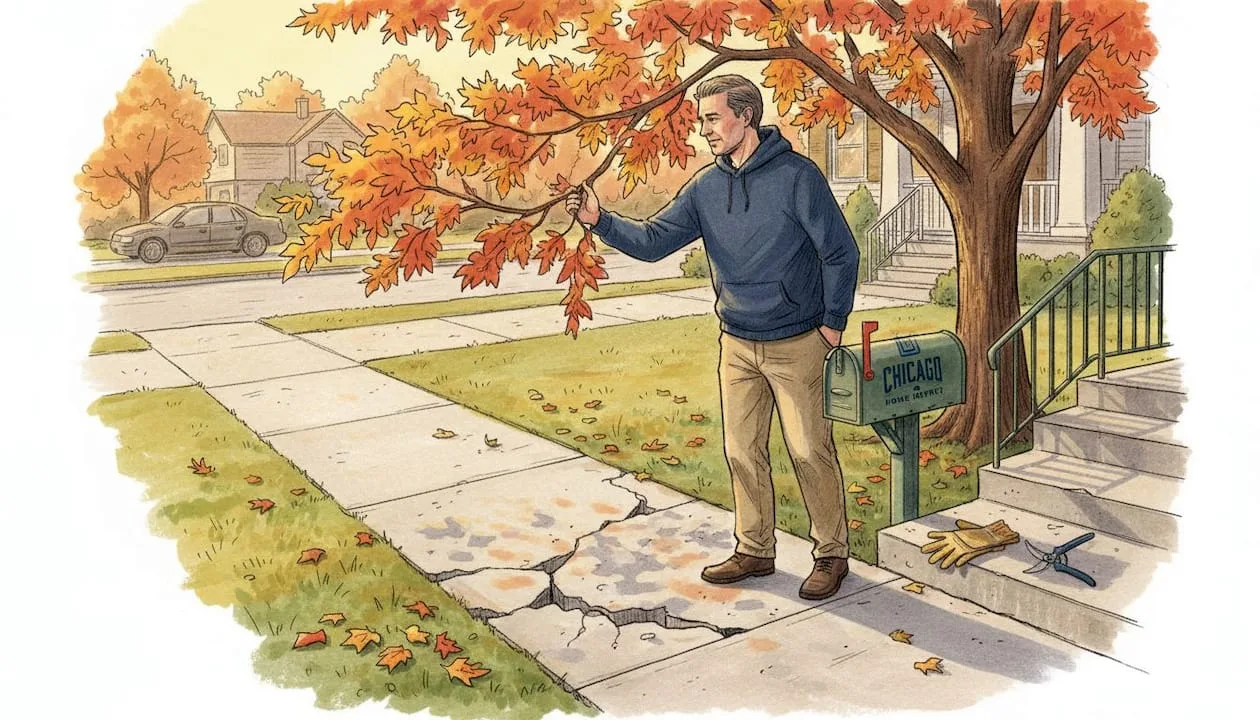
Inspectors assess limbs based on more than just clearance. They’re trained to spot structural problems that signal a limb or entire tree may be at risk of failure. Checking for deadwood, cracks, and root flare issues is standard practice in Chicago-area tree assessments. A dead branch over a driveway or a cracked limb leaning toward a roofline are inspection red flags that don’t require an arborist’s license to notice.
What inspectors typically flag vs. what triggers code violations:
| Condition | Inspection Note | Code Violation Risk |
|---|---|---|
| Limb below 6 ft over sidewalk | Yes, flagged | High |
| Dead branch over structure | Yes, safety note | Low (unless public way) |
| Crack or split at branch union | Yes, structural flag | Low |
| Abnormal lean toward home | Yes, flagged | Low |
| Live limb above clearance height | Generally no | None |
| Tree touching roof or gutters | Yes, flagged | Low |
After a major storm, Chicago has historically issued notices to homeowners whose trees drop limbs onto public sidewalks or block rights-of-way. This means deferred pruning isn’t just a maintenance issue. It’s a liability waiting to happen.
What inspectors check during a tree limb assessment:
- Measure or estimate clearance height over public ways
- Look for deadwood, hanging broken branches, or “widow-makers” lodged in the canopy
- Check for cracks, splits, or co-dominant stems (two trunks growing from one base)
- Assess whether limbs or branches make contact with the roof, gutters, siding, or chimney
- Note any abnormal lean and estimate the fall zone relative to structures
Refer to a maintenance checklist for tree hazards to stay on top of these items between inspection cycles. And if you’re buying and wondering what else might be hiding in plain sight, take a look at overlooked home inspection defects common to Chicago properties.
Pro Tip: Schedule an annual pruning in late fall or early spring. This timing avoids disease transmission, lets you see the branch structure clearly without leaves, and keeps you ahead of any spring code enforcement sweeps in Chicago neighborhoods.
Hidden dangers of tree roots: Plumbing, foundation, and inspection issues
If limbs are the visible problem, roots are the invisible one. They work slowly, silently, and underground, which is why root-related damage often goes undetected until a buyer’s inspection or a costly plumbing emergency forces the issue.
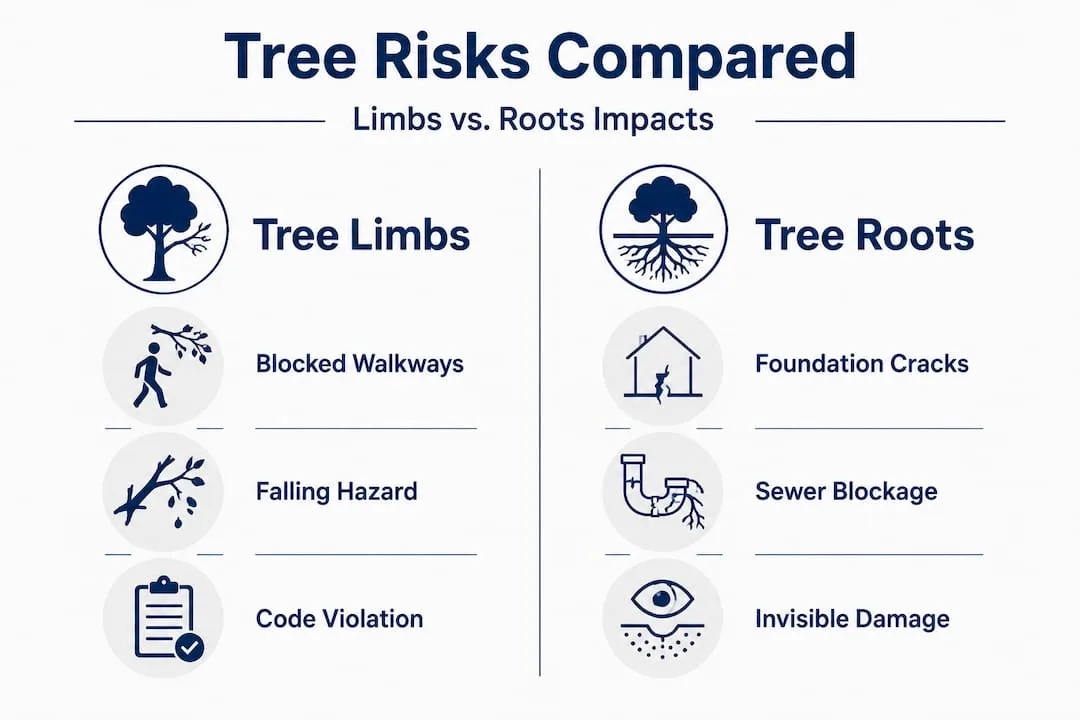
Chicago’s clay soil promotes root intrusion into pipes through shrink-swell cycles and pipe movement that create entry points for roots over time. Chicago’s housing stock includes many homes with clay tile or cast iron sewer laterals that are 50 to 100 years old. These materials are already prone to cracking. Add a nearby tree and cyclically moving soil, and you have a recipe for root infiltration.
Buyers often don’t think to ask about sewer lines during a transaction, but this is one of the highest-value inspections available. A sewer line inspection uses a video camera to look directly into the pipe and identify roots, cracks, offset joints, or blockages. The footage becomes concrete documentation that you can use in negotiations.
Common warning signs of root-related property problems:
- Raised or cracked sidewalk sections near large trees
- Slow drains or recurring sewer back-ups in older homes
- Wet spots in the yard that don’t dry after rain
- Foundation cracks, especially horizontal ones near grade level
- Fungal growth at the base of a tree trunk (sign of internal decay)
- Unexplained low spots in the lawn, which can indicate collapsed pipe sections
“Inspectors commonly check for root flare, girdling roots, and fungal presence as signs of risk during tree assessments.”
Girdling roots (roots that circle the trunk and gradually strangle it) are particularly dangerous because they weaken the tree structurally while also pushing against nearby surfaces. A girdled tree may look healthy for years before it fails suddenly.
Root intrusion risk by tree type and proximity:
| Tree Species | Root Aggression | Safe Distance from Sewer |
|---|---|---|
| Silver maple | Very high | 30 feet or more |
| Cottonwood | Very high | 30 feet or more |
| Willow | High | 25 feet or more |
| Oak | Moderate | 15 to 20 feet |
| Crabapple | Low | 10 feet or more |
If you’re concerned about what foundation cracks might be telling you, read more about when to worry about foundation cracks in Chicago. And for a broader picture of what inspectors regularly find, common inspector findings for Chicago homes includes tree-related items alongside structural and mechanical defects.
When tree-related findings impact negotiations and next steps
Finding tree root or limb issues in an inspection report doesn’t have to derail a transaction. It can actually work in your favor if you approach it correctly.
The first rule is not to assume causation without evidence. Not every foundation crack is caused by roots. Not every slow drain is a root intrusion. Symptom-based diagnosis and expert evaluation are essential before you make repair demands or walk away from a deal. Inspectors will note what they observe, but specialty evaluations like sewer scopes, arborist reports, or structural engineering reviews provide the hard evidence you need.
Steps to take when an inspection reveals potential tree-related issues:
- Read the inspection report carefully and note whether the finding is a suspected concern or a confirmed defect
- Commission a sewer scope inspection if there’s any evidence of root proximity to drain or sewer lines
- Hire a certified arborist for any tree with visible structural problems, girdling roots, or fungal growth
- Document all findings with photos, video, and written reports before making any repair requests
- Use the documented evidence to negotiate repair credits, price reductions, or required remediation before closing
Real-world negotiations over tree root issues are more common than most buyers expect. In one widely discussed case, a seller refusing to clear roots from a sewer became a sticking point that required documented evidence of intrusion to resolve. That’s exactly why video footage from a sewer scope is so valuable. It turns a subjective concern into an objective finding.
Pro Tip: When negotiating root-related sewer repairs, ask for a complete scope report with time-stamped video, not just a verbal summary. That documentation protects you after closing if the same issue recurs and you need warranty or insurance support.
Sellers benefit from this process too. A pre-listing inspection that identifies tree concerns gives you the chance to address them on your own timeline, rather than under pressure during a buyer’s contingency period.
The truth most Chicago homeowners miss about tree roots and limbs
After years of inspecting Chicago homes, here’s what we consistently see: homeowners and buyers tend to either ignore tree risks entirely or panic when they hear the word “roots” in an inspection report. Neither response serves them well.
The reality is that Chicago’s climate and clay soils do amplify certain risks compared to other regions. That’s just a fact of life in this market. But most root and limb problems only become serious when they combine with other factors, things like deferred maintenance, aging pipes, poor drainage, or a crack that’s been ignored for a decade. A healthy property with good drainage and well-maintained trees is far less likely to suffer root intrusion than a property where problems have been building quietly for years.
The biggest mistake we see is blaming trees first. A crack in a foundation wall near a tree isn’t automatically a root problem. A slow drain isn’t automatically root intrusion. Symptom-based diagnosis before assuming trees are the cause saves homeowners real money and prevents unnecessary removals of healthy trees that were innocent bystanders.
What actually works is a consistent, data-driven approach. Schedule annual checkups. Get a sewer scope if you have mature trees near your lateral. Know what your inspection report is actually saying rather than reacting to the most alarming-sounding line item. Learn how Chicago weather wears down homes across all systems, not just trees, so you can prioritize maintenance intelligently.
Trees are assets. Managed properly, they increase property value, reduce energy costs, and make Chicago neighborhoods worth living in. The goal isn’t to remove every large tree near your house. The goal is to understand the actual risks, inspect regularly, and act on evidence rather than assumptions.
Protect your Chicago home: Inspection resources and next steps
If anything in this guide raises questions about your property or a home you’re considering buying, the best next step is a professional inspection by someone who knows Chicago’s specific conditions. At our firm, we’re licensed, insured, InterNACHI Certified, and BBB Accredited, with weekend availability across Chicago and the suburbs. Our inspectors are trained to identify tree-related risks alongside every other system in the home.
Browse interior inspection photo examples and exterior inspection photo examples to get a sense of what a professional inspection report looks like and what real findings look like in Chicago homes. For plumbing-specific concerns related to root intrusion, our plumbing inspection photo examples show exactly what inspectors document. Whether you need a buyer’s pre-purchase inspection, a seller’s pre-listing inspection, a sewer scope, or just a yearly home checkup, we’re ready to help you make confident, evidence-based decisions about your Chicago property.
Frequently asked questions
How do I know if tree roots are damaging my plumbing in Chicago?
Frequent sewer back-ups, slow drains, or findings from a video sewer scope are the most reliable signs of root intrusion. Clay-rich soils promote root intrusion into aging pipes, making these symptoms more common in Chicago than in many other cities.
Is a code violation possible for overhanging tree limbs in Chicago?
Yes, absolutely. Chicago code mandates clearance of 6 feet or higher for limbs extending over sidewalks and public ways, and owners can be cited, particularly after storm events.
Should I remove a large tree near my home before selling?
Not automatically. Symptom-based diagnosis and expert evaluation from a certified arborist or home inspector will tell you whether the tree poses an actual risk or is simply close to the structure without causing harm.
What signs do inspectors look for in tree assessments?
Inspectors check for deadwood, cracks, trunk lean, root issues, fungal growth at the base, and sidewalk displacement as primary indicators of structural tree problems or root activity.