
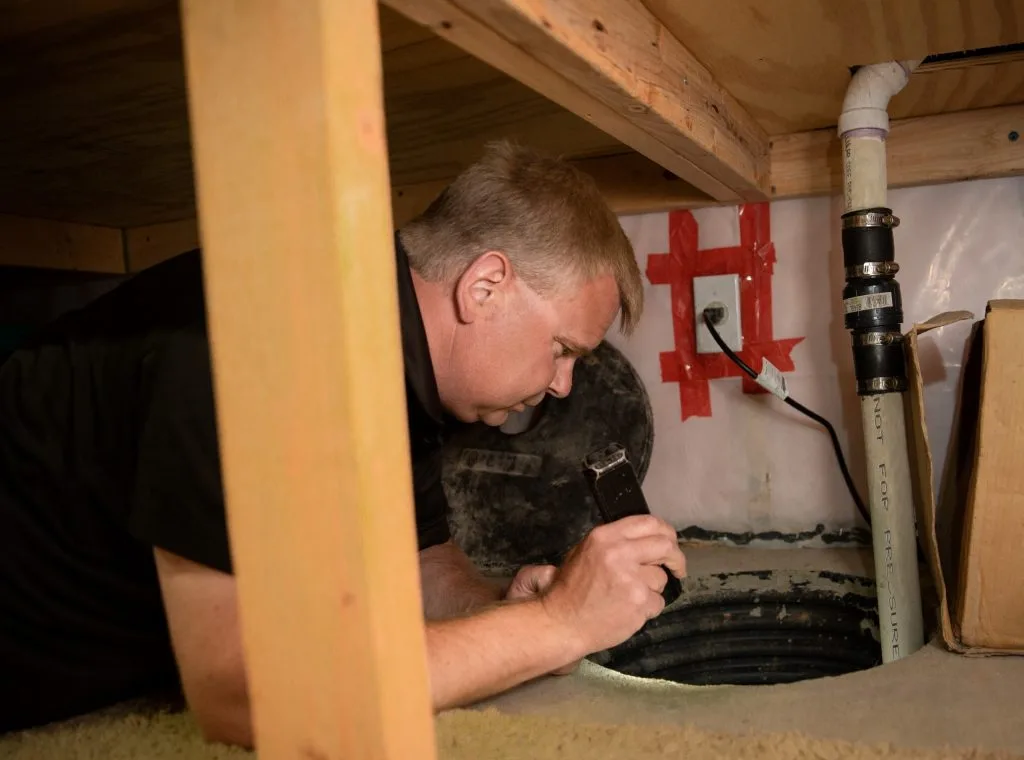
Before your upcoming radon test, we need your help maintaining what’s called closed-building conditions. This page explains what that means, why it matters, and exactly what to do — starting 12 hours before the test begins and continuing through the entire measurement.
Your Timeline at a Glance
12 hours before the test — Closed-building conditions must be in place a full 12 hours before the monitor starts recording.
Test begins (Hour 0) — We place and activate the radon monitor in the lowest livable area of the home.
Throughout the test (typically 48 hours) — Maintain closed conditions the entire time. Normal entry and exit through doors is fine.
What It Means
Radon is a gas that rises from the ground into your home. It mixes with indoor air and, under normal living conditions, settles into a fairly steady level. Closed-building conditions are simply the set of rules that let us measure that steady level accurately.
Leaving a window cracked, running a whole-house fan, or airing out the basement during a test will dilute the radon in the house and give us a result that doesn’t reflect how the home actually breathes day to day. We need a true reading — not a best-case one.
During Closed-Building Conditions
Applies for 12 hours before the test through the end of the test.
✓ Please Do
- Keep all windows closed — every level of the home, including the basement.
- Keep exterior doors closed except for normal, brief entry and exit.
- Run heating and cooling as usual (between 65F and 80F) systems that recirculate indoor air are fine — and encouraged — to reflect normal living conditions.
- Leave any existing radon mitigation system running if one is installed.
- Keep pets and children away from the monitor. Don’t move, cover, or unplug it.
- Come and go normally. You can live in the home during the test — just close the door behind you.
✕ Please Don’t
- Don’t open windows — not even for a few minutes, and not at night.
- Don’t prop open exterior doors for moving, deliveries, pets, or ventilation.
- Don’t run whole-house fans, attic fans, or window A/C units that pull in outside air.
- Don’t use fireplaces or wood stoves. These change pressure in the home and skew results.
- Don’t use bathroom or kitchen exhaust fans for extended periods. Brief, normal use is okay.
- Don’t disturb, move, or tamper with the monitor. Interference is illegal in Illinois and will void the test.
Why Twelve Hours?
Radon levels inside a home fluctuate with the weather, wind, and how much fresh air is moving through. When a home is closed up, radon reaches a stable concentration — a steady state — in roughly 12 hours.
That 12-hour head start before the monitor turns on is what lets a short, 48-hour test tell us something meaningful about what you’d actually be breathing long-term. Skip it, and the number on the report is just a snapshot of a home mid-transition.
These guidelines follow U.S. EPA protocol and the Illinois Emergency Management Agency’s radon testing requirements. Following them protects the accuracy of your test — and, if radon is elevated, your case in any real estate negotiation.
Common Questions
Can I still live in the house during the test? Yes, absolutely. You can cook, shower, sleep, watch TV, and come and go normally. The only change is keeping windows closed and avoiding anything that brings outside air in. Most clients find the test doesn’t affect their routine at all.
What if someone opens a window by accident? Close it as soon as you notice and let us know when we pick up the monitor. A brief mistake usually isn’t enough to invalidate the test, but we’d rather know about it than guess at the data. If the breach was significant, we may recommend retesting.
What about my dog — can I open the door to let them out? Yes. Normal entry and exit is expected and allowed. Just don’t prop the door open or leave a sliding door cracked for pet access during the test.
Can I run the air conditioner? Central A/C that recirculates indoor air — yes, run it as you normally would. Window units that exchange air with the outside — no, please keep those off during the 12 hours before and throughout the test.
The house has a radon mitigation system. Should I turn it off? No — leave it running exactly as it normally operates. We’re testing the home as it functions in daily life, and that includes any active mitigation system.
What if the test needs to be redone? If closed conditions weren’t maintained, a retest is the right call. A bad test helps no one — not you, not the seller, not the buyer. Reach out and we’ll schedule a follow-up.
Questions before or during your test? Contact us anytime.