
TL;DR:
- Air conditioners freeze or short-cycle in summer mainly due to restricted airflow or low refrigerant levels. These issues cause ice buildup on the evaporator coil or rapid compressor cycling, stressing the system and risking costly repairs. Proper maintenance, including filter changes and professional inspections, prevents these problems and extends AC lifespan.
An air conditioner freezes up or short-cycles in summer when restricted airflow or low refrigerant levels disrupt the normal cooling process, causing ice to form on the evaporator coil or forcing the compressor to switch on and off too rapidly. Both problems stress the compressor. A healthy AC run cycle lasts 15–20 minutes; cycles under 10 minutes signal short cycling that accelerates compressor wear. Left unaddressed, what starts as a $200 repair can escalate into a $3,000 compressor replacement. Chicago homeowners in Climate Zone 5 face added risk from wide seasonal temperature swings that make these failures more likely. Chicago Home Inspect LLC sees both problems regularly across bungalows on the Northwest Side and two-flats in Logan Square.
Why your AC freezes up or short-cycles in summer: the core causes
Two root causes drive the majority of AC freezing issues and short cycling events: restricted airflow and low refrigerant. Both prevent the evaporator coil from absorbing heat at the right rate. When the coil cannot absorb enough heat, its surface temperature drops below 32°F and moisture in the air freezes onto it. The ice then blocks airflow further, compounding the problem until the system shuts down or the coil becomes a solid block of ice.
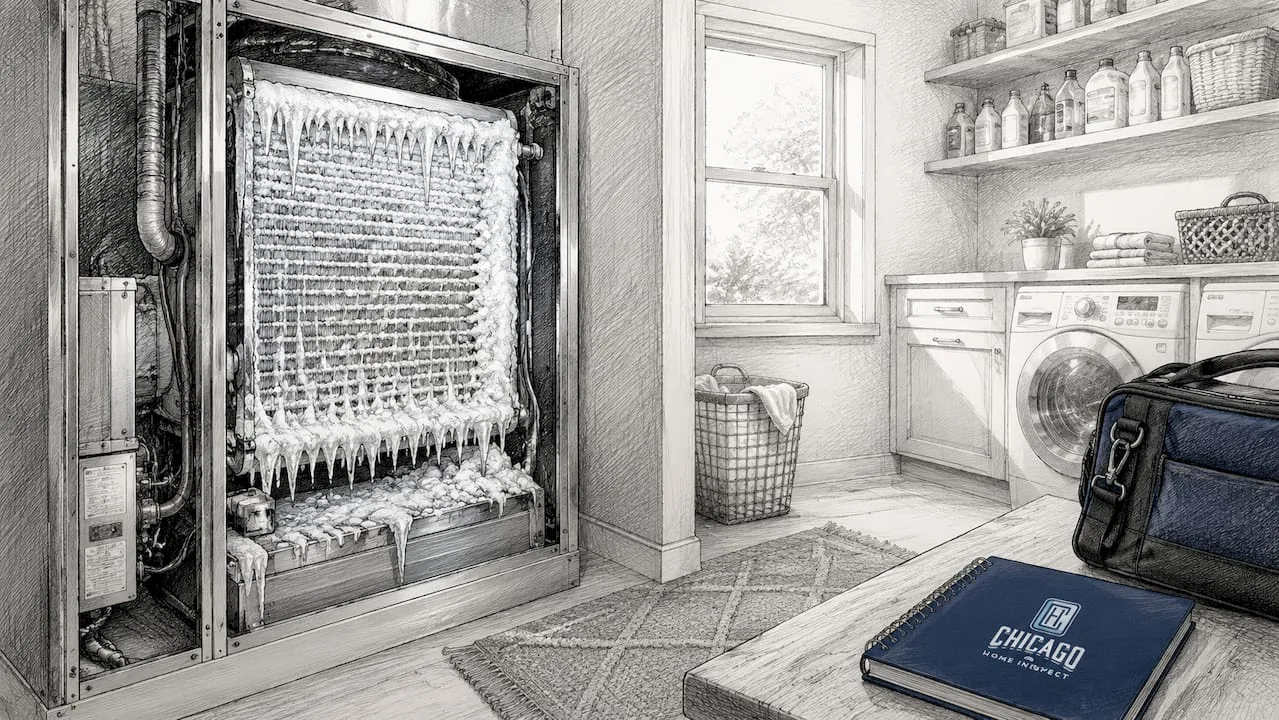
The industry term for the freezing condition is “evaporator coil freeze,” and the term for the rapid on/off pattern is “short cycling.” Understanding both terms matters because each has a distinct fix. Treating the symptom, such as defrosting the coil, without addressing the root cause guarantees the problem returns. Defrosting alone does not fix the underlying cause.
How do airflow problems cause AC freezing and short cycling?
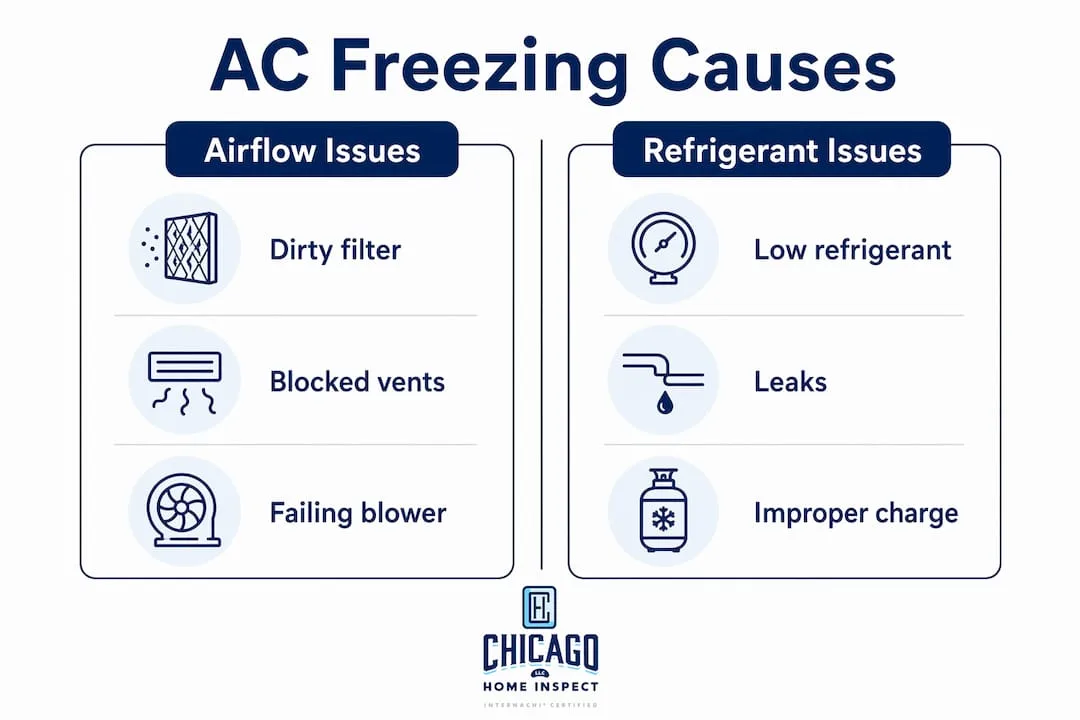
Airflow problems are the most common and most preventable cause of a frozen AC. When air cannot move freely across the evaporator coil, the refrigerant inside the coil stays too cold and the coil surface drops below freezing.
The most frequent airflow culprits include:
- Dirty or clogged air filter. A filter clogged with dust cuts the volume of air reaching the coil. This is the single most common cause of evaporator coil freeze in Chicago homes, particularly in older bungalows with original ductwork.
- Closed or blocked supply vents. Closing vents in unused rooms raises system pressure and reduces total airflow. Many homeowners do this to save energy, but it backfires by starving the coil.
- Failing blower motor. The blower motor pushes air across the coil. A motor running below rated speed delivers less air volume, dropping coil temperatures even when the filter is clean.
- Dirty evaporator coil. A layer of dust or grime on the coil surface acts as insulation. Heat transfer slows, coil temperature falls, and ice forms. Coil cleaning costs $200–$500 and is recommended every 2–3 years.
Reduced airflow also causes short cycling. When the coil ices over, the system loses cooling capacity. The thermostat keeps calling for cooling, the compressor runs briefly, then the safety switch trips and shuts the unit off. The cycle repeats every few minutes, stressing the compressor with each restart.
Pro Tip: Replace your air filter every 30–60 days during peak cooling season. In Chicago’s older housing stock, where ductwork is often undersized, a 1-inch MERV-8 filter strikes the right balance between filtration and airflow.
Why does low refrigerant cause your AC to freeze or short-cycle?
Refrigerant operates in a closed loop. Low refrigerant always indicates a leak, not normal depletion. This distinction matters because simply recharging the system without finding and repairing the leak is a temporary fix that fails within weeks or months.
When refrigerant level drops, pressure inside the evaporator coil falls. Lower pressure means lower boiling point, which drives coil temperatures well below freezing. Ice forms, airflow drops, and the compressor short-cycles trying to compensate.
Signs that point to a refrigerant leak include:
- Ice forming on the copper refrigerant lines running to the outdoor unit
- A hissing or bubbling sound near the indoor air handler
- Weak or warm airflow from supply vents despite the system running
- Higher-than-normal electric bills without a change in usage
Ice on copper lines signals a refrigerant problem, while ice on the coil face typically points to an airflow problem. Knowing which pattern you see helps a technician diagnose the issue faster.
Refrigerant leak repair costs $400–$1,500 depending on leak location and refrigerant type. EPA-certified technicians are required by law to perform leak detection and recharge. A technician who offers to recharge without first locating the leak is not following standard practice. For more on refrigerant safety in your home, the guide on Freon leak risks explains what homeowners need to know.
Pro Tip: Never attempt a DIY refrigerant recharge with a store-bought kit. Without fixing the leak first, the refrigerant escapes again and you have spent money on a problem that is still getting worse.
What other factors cause AC freezing and short cycling?
Beyond airflow and refrigerant, three additional causes account for a meaningful share of AC problems in Chicago homes.
Malfunctioning thermostat
A thermostat that reads temperature incorrectly can call for cooling too often or too briefly. The result is short cycling that has nothing to do with the refrigerant or airflow. Replacing a faulty thermostat costs far less than diagnosing a refrigerant leak, so it is worth ruling out early.
Oversized AC units
An oversized unit cools too quickly, satisfying the thermostat before completing a full dehumidification cycle. The unit shuts off, the space warms slightly, and the cycle repeats every few minutes. The home feels cool but stays humid, and the compressor ages prematurely from the constant starts. This is a frequently overlooked cause of short cycling in Chicago homes where owners have upgraded to larger units without a proper load calculation.
Running the AC when outdoor temperatures drop below 60°F
Chicago’s spring and fall bring days where afternoon temperatures reach the mid-60s and mornings dip into the 50s. Running AC below 60°F outdoor temps causes refrigerant pressure to drop even in a perfectly healthy system. Most residential units lack low-ambient kits designed for these conditions. The result is a freeze-up that looks like a refrigerant problem but resolves once outdoor temperatures rise.
The table below summarizes the main causes, their visible signs, and typical repair costs.
| Cause | Visible sign | Typical repair cost |
|---|---|---|
| Dirty air filter | Ice on coil face, weak airflow | $5–$30 (filter replacement) |
| Dirty evaporator coil | Ice on coil face, reduced cooling | $200–$500 (coil cleaning) |
| Failing blower motor | Weak airflow, no ice on lines | $300–$800 (motor replacement) |
| Refrigerant leak | Ice on copper lines, hissing sound | $400–$1,500 (leak repair and recharge) |
| Oversized unit | Short cycles, high humidity | Varies (system replacement or load recalculation) |
| Low outdoor temperature | Freeze-up in spring or fall | No repair needed; avoid running below 60°F |
Pro Tip: In Chicago, the shoulder seasons of april through may and september through october are the most common times for freeze-ups caused by cold outdoor temperatures. If your AC ices up on a cool morning, turn it off and switch to fan-only mode before calling a technician.
How to prevent AC freezing and short cycling: practical steps
Preventing these problems costs far less than repairing them. The steps below are organized from the simplest to the most involved.
- Turn the system off immediately if you see ice. Running a frozen AC forces liquid refrigerant back into the compressor, which can turn a $200 repair into a $3,000 compressor replacement. Switch to fan-only mode to thaw the coil safely, which typically takes 1–3 hours.
- Replace the air filter every 30–60 days. During Chicago summers, when the system runs daily, a 60-day filter change schedule is the minimum. Homes with pets or older ductwork benefit from monthly changes.
- Check all supply vents and registers. Walk through every room and confirm vents are open and unobstructed by furniture, rugs, or curtains. Closing even two or three vents in a small home can restrict airflow enough to cause freezing.
- Schedule professional coil cleaning every 2–3 years. A technician cleans both the evaporator and condenser coils, checks refrigerant pressure, and inspects the blower motor. This single visit catches most developing problems before they cause a failure.
- Have a technician inspect the blower motor if airflow feels weak. Blower motor replacement costs $300–$800, which is significantly less than the compressor damage that follows if the motor fails completely.
- Call an EPA-certified technician for any suspected refrigerant leak. Do not delay. A leak that goes unrepaired for a full season can damage the compressor beyond economical repair.
For Chicago homeowners dealing with a system that has sat unused over winter, the guide on fixing AC startup issues covers the pre-season checks that prevent the first freeze-up of summer.
Pro Tip: Note your AC’s age before scheduling repairs. Units over 15 years old with a refrigerant leak or failing compressor often cost more to repair than to replace. The guide on AC and furnace age helps you make that call with real numbers.
What we see in Chicago homes: our perspective on AC freeze-ups
We have inspected hundreds of homes across Lake, McHenry, DuPage, and northern Cook Counties, and the pattern is consistent. The homes most likely to have a frozen or short-cycling AC are the ones where deferred maintenance has compounded over several seasons. A dirty filter leads to a dirty coil. A dirty coil leads to a stressed compressor. A stressed compressor leads to a refrigerant leak. By the time the homeowner calls us, what started as a $30 filter change has become a $1,200 repair.
Chicago’s Climate Zone 5 conditions make this worse than in warmer markets. Our freeze-thaw cycles stress refrigerant lines and fittings every spring. Older bungalows and two-flats often have undersized ductwork that was never designed for modern high-efficiency systems. When a homeowner upgrades to a larger unit without adjusting the ductwork, short cycling is almost guaranteed.
The most useful thing we can tell any homeowner is this: the ice is never the problem. The ice is the result of the problem. Fix the airflow, fix the leak, or stop running the system below 60°F, and the ice does not come back. Treating the ice and ignoring the cause is the most expensive mistake we see repeated season after season.
We also see homeowners who are surprised that a home inspection covers HVAC systems in this level of detail. It does. An InterNACHI-certified inspection documents coil condition, blower motor function, refrigerant line condition, and thermostat operation. Catching these issues before a purchase or before a warranty expires saves real money.
— Chicago Home Inspect LLC
How a professional inspection can catch AC problems early
If your AC has frozen up or short-cycled this season, a professional inspection gives you a clear picture of what is actually wrong before you spend money on repairs. Chicago Home Inspect LLC serves Lake, McHenry, DuPage, and northern Cook Counties, with weekend appointments available. Our InterNACHI-certified inspectors document HVAC system conditions in detail, including coil condition, refrigerant line integrity, and blower motor function. The HVAC inspection photo gallery shows exactly what we look for and how we document findings. An inspection report gives you the specific information you need to have an informed conversation with any HVAC technician.
FAQ
What causes an AC to freeze up in summer?
The two primary causes are restricted airflow, from a dirty filter, blocked vents, or a failing blower motor, and low refrigerant from a leak. Both drop evaporator coil temperatures below 32°F, causing moisture to freeze on the coil surface.
How long should an AC run cycle last?
A healthy AC run cycle lasts 15–20 minutes. Cycles under 10 minutes indicate short cycling, which prevents full dehumidification and accelerates compressor wear.
Can I just defrost my AC and keep using it?
Defrosting the coil removes the ice but does not fix the root cause. Without addressing the airflow restriction or refrigerant leak, the coil will freeze again, often within hours.
Why is my AC short cycling even though it cools the house?
An oversized unit can cool the space quickly while still short cycling. The home reaches the set temperature before completing a full dehumidification cycle, leaving the air feeling cool but humid and stressing the compressor with frequent restarts.
When should I call a professional for a frozen AC?
Call a professional if the system refreezes after you have replaced the filter and cleared all vents, if you hear hissing near the air handler, or if you see ice on the copper refrigerant lines. These signs point to a refrigerant leak that requires an EPA-certified technician.