TL;DR:
- Well and septic inspections in Chicago suburbs require separate private assessments beyond county evaluations, which only verify compliance.
- Private inspections evaluate system condition, water quality, and remaining lifespan, helping buyers negotiate repairs or walk away.
If you’re buying a home in the Chicago suburbs with a private well or septic system, there’s a good chance you’ve heard the phrase “county evaluation” and assumed that covers everything. It doesn’t. Well and septic inspections for Chicago suburban buyers involve two separate tracks, and confusing them can leave you owning a system that looks compliant on paper but fails within months. This guide breaks down exactly what each type of inspection covers, what it costs, how to schedule it, and what to do when the results come back with problems.
Table of Contents
- Why well and septic systems matter in Chicago suburbs
- County evaluations vs. private inspections
- Budgeting and timing your inspections
- What to do when inspection results show problems
- Key best practices before you close
- My perspective on getting these inspections right
- Schedule your well and septic inspection with Chicagohomeinspector
- FAQ
Why well and septic systems matter in Chicago suburbs
More homes than most buyers expect in the Chicago metro area sit outside the reach of municipal water and sewer service. Communities in Lake County, McHenry County, and parts of Kane and Will County commonly rely on private wells and septic systems. If you’re looking in areas like Cary, Fox Lake, Wauconda, or rural stretches near Arlington Heights, there’s a real chance the home you’re touring runs on one or both.
These systems handle two of the most fundamental needs in any home: drinking water and waste removal. When they work, you barely notice them. When they fail, the consequences are immediate and expensive.
Common risks with aging systems include:
- Septic tanks that haven’t been pumped in years, leading to drain field saturation
- Well pumps nearing end of life, which typically runs 10 to 15 years
- Cracked or deteriorating tank walls that allow groundwater infiltration
- Bacterial contamination in well water that has no taste or odor but poses serious health risks
- Drain fields failing silently underground, only visible through a dye test or camera inspection
System failures can affect your ability to finance the purchase too. Many lenders, including FHA and USDA loan programs, require proof of safe, functioning systems before closing. A private well and septic inspection that identifies major deficiencies can delay or kill your financing if you don’t address it early.
Pro Tip: Ask the listing agent directly whether the home uses a private well, septic, or both, before you even schedule a general home inspection. This changes your entire inspection strategy and timeline.
County evaluations vs. private inspections
This is where most buyers go wrong. When a real estate listing or agent mentions a “county well and septic evaluation,” many buyers picture a thorough diagnostic check. What they’re actually describing is a compliance screening.
Lake County Health Department evaluations, for example, are limited to a visual review, verification that setbacks from property lines and structures meet code, and an optional water test. That’s it. No digging. No pressure testing of the tank or distribution lines. No evaluation of how much life is left in the drain field. No assessment of pump or alarm functionality.
A property can pass county visual review and still have hidden failures that will cost you tens of thousands of dollars to fix after closing. County health departments perform compliance screenings, not diagnostic inspections. Understanding that distinction is the most important thing you can take away from this article.
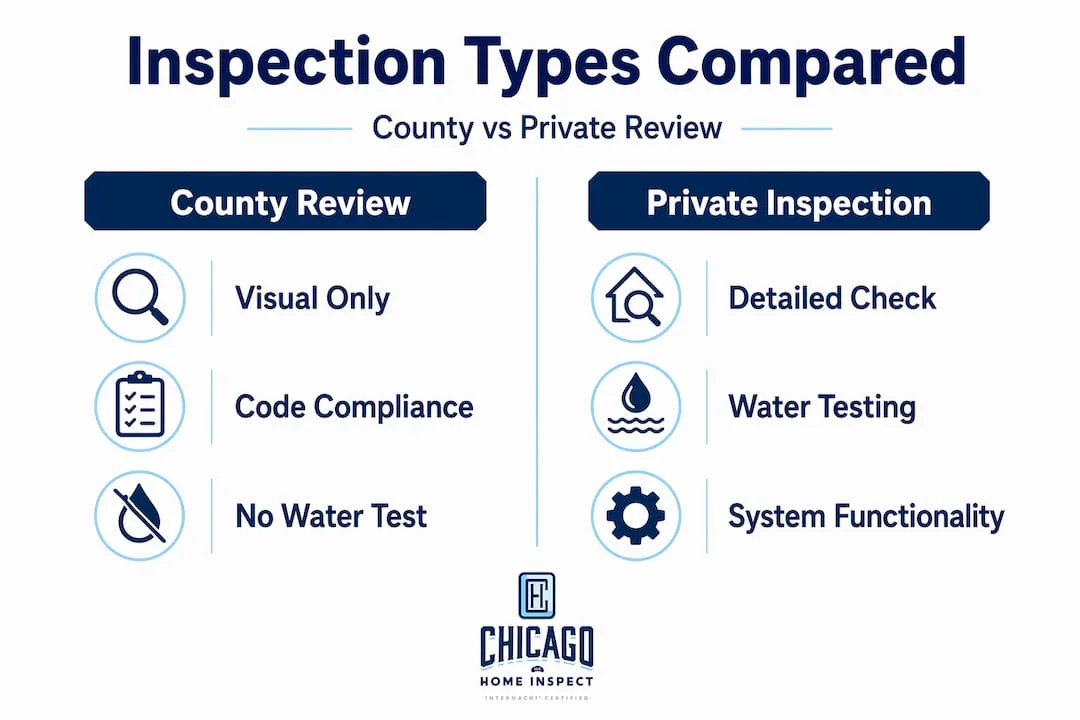
Here’s a direct comparison of what each covers:
| Inspection Element | County Evaluation | Private Inspection |
|---|---|---|
| Visual site review | Yes | Yes |
| Setback verification | Yes | Yes |
| Water quality test (basic) | Optional | Yes (coliform, nitrates) |
| Septic tank condition | No | Yes |
| Drain field evaluation | No | Yes (dye test or camera) |
| Pump and alarm check | No | Yes |
| System lifespan estimate | No | Yes |
| Pressure or load testing | No | Yes |
A private well and septic inspection in Lake County covers the septic tank, distribution box, drain field, pump and alarm systems, and a full water quality panel. It gives you an actual picture of system condition and remaining useful life, not just a compliance checkbox.
Pro Tip: Request copies of any prior county evaluations from the seller, but treat them as a starting point only. Schedule your own private inspection regardless of what those reports say.
Budgeting and timing your inspections
One of the most common mistakes buyers make is treating well and septic inspections as an afterthought. They schedule a general home inspection, feel good about the results, and then scramble to get well and water testing done in the last week before closing. That approach creates real risk.

Here’s what you’re typically looking at for costs in the Chicago area:
| Inspection Type | Estimated Cost |
|---|---|
| Private well water testing | ~$400 |
| Septic tank inspection | ~$184 |
| General home inspection | ~$320 |
| Combined well and septic package | $500 to $700+ |
These figures reflect typical Chicago area inspection costs and can vary based on lab panels, system complexity, and the inspector’s scope. Larger tanks, older systems, or properties requiring camera work will push costs higher.
On timing, this matters more than most buyers realize. Septic inspections often require two to four weeks from ordering to receiving final results when you factor in scheduling, the inspection itself, lab processing for water tests, and report delivery. That’s a significant window inside your typical 45 to 60 day closing timeline.
Schedule your inspections with these priorities in mind:
- Order well and septic inspections during the attorney review period, not after
- Confirm whether your lender requires a county health certification, a private inspection, or both
- Allow extra time if the home has an older system, since follow-up testing may be needed
- Coordinate with your real estate attorney to tie inspection results to a contingency in the contract
- Don’t assume your general home inspection covers these systems, since plumbing and exterior inspections are separate from specialized well and septic evaluations
Pro Tip: Treat well and septic inspections as a parallel track alongside your general home inspection, not a step that follows it. Starting both at the same time keeps your timeline intact.
What to do when inspection results show problems
Getting back a report with red flags doesn’t automatically mean you should walk away. It means you now have information that the seller likely didn’t want you to have until after closing. That’s valuable.
Understanding what different findings actually mean is the first step.
A county certification means the system met minimum visual standards on a given date. As county clearance shows, it satisfies lender requirements but says nothing about system lifespan or hidden condition issues. Use it to clear financing, not to evaluate the system.
For septic findings, watch for these indicators that signal serious problems:
- Wet or soggy areas above the drain field, which suggest saturation or failure
- Sewage odors near the tank or distribution box
- Tanks that haven’t been pumped within the recommended three to five year window
- Deteriorated baffles, cracked lids, or collapsed distribution boxes
- A failed dye or pump test indicating the drain field isn’t accepting effluent
On the well water side, contamination results require immediate action. Cook County public health guidance on boil orders makes clear that water must meet safety standards before it’s safe to consume, and follow-up testing is required after any remediation. Coliform bacteria and nitrate contamination are the most common findings. They can often be addressed with well disinfection or filtration, but some situations require well replacement.
If your inspection turns up significant deficiencies, your options include:
- Requesting the seller repair or replace the system before closing
- Negotiating a price reduction to cover your estimated repair costs
- Requiring the seller to escrow funds for work that can’t be completed before closing
- Walking away entirely if costly repairs or replacements make the deal unworkable
Your real estate attorney is your best ally here. Make sure any inspection contingency language is specific about what findings trigger your right to renegotiate or exit the contract.
Key best practices before you close
Getting this right comes down to a few decisions that are easy to make once you understand the stakes.
- Never assume county sign-off equals a healthy system. County evaluations check for compliance, not condition. They are a floor, not a ceiling.
- Always hire a private inspector for a full performance evaluation. This includes the tank, drain field, pump, alarm, and a water quality test covering coliform and nitrates at minimum.
- Verify what your lender actually requires. FHA and conventional loans have different standards. Some lenders accept a county health certification while others require a private inspection report.
- Budget for both the inspection and potential repairs. A $184 septic inspection might reveal a $15,000 drain field replacement. Knowing that before closing is worth every penny.
- Follow local health department guidance on water safety. Cook County and Lake County both publish clear protocols for well water testing and contamination response. If you get a positive coliform result, follow the prescribed disinfection and retesting steps before using the water.
Pro Tip: Ask your inspector specifically whether the water test panel includes nitrates, not just coliform. Nitrate contamination from agricultural runoff is common in certain suburban and rural areas of Illinois and doesn’t show up on basic bacterial tests.
My perspective on getting these inspections right
I’ve reviewed enough inspection reports over the years to tell you that the buyers who get burned are almost never the ones who asked too many questions. They’re the ones who trusted a county sticker and a seller’s disclosure and called it done.
In my experience, the Lake County and McHenry County markets are where I see this play out most often. A home has sat on the market for a few months, the county evaluation came back fine, and the buyer skips the private inspection to save $500 and speed up the closing. Six months later, the drain field is gone and they’re staring at a five-figure bill.
What I’ve found actually helps buyers is reframing these inspections as leverage, not obstacles. When you know the true condition of the system, you negotiate from a position of knowledge. You can price in the repair cost, require the seller to fix it, or make an informed decision to walk. That’s power.
The buyers who treat well and septic inspections as a formality are the same ones who call their agents in a panic six months after moving in. The ones who insist on thorough private inspections, get their water tested properly, and loop in their attorney early tend to close with confidence and rarely have surprises.
Approach these inspections the way you’d approach any other significant financial decision: get the real information, understand what it means, and then decide.
Schedule your well and septic inspection with Chicagohomeinspector
If you’re buying a home in the Chicago suburbs and need trusted, thorough inspection services, Chicagohomeinspector is the team to call. Chicago Home Inspect LLC is InterNACHI Certified, BBB Accredited, and licensed to serve buyers across the Chicago metro and surrounding suburbs, including Arlington Heights, Lake County, McHenry County, and beyond.
Chicagohomeinspector offers pre-purchase inspections in Arlington Heights and the broader Chicago area, with scheduling available on weekends to fit your buying timeline. Beyond well and septic coordination, the team covers plumbing, HVAC, roofing, mold testing, and radon testing under one roof. You can browse plumbing inspection photos to see the level of detail that goes into every report.
Contact Chicagohomeinspector early in your attorney review period so inspections can run in parallel with your contract timeline. The earlier you schedule, the more negotiating room you protect.
FAQ
What do well and septic inspections cover for Chicago suburban buyers?
A private well and septic inspection covers the septic tank condition, drain field performance, pump and alarm systems, and well water quality testing for contaminants like coliform bacteria and nitrates. This goes well beyond what a county health department evaluation includes.
How much do well and septic inspections cost in the Chicago area?
In the Chicago suburbs, well water testing runs around $400 and septic inspections run approximately $184, though combined packages and more complex systems will cost more.
How long does the well and septic inspection process take?
From ordering to receiving final results, the full process typically takes two to four weeks, including scheduling, the inspection itself, and lab processing for water tests.
Does a county health department approval mean the system is in good condition?
No. County evaluations check for code compliance through a visual review only. A property can pass county review and still have serious hidden problems that only a private inspection would catch.
What happens if the inspection finds contamination in my well water?
Follow your local health department’s protocols immediately. Cook County’s boil order guidance requires retesting after disinfection before water is considered safe. Depending on the contamination source, solutions range from shock chlorination to full well replacement.