TL;DR:
- Storm chaser roofing scams involve out-of-town contractors pressuring homeowners into quick contracts with subpar work or no shows.
- Homeowners should use the FTC Cooling-Off Rule within three days and verify contractor licenses before signing any agreement.
Storm chaser roofing scams are defined as schemes where out-of-town contractors flood hail-damaged neighborhoods, pressure homeowners into signing contracts immediately, and then deliver substandard work or disappear entirely. Chicago-area homeowners face this threat after every major hail event, from the Northwest Side bungalows to the two-flats in Logan Square. The FTC Cooling-Off Rule gives you three business days to cancel any home-improvement contract signed at your residence, which is one of your strongest legal tools. Knowing the warning signs before you sign is the difference between a solid repair and a costly mistake.
What are the common red flags of a storm chaser roofing scam?
Storm chasers rely on urgency. Their entire business model depends on getting your signature before you slow down and think. Recognizing the tactics they use is the fastest way to protect yourself.
The most common warning signs include:
- Pressure to sign immediately. A contractor who shows up at your door within hours of a storm and insists the deal expires today is using a classic high-pressure tactic. Legitimate roofers do not manufacture deadlines.
- Large upfront deposits. Requests for 25–30% or more before work begins are a primary fraud indicator. Contractors who collect large deposits and then disappear are one of the most reported scam patterns.
- Offers to waive your deductible. Absorbing your deductible is insurance fraud. Both you and the contractor face legal liability if this arrangement is discovered.
- Bait-and-switch pricing. A suspiciously low initial quote that balloons into a much larger final bill is a documented scam pattern. Contracts must specify the full scope and total price to prevent mid-project price increases.
- Copycat business names. Scammers use names similar to reputable local companies to build false trust. Always verify the physical address and contact information against official licensing records.
One nuance worth knowing: a contractor knocking on your door or offering a free inspection is not automatically a red flag. Door-to-door outreach can be legitimate. What matters is the contractor’s license, the contract terms, and how they conduct themselves throughout the process.
Pro Tip: Before any contractor sets foot on your roof, ask for their Illinois contractor license number and verify it directly with the Illinois Department of Financial and Professional Regulation. Here is how to use the Chicago contractor license lookup for other trades.
What legal protections do Chicago homeowners have after signing?
Chicago homeowners have real legal tools available, and using them correctly requires knowing the exact steps.
- Invoke the FTC Cooling-Off Rule. The FTC Cooling-Off Rule grants you three business days to cancel any home-improvement contract signed at your home. This applies even if you felt pressured at the time of signing.
- Cancel in writing via certified mail. Verbal cancellation does not suffice legally. Send your cancellation letter by certified mail with a return receipt so you have documented proof of the date and delivery.
- Verify contractor licensing. Illinois requires roofing contractors to carry proper licensing and insurance. Check credentials through the Illinois Department of Financial and Professional Regulation before any work begins.
- Avoid signing Assignment of Benefits forms. An AOB form transfers your insurance claim rights directly to the contractor. Signing an AOB removes your ability to monitor costs and dispute inflated charges with your insurer.
- Review every contract line by line. Confirm that the scope of work, materials, total price, and warranty terms are written out in full. Any blank spaces in a contract are a serious warning sign.
The three-day cancellation window is shorter than most homeowners realize. If you signed under pressure and have doubts, act the same day.
Pro Tip: Keep a copy of your certified mail receipt and the cancellation letter together in a folder with all other contract documents. If a dispute arises, that paper trail is your strongest defense.
How can you vet and choose a trustworthy roofing contractor?
Choosing the right contractor after hail damage requires a structured approach, not a gut feeling. The steps below apply whether you are dealing with a Chicago bungalow on the Northwest Side or a frame home in the northern Cook County suburbs.

| Vetting Step | What to Check | Why It Matters |
|---|---|---|
| License and insurance | Illinois IDFPR license number, general liability, workers’ comp | Protects you from liability and ensures legal compliance |
| Physical presence | Local office address, not just a phone number | Out-of-town contractors have no long-term accountability |
| Written estimates | Get at least three from separate contractors | Reveals fair market pricing and scope differences |
| BBB and reviews | BBB accreditation, Google reviews, references | Shows track record with real customers |
| Contract terms | Full scope, materials, price, and warranty in writing | Prevents bait-and-switch and mid-project disputes |
| Payment terms | No full payment upfront, no cash-only demands | Protects you if work is incomplete or substandard |
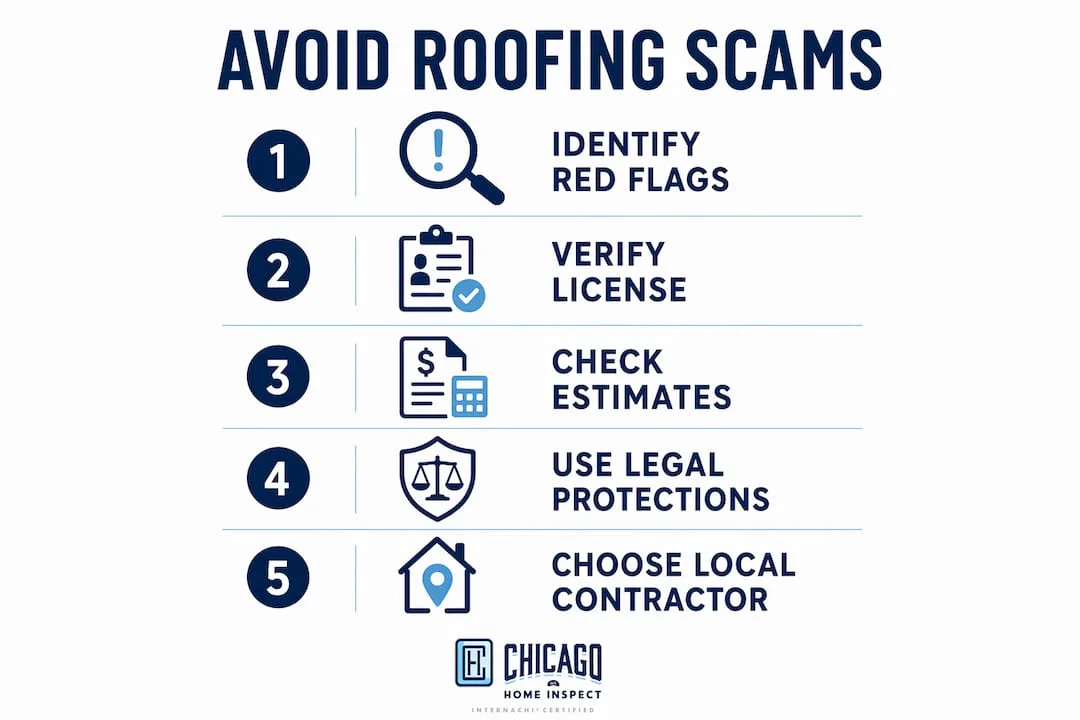
Local contractors are more likely to honor warranties and address defects over time because their reputation depends on it. An out-of-town storm chaser has no community stake in your neighborhood and no reason to return if problems develop six months later.
Getting three written estimates is not just about finding the lowest price. It reveals whether one contractor is dramatically underbidding (a bait-and-switch setup) or dramatically overbidding. The middle estimates usually reflect actual market rates for your area. You can also use our roof damage identification guide to understand what legitimate hail damage looks like before any contractor walks your property.
How does the insurance claims process interact with roofing scams?
The insurance claim process is where storm chasers cause the most financial harm. Understanding your rights here protects both your wallet and your coverage.
Key facts every Chicago homeowner should know:
- Contractors are not authorized to negotiate your claim. Homeowners should control the claim process and communicate directly with their insurer. A contractor who insists on “handling everything” is overstepping their role.
- Deductible absorption is fraud. When a contractor offers to cover your deductible, they typically inflate the claim to your insurer to recover that cost. This exposes you to policy cancellation and potential legal consequences.
- Notify your insurer directly. Contact your insurance company as soon as possible after a hail event. Do not let a contractor make that first call on your behalf.
- Avoid AOB forms. Signing an Assignment of Benefits transfers control of your claim to the contractor. Once signed, you lose the ability to dispute costs or redirect the repair process.
- Document everything yourself. Photograph your roof and any visible damage before any contractor arrives. This protects you if a contractor later claims damage that was not there.
Understanding how to negotiate with your insurer directly is a skill worth developing. Homeowners who manage their own claims consistently report better outcomes than those who hand control to a third party.
Pro Tip: Ask your insurer to send their own adjuster before you agree to any contractor’s scope of work. The adjuster’s report becomes the baseline for what your policy will cover, and it limits a contractor’s ability to inflate the claim.
What risks do Chicago’s climate and building types add to hail damage repairs?
Chicago’s weather creates roofing challenges that out-of-town contractors routinely underestimate. The city’s freeze-thaw cycles, which can occur dozens of times each winter, accelerate roof aging and turn minor hail damage into major structural problems if repairs are done incorrectly.
Storm chasers often lack knowledge of local building codes and the specific roofing demands that Chicago’s Climate Zone 5 environment creates. A contractor from out of state may install materials rated for milder climates, which fail within a season or two under Chicago conditions. That failure voids your warranty and leaves you paying for a second repair.
Chicago’s housing stock adds another layer of complexity. Older bungalows on the Northwest Side, two-flats in Logan Square, and graystones in Lincoln Park often have aging underlayment, original flashing, and non-standard roof pitches. A fast-moving storm chaser is unlikely to inspect these details carefully. The result is a surface-level repair that looks fine in october but leaks by february when ice dams form.
Local contractors who work in Chicago year-round understand these building types and the city’s permit requirements. They also carry the right insurance for Illinois, which matters if a worker is injured on your property during repairs.
Pro Tip: Ask any contractor bidding on your roof whether they have completed work on homes of similar age and construction in your specific Chicago neighborhood. A contractor who cannot name a single local reference should not be on your shortlist.
What we have seen after hail events in Chicago
We have inspected roofs across Lake, McHenry, DuPage, and northern Cook Counties after major hail events, and the pattern is consistent. Homeowners who slow down and get an independent inspection before signing any contract almost always end up with better outcomes. Those who sign the same day a storm chaser knocks on their door frequently discover later that the work was incomplete, the materials were substandard, or the contractor is unreachable.
The most damaging cases we have seen involve homeowners who signed AOB forms without understanding what they were giving up. Once that form is signed, the homeowner is effectively removed from their own claim. We have seen families in Waukegan and Schaumburg spend months trying to reverse that decision, often with limited success.
Our position is straightforward: get an independent inspection before you commit to any contractor. Not because every contractor is dishonest, but because you deserve verified information before you spend thousands of dollars on your home. Slowing down and documenting everything reduces the influence of high-pressure tactics and produces better claim outcomes. That is not a theory. It is what we observe repeatedly in the field.
Trustworthy repairs preserve your property value and your peace of mind. A roof done right the first time, with proper materials and permits, protects a Chicago home through decades of freeze-thaw cycles. A rushed repair by an out-of-town contractor often costs more in the long run than the original damage would have.
— Chicago Home Inspect LLC
How Chicago Home Inspect LLC helps you avoid roofing scams
Before you sign any roofing contract, an independent inspection from Chicago Home Inspect LLC gives you verified documentation of what damage actually exists. Our residential home inspection services include detailed photos and written reports that you can use directly with your insurance adjuster, giving you an accurate baseline before any contractor enters the picture. We serve Lake, McHenry, DuPage, and northern Cook Counties, with weekend availability so you do not have to wait. Our exterior inspection photo documentation creates a clear record of roof and exterior conditions that protects you throughout the repair and claims process. Schedule before you sign.
FAQ
What is the FTC Cooling-Off Rule for roofing contracts?
The FTC Cooling-Off Rule gives homeowners three business days to cancel a home-improvement contract signed at their residence. Cancellation must be submitted in writing via certified mail to be legally effective.
Is it illegal for a roofer to waive my insurance deductible?
Yes. Waiving or absorbing a homeowner’s insurance deductible is insurance fraud under Illinois law. Both the contractor and the homeowner can face legal consequences if this arrangement is discovered by the insurer.
What is an Assignment of Benefits form and should I sign one?
An Assignment of Benefits (AOB) form transfers your insurance claim rights to the contractor. Signing one removes your ability to monitor costs or dispute inflated charges, so avoid signing any AOB without consulting an attorney first.
How do I verify a roofing contractor’s license in Illinois?
Check the contractor’s license number through the Illinois Department of Financial and Professional Regulation’s online license lookup tool. Confirm that both the license and their insurance certificates are current before any work begins.
How many estimates should I get after hail damage?
Get at least three written estimates from separate contractors. Multiple estimates reveal the fair market price range for your repair and help you identify bids that are suspiciously low or inflated.