
TL;DR:
- The age of HVAC systems in Chicago homes significantly affects their lifespan due to harsh weather conditions. Regular inspections, maintenance, and understanding manufacturer age codes help determine when replacement is necessary. Proactive monitoring and timely repairs can prevent costly emergencies and improve energy efficiency over time.
That furnace humming away in the basement might look perfectly fine. But if it’s 18 years old, sitting through its 18th Chicago winter, and nobody’s touched it since the Clinton administration, you’re one cold snap away from a $5,000 emergency replacement. HVAC age is one of the most misread factors in any home purchase or ownership decision, and the mistake isn’t just ignoring it entirely. It’s assuming a system is fine simply because it hasn’t broken down yet. Here’s what you actually need to know.
Table of Contents
- Why AC and furnace age matters in Chicago homes
- How inspectors determine system age: AC and furnace decoding
- Too old or just aging? Lifespan benchmarks vs. red flags
- What to do with an older AC or furnace: repair, budget, or replace?
- Why our industry still gets it wrong: lessons from Chicago inspections
- Take the next step: get a professional HVAC inspection before you decide
- Frequently asked questions
Key Takeaways
| Point | Details |
|---|---|
| Know your system’s age | Finding out how old your AC and furnace really are is key to smart home decisions. |
| Don’t trust age alone | Warning signs and repair costs matter as much as the years—combine for true risk assessment. |
| Mid-life checks prevent surprises | Start inspections and budgeting at 10 years for AC, 15 for furnace to plan ahead. |
| Take action, not just notes | When aging HVAC units show issues, act now to avoid bigger bills and headaches later. |
Why AC and furnace age matters in Chicago homes
Chicago doesn’t play nice with heating and cooling equipment. Summers regularly push into the 90s with brutal humidity, while winters can drop below zero for days at a time. That means your central AC and furnace aren’t just working hard in one season. They’re getting hammered twice a year, every year. That how Chicago weather affects HVAC equipment lifespan is a very real factor, and it’s why age benchmarks matter more here than in, say, Phoenix or Miami where systems handle only one extreme.
Here’s the basic framework every Chicago homeowner and buyer should memorize:
- Central air conditioners: Typical lifespan is 10 to 15 years
- Gas furnaces: Typical lifespan is 15 to 20 years
- Heat pumps: Typically 10 to 15 years depending on usage
- Boilers: Often last 20 to 30 years with proper maintenance
Several factors affect HVAC lifespan beyond age alone, including installation quality, maintenance frequency, refrigerant type, and how heavily the system has been used over the years.
Waiting for a total breakdown to act is an expensive strategy. Emergency HVAC replacements in the middle of a July heat wave or a January polar vortex cost significantly more than planned replacements. Contractors charge premium rates for emergency service calls, and supply chain delays can leave you without heat or cooling for days. An older system also burns more energy. According to the U.S. Department of Energy, replacing a 20-year-old furnace with a modern high-efficiency unit can cut heating costs by up to 30 percent.
You should start budgeting and monitoring when you approach the middle of the typical lifespan ranges: around 7 years for an AC unit, and around 10 years for a furnace. That’s when problems start quietly developing, and that’s when a professional eye matters most.
Pro Tip: Schedule a dedicated HVAC inspection at the midpoint of your system’s expected lifespan. Catching a failing capacitor or cracked heat exchanger at year 8 is far cheaper than replacing an entire system at year 13 under emergency conditions.
How inspectors determine system age: AC and furnace decoding
Most homeowners and buyers don’t realize there’s a gap between the model year of an HVAC unit and when it was actually installed in the home. A furnace manufactured in 2010 might have sat in a warehouse for a year before being installed in 2011. The installation year is what matters for your practical lifespan calculation. Inspectors cross-check manufacturer data plates and serial numbers against known age codes to get the real picture.
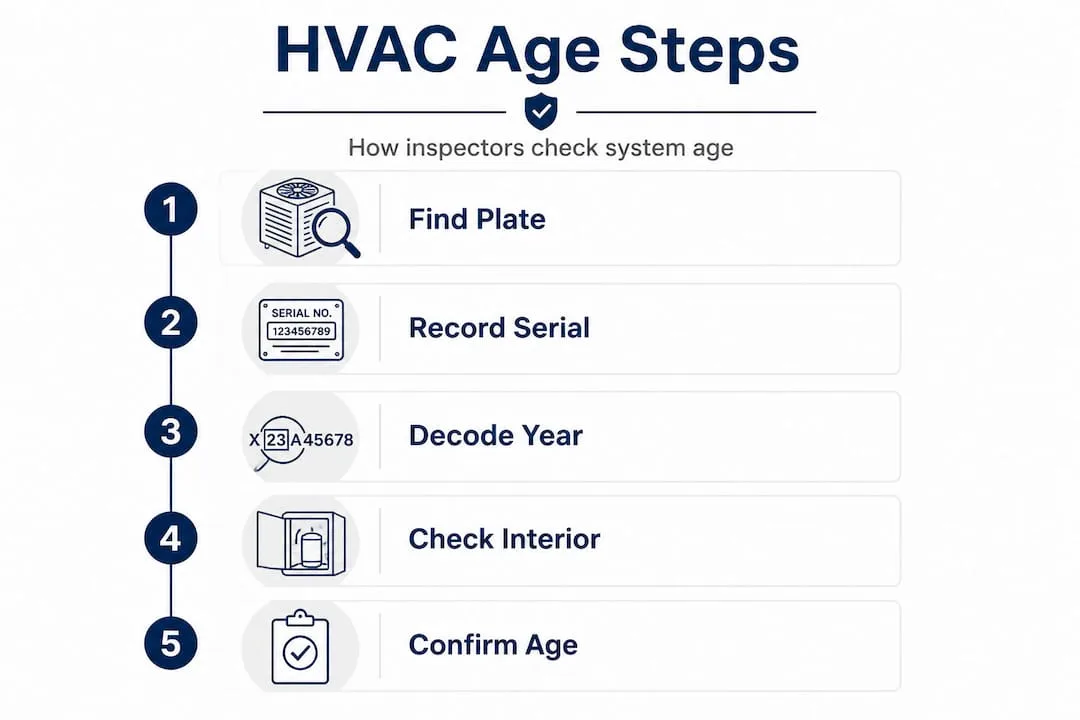
Here’s the step-by-step process a trained inspector uses, and what you can do yourself:
- Locate the data plate. Every AC condenser (the outdoor unit) and furnace has a metal data plate, usually on the side or back of the unit. This plate includes the model number, serial number, and sometimes a manufacture date.
- Decode the serial number. Most manufacturers embed the year and sometimes the week or month of manufacture into the serial number using a specific pattern. For example, a Carrier serial number starting with “4900” means it was manufactured in the 49th week of 2000.
- Use a brand-specific decoder. Different brands use different encoding methods. Below is a quick reference table for brands common in Chicago-area homes.
- Check service stickers and inspection tags. Many HVAC technicians leave stickers inside the furnace cabinet or on the AC unit each time they service the system. These stickers show dates and can help you build a maintenance history even when the data plate is faded.
- Review permit records. The City of Chicago and most suburbs require permits for HVAC installations. These records are often public and can confirm when a system was put in.
Want to skip the decoding? Take a photo of the data plate and drop it into our free Appliance Age Checker. It reads the model and serial numbers, decodes the build date against the same manufacturer database we use on our own inspections, and checks the model against U.S. CPSC recall notices.
| Brand | Where age info appears | Decoding method |
|---|---|---|
| Carrier / Bryant | First 4 digits of serial | Week + year (e.g., 4900 = week 49, year 2000) |
| Lennox | Letters in serial number | Month + year letter code |
| Trane / American Standard | First 2 digits of serial | Year of manufacture |
| Rheem / Ruud | Digits 3 and 4 of serial | Year of manufacture |
| York | Second letter of serial | Decade + year letter code |
| Goodman / Amana | First 4 digits of serial | Year + week |
You can also find HVAC inspection photos from real Chicago inspections to see exactly what a data plate looks like and how inspectors document what they find. Understanding home inspector protocols gives you a clearer picture of what’s being evaluated during the visit.
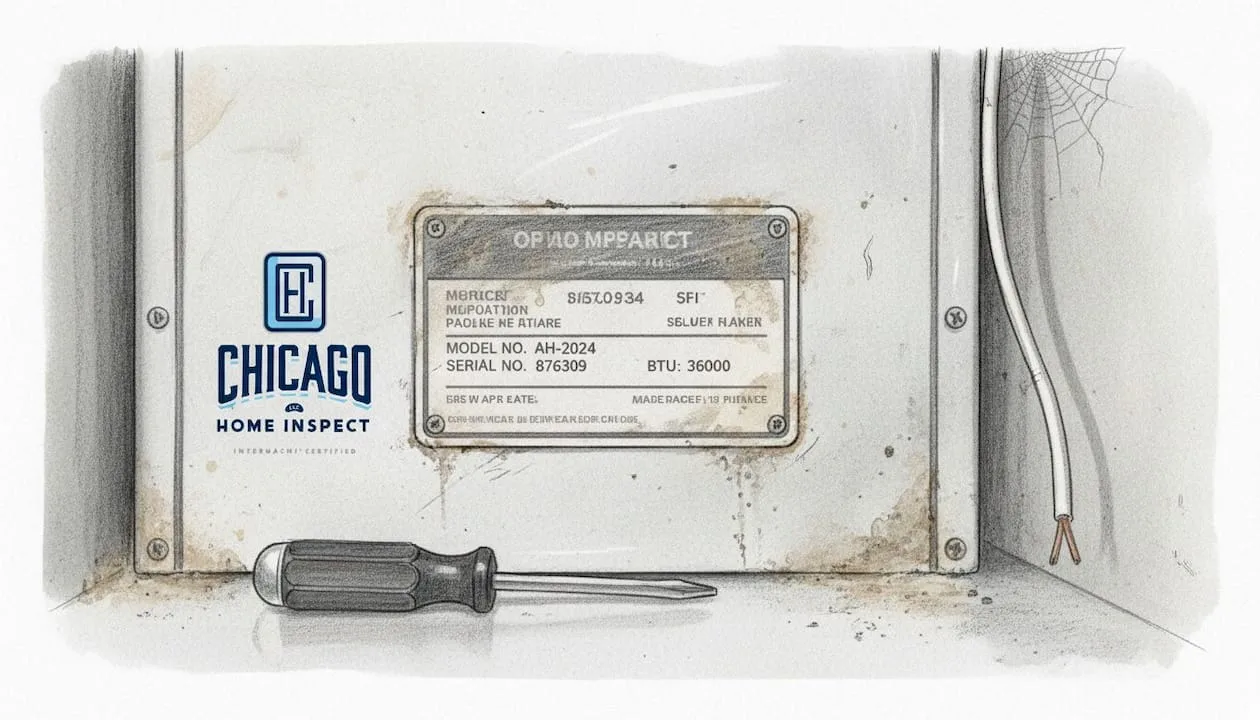
A thorough HVAC inspection checklist covers much more than age, including airflow, electrical connections, heat exchanger condition, refrigerant levels, and thermostat calibration.
Pro Tip: If the data plate is missing or unreadable, look inside the furnace cabinet for a manufactured date stamped on internal components like the blower motor. Some contractors also write the install date in marker on the inside of the cabinet door.
Too old or just aging? Lifespan benchmarks vs. red flags
Here’s where most people get confused. Age is a starting point, not a verdict. A 14-year-old AC unit that’s been serviced annually, hasn’t needed major repairs, and runs efficiently isn’t automatically a liability. Meanwhile, a 9-year-old furnace that’s been neglected, repaired three times in two years, and is making banging noises is a serious problem. Understanding the difference between a system that’s simply older and one that’s genuinely at risk helps you decide what to do next.
| System | Typical lifespan | “Monitor closely” zone | “Replace soon” zone |
|---|---|---|---|
| Central AC | 10 to 15 years | 8 to 12 years | 13+ years with issues |
| Gas furnace | 15 to 20 years | 12 to 16 years | 17+ years with issues |
| Heat pump | 10 to 15 years | 8 to 12 years | 13+ years with issues |
| Boiler | 20 to 30 years | 18 to 25 years | 25+ years with issues |
The red flags that push a system from “aging” into “replace now” territory are specific. Watch for these warning signs:
- Loud, unusual noises like banging, rattling, or squealing during operation
- Visible rust, cracks, or corrosion on the heat exchanger (a serious safety issue for gas furnaces)
- Refrigerant leaks or repeated need to “recharge” the AC system
- Uneven heating or cooling throughout the home despite running constantly
- Energy bills that have risen noticeably without a change in usage habits
- A system that’s been repaired more than twice in the past two years
- Yellow or flickering flame on a gas furnace (should be steady blue)
You can review common HVAC problems that Chicago inspectors find during home evaluations to get a stronger sense of what “at risk” actually looks like.
“Replace when combined with warning signs and/or repair-cost pain points. Otherwise you risk paying for repeated failures late in the life cycle.”
That’s the key framing. A working air conditioner assessment guide asks two questions at once: How old is this system, and what is it showing me right now? Both answers together tell the real story.
Must replace immediately:
- Heat exchanger is cracked (carbon monoxide risk)
- System is past expected lifespan AND showing multiple warning signs
- Repair cost exceeds 50 percent of a new unit’s cost
- R-22 refrigerant system (phased out as of 2020, parts and refrigerant are now extremely expensive)
Monitor closely:
- System is in the “mid-life” zone with no warning signs
- One minor repair in the past year
- Energy bills have held steady or increased slightly
- System passes a professional inspection with only minor notes
What to do with an older AC or furnace: repair, budget, or replace?
Finding out during a home inspection that the furnace is 16 years old or the AC is 13 years old doesn’t mean you should walk away from the deal or immediately call for a replacement quote. What it does mean is that you need a clear, level-headed action plan. By taking an informed approach, you avoid major surprises and costly mistakes in your home purchase or ownership journey.
Here’s how to move forward depending on your situation:
- Get the inspection report in writing. Your home inspector should document the system’s age, condition, and any observed issues with photos and notes. This report is your starting point for every conversation that follows.
- Request a separate HVAC contractor quote. If the inspection flags concerns, bring in an independent HVAC contractor to provide a repair or replacement estimate. This gives you a real number to work with.
- Apply the 50 percent rule. If the cost to repair the system exceeds 50 percent of what a new unit would cost, replacement is almost always the better financial decision. This is especially true for systems already near or past their expected lifespan.
- Negotiate as a buyer. If you’re purchasing a home and the inspection reveals a system that’s aging with issues, use the inspection report to negotiate. You can request a price reduction, a seller credit toward replacement, or ask the seller to replace the unit before closing.
- Build it into your ownership budget. If you’re the current owner and the system is in the “monitor closely” zone, set aside money now. A furnace replacement in the Chicago area typically runs $3,000 to $7,000 depending on size and efficiency rating. An AC replacement often runs $4,000 to $8,000. Knowing this ahead of time means you’re never caught off guard.
Hidden HVAC issues are among the most expensive surprises a homeowner or buyer can face, which is exactly why a professional inspection before any major decision is worth every dollar.
HVAC preventative maintenance tips can meaningfully extend a system’s useful life when followed consistently, including annual tune-ups, regular filter changes, and keeping the area around outdoor units clear of debris.
As Homes.com’s guidance makes clear, paying for repeated failures late in a system’s life cycle costs far more than a single planned replacement at the right time.
Pro Tip: In Chicago, plan your HVAC decisions in the shoulder seasons, spring for AC and fall for furnaces. Contractors are less busy, prices are often lower, and you have time to compare quotes without the pressure of an active heat wave or cold snap.
Why our industry still gets it wrong: lessons from Chicago inspections
Here’s something we’ve learned from hundreds of inspections across Chicago and the suburbs: the “replace at X years” rule causes as many problems as it prevents. We’ve inspected 20-year-old furnaces that were running cleanly, efficiently, and safely because a diligent owner had them serviced every single year. We’ve also walked into homes with 10-year-old AC systems that were clearly on their last legs because of poor installation, no maintenance, and years of Chicago weather doing their work unchecked.
The industry often defaults to simple age thresholds because they’re easy to communicate and easy to act on. But they miss context. Maintenance history matters enormously. Installation quality matters. How hard a system has been pushed matters. A furnace in a 4,000-square-foot house in Naperville that was consistently overworked will age faster than the same model in a well-insulated 1,800-square-foot bungalow in Andersonville.
The most expensive surprises we see come from ignoring context clues and fixating on numbers. A buyer who hears “the furnace is only 10 years old” and stops asking questions is setting themselves up. Ask about maintenance records. Look for service stickers. Ask the seller how many times they’ve had it repaired. Check the inspection lessons from older Chicago homes to understand the patterns that experienced local inspectors know to look for.
Chicago’s harsh weather cycles also create a specific problem: systems that look and sound fine during a moderate-temperature inspection in April may completely fail during the first serious test in July or January. That’s not bad luck. That’s physics. Stress reveals weakness, and Chicago applies plenty of stress. Extra scrutiny during your home inspection, specifically asking your inspector to evaluate HVAC condition in the context of local climate demands, is always worth it.
Take the next step: get a professional HVAC inspection before you decide
At Chicago Home Inspect LLC, we give buyers and owners the clear, actionable information they need to make confident decisions about HVAC systems. Whether you’re purchasing a home in the suburbs or doing a yearly checkup on a property you’ve owned for a decade, our InterNACHI certified inspectors document system age, current condition, and any warning signs in plain language. Browse real Chicago HVAC inspections to see exactly how we identify and document issues, or review a sample inspection report to understand what you’ll receive. We’re licensed, insured, BBB accredited, and available on weekends across the Chicago area and suburbs. Call us before you sign anything or spend a dollar on repairs.
Frequently asked questions
What is the average lifespan of a furnace or AC in Chicago?
Central ACs typically last 10 to 15 years and furnaces 15 to 20 years, but Chicago’s extreme weather cycles can push systems toward the shorter end of those ranges.
What warning signs mean I should replace, not repair, my furnace or AC?
Repeated breakdowns, unusual noises, rising energy bills, visible rust or cracks, and repair quotes that exceed 50 percent of a new unit’s cost all signal it’s time to replace. Warning signs combined with repair-cost pain points are your clearest indicator.
How do inspectors check HVAC age during a home inspection?
Inspectors locate the data plate on the unit and cross-check serial numbers against manufacturer-specific age codes, while also reviewing service records, permit history, and installation tags.
Can an old HVAC unit still be safe and efficient?
Yes, with consistent maintenance and no active warning signs, some older units operate safely well into their expected lifespan. Start monitoring at mid-life and let condition, not just age, drive your replacement decision.
Recommended
- HVAC Home Inspection Photos | Chicago Home Inspect LLC
- Electrical Home Inspection: Red Flags in Older Chicago Homes
- Chicago FHA & VA Inspections: Fix HVAC Issues 40% Faster
- Electrical Home Inspection Photos | Chicago Home Inspect LLC
- Dé ultieme checklist huis bezichtiging: 8 cruciale inspectiepunten voor 2026
- Solve Common HVAC Issues for Cleaner, Efficient Air
- Fix common air conditioning problems: solutions that last