

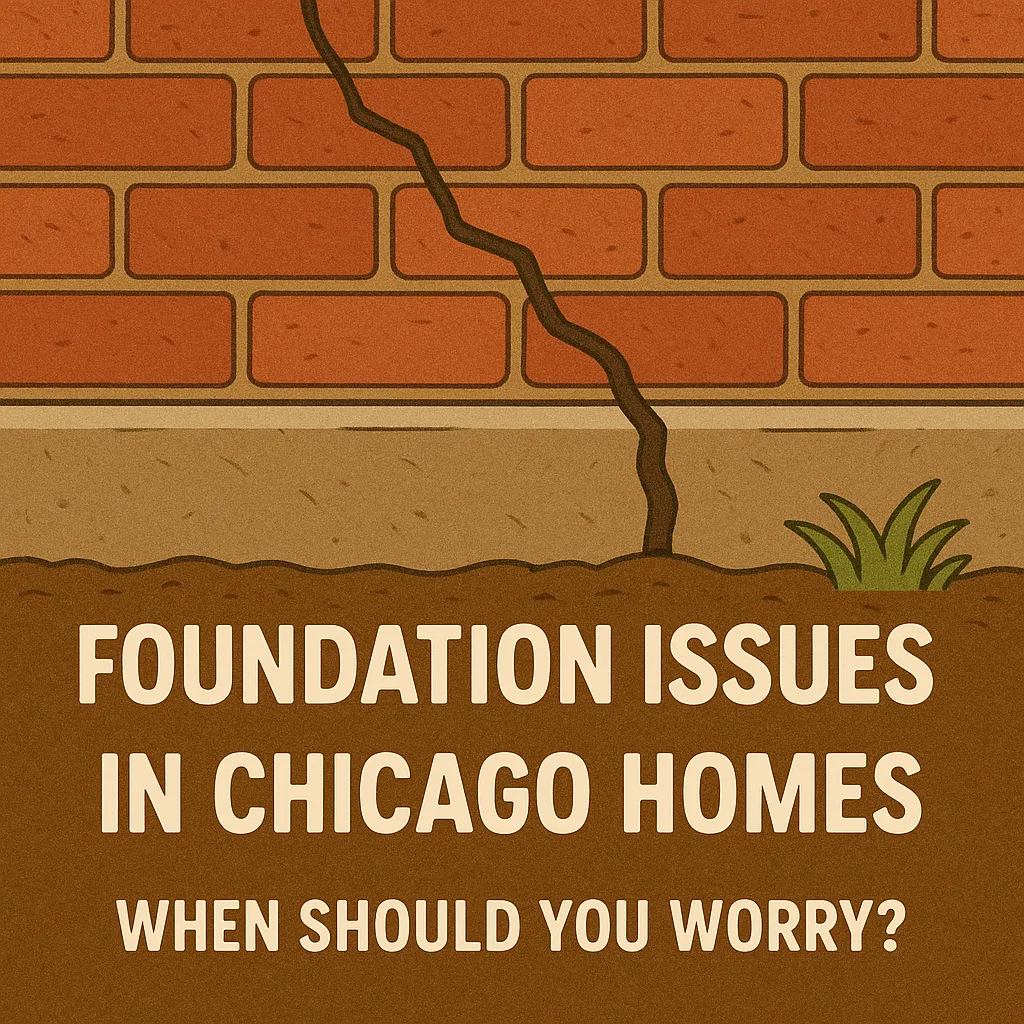
TL;DR: Most foundation cracks we photograph in Chicago basements are shrinkage cracks in poured concrete or old mortar joints in brick, and they go in the report as observations, not defects. The ones that change a deal are horizontal cracks, step cracks with displacement, walls out of plumb, and any crack that is actively leaking, and for those we write “evaluate by a licensed structural engineer” and tell you exactly what to ask the seller for.
What kind of foundation does the house have, and why do we start there?
The Illinois Standards of Practice (68 Ill. Adm. Code 1410.200(g)) require us to describe the foundation and its construction type, and that is the first thing we settle in the basement because the same crack means different things in different materials.
- Poured concrete. Smooth walls, form-tie holes in a grid, typical of post-war construction and everything since. Cracks here are usually shrinkage.
- Concrete block (CMU). Common in mid-century bungalows and ranches across the Northwest Side and the suburbs. Block walls crack along mortar joints and are the ones that bow.
- Brick. Many pre-war two-flats, greystones and workers’ cottages sit on several courses of common brick below grade. Mortar condition matters more than the brick.
- Rubble stone. Turn-of-the-century houses in Austin, Pilsen, Bridgeport and the older suburbs often have a stone rubble foundation with lime mortar. We inspected one from 1900 with a cracked slab and no sump this summer; the foundation itself was sound, the slab was the story.
If the basement is finished, the report says the foundation walls were concealed. In a 1910 building that limitation matters.
Are hairline cracks in a poured concrete wall a problem?
Almost never. Concrete shrinks as it cures, and a poured wall relieves that stress with thin vertical cracks, often at the corners of basement window openings or mid-way along a long wall. A business card will not go in, they run more or less straight up and down, and both faces are in the same plane.
What we write: “Hairline vertical crack(s) observed in the poured concrete foundation wall. No displacement, no moisture staining. Consistent with concrete shrinkage. Monitor.” It goes in the body of the report, not the summary.
Structural engineer? No.
What to ask for: Nothing from the seller. Take a dated photo the day you close so you have a baseline. If the same crack is wider a year later, that is new information.
Vertical, diagonal or horizontal: which direction actually matters?
Direction is the first thing we classify because it points to a cause.
Vertical
Shrinkage, or minor settlement that finished decades ago. Uniform width top to bottom. Low concern unless water is coming through it, which is a drainage problem rather than a structural one (see below).
Diagonal
A diagonal crack that is wider at one end than the other is the signature of differential settlement: one part of the footing dropped more than the rest. We look at what is above and outside that spot. Very often it is a corner where a downspout discharges at the wall, or the side of the house nearest a large tree. Diagonal cracks that run from the corner of a window opening down toward the floor are the ones we take most seriously.
What we write: The location, the orientation, the widest measured width, whether the faces are in plane, and what is outside that wall (the downspout, the grade sloping toward the house, the tree). If the crack is wider than roughly a quarter inch, tapers, or has been patched before and reopened, we recommend a structural engineer.
Horizontal
A horizontal crack part-way up a basement wall, especially in concrete block, means soil is pushing the wall inward. That is lateral pressure from saturated clay and frost, and it is the crack type we never call cosmetic. We put a four-foot level on the wall and look for bowing; a block wall that is visibly out of plumb at the crack line is a structural defect on the day we see it.
What we write: “Horizontal crack observed in the block foundation wall at approximately X courses above the slab, with inward bowing. This is consistent with lateral soil pressure. Recommend evaluation by a licensed structural engineer prior to close.” This goes in the summary.
Structural engineer? Yes, before your inspection contingency runs. Our post on when to call a structural engineer during the purchase covers what that visit produces and how to fit it inside the contract clock.
What does a step crack in block or brick mean?
Block and brick almost never crack through the unit. They crack along the mortar joints, so the crack climbs in a stair-step pattern. Where it is and what it does at the ends is what we read.
- Step crack in a block foundation wall below grade, tight, no displacement, running from a corner: usually old settlement. We note it and check the same corner outside for drainage.
- Step crack with one side proud of the other, or a crack that you can slide a coin into at the top and not at the bottom: active or recent movement. Engineer.
- Step crack in brick above grade, starting at the corner of a window or door: look at the lintel first. A rusting steel lintel expands and lifts the brick above it, and the crack that results is a lintel problem, not a foundation problem. That is a masonry repair, and it is common on every pre-war block in the city.
- Step cracking spread across a whole elevation with mortar loss, the kind we noted on a 1907 building in River North this year: that is deteriorated mortar first. Tuckpointing before structure.
What we write: Which wall, how many courses the crack spans, whether the units are displaced, whether the mortar is sound or sandy, and what is directly above or outside. Displacement or bowing gets the engineer recommendation. Mortar loss alone gets a masonry contractor recommendation.
When does a crack become a structural engineer call?
We recommend an engineer when we see any one of these, and we say which one in the report:
- Displacement. One face of the crack sits in front of the other. Run a finger across it; if it catches, the wall has moved, not just cracked.
- Bowing or lean. A level or a plumb line shows the wall is out of plane at the crack.
- Width and taper. Wider than about a quarter inch, or noticeably wider at one end.
- A repair that failed. Epoxy or hydraulic-cement patching with a new crack running through it. Somebody already tried once.
- Symptoms upstairs that line up with the crack. A sloping floor, a door that will not latch, a drywall crack above a doorway, all on the same side of the house as the foundation crack.
- Active water. Wet at the time of inspection, or a leak path with staining and efflorescence on a crack that is also displaced.
What we do not do is size the repair. The Standards of Practice say a home inspector is not required to perform engineering services, and a wall anchor, a carbon-fibre strap, drain tile and a full excavation are four different answers to what can look like the same crack. The engineer’s letter names one.
What to ask the seller for. The Illinois disclosure form (765 ILCS 77/35) asks the seller two direct questions: item 3, whether they are aware of flooding or recurring leakage in the basement, and item 5, whether they are aware of material defects in the basement or foundation, “including cracks and bulges.” Read those two answers against what we found. Then ask for any prior engineer’s report, any foundation contractor’s invoice and warranty (many are transferable, some only if you register them), and the permit for the work. Our guide to checking a Chicago permit history shows where to look.
Why do Chicago’s clay and winters do this to foundations?
Most of the city sits on glacial clay. It is not the high-swell clay of Texas or Colorado; its problem is that it drains slowly. Rain that lands next to the house stays next to the house, the clay holds it against the foundation wall, and the wall carries that hydrostatic load until the soil dries out. Then winter arrives and the saturated soil freezes and expands. The Chicago Building Code requires footings to extend at least 42 inches below grade for frost (Section 1809.5), which is why frost heave of the footing itself is rare in a code-built house. The wall above the footing is what takes the sideways push.
That is why the same three exterior findings show up in our reports next to nearly every foundation crack: a downspout discharging at the wall, grade sloping toward the house, and a gangway between two buildings with nowhere for water to go. Fix the water and most foundation cracks stop growing. Our post on grading and drainage covers what to change first.
What if water is coming through the crack?
A wet crack is usually a drainage defect before it is a structural one. Efflorescence (the white mineral bloom), a rust-brown stain fanning out below the crack, and a damp cove joint where the wall meets the slab all say water is getting in. Radon comes in the same way, which is one reason we recommend testing in any basement with a cracked slab and no sump.
What we write: “Moisture staining and efflorescence at the vertical crack in the north foundation wall. Evidence of past or ongoing water entry. Recommend correcting exterior drainage and sealing the crack; monitor.” Sealing a shrinkage crack from inside is a routine job. Sealing a displaced crack is a cover-up.
What to ask for: The seller’s answer to disclosure item 3, the sump pump’s age and whether it has a battery backup, and a look at the basement after a hard rain if the contingency period allows it. Our post on signs of moisture intrusion lists what else we check.
Greystones and brick two-flats: tuckpointing, lintels and parapets
Reading the masonry above the foundation
On a greystone or a brick two-flat the foundation is only half the structural story. The load-bearing walls are masonry all the way up, so we read the outside of the building the same way we read the basement.
- Mortar. Sandy, recessed or missing joints on the common-brick side and rear walls let water into the wall, and in winter that water freezes and spalls the brick face. Hard Portland-cement tuckpointing over soft lime-mortar brick makes it worse. Our post on failing mortar and tuckpointing red flags shows what good and bad repointing look like.
- Lintels. Every window and door in a brick wall sits on a steel or stone lintel. Rust jacking on a steel lintel produces the step crack at the upper corners of the opening and a sagging brick course above it. Read our lintel types and safety guide for how they fail.
- Parapets. Loose coping and open joints on a two-flat parapet are masonry repairs, not foundation ones, but water from a failed parapet can run inside the wall to the basement and show up as a “foundation” stain.
Our post on the hidden risks in Chicago greystones covers the limestone facade and what sits behind it.
The short version, by crack type
| What we see | What we write | Engineer? | Ask the seller for |
|---|---|---|---|
| Hairline vertical, poured concrete, dry | Shrinkage crack, monitor | No | Nothing; take a baseline photo |
| Vertical crack, wet or stained | Water entry at crack; correct drainage, seal | No | Disclosure item 3 answer, sump age |
| Diagonal, tapering, from a window corner | Differential settlement suspected | Yes if over a quarter inch or displaced | Prior engineer letter, drainage fix history |
| Horizontal, block wall, any bowing | Lateral soil pressure; structural | Yes, before contingency ends | Engineer evaluation, repair warranty, permit |
| Step crack, tight, no displacement | Old settlement or mortar; monitor or tuckpoint | No | Tuckpointing history |
| Step crack with displacement | Movement; structural | Yes | Engineer evaluation |
| Any crack through a failed repair | Prior repair unsuccessful; structural | Yes | Who did the repair, invoice, warranty |
What should you do next?
If you are under contract on a Multi-Board 8.0 form, the foundation falls under the “structural and mechanical components” named in the Paragraph 15 inspection contingency, and the clock to serve notice on the seller is five business days from acceptance. That is enough time for our inspection, the report the next business day, and an engineer’s visit if the report calls for one, but only if the inspection is booked early. You can book online with real-time availability and the price on screen, and you can read a sample report first to see how a foundation finding is written up, photographed and placed in the summary.
If you already own the house and a crack got bigger: photograph it with a ruler, find the downspout or grade feeding it, and fix the water before you hire anyone to fix the wall.