

TL;DR: A missing dishwasher high loop is one of the most common lines in a Chicago inspection report and one of the least important to argue about. The Illinois Plumbing Code says the drain hose has to rise to the underside of the sink rim before it drops to the drain; if yours lies flat on the cabinet floor, the fix is a screw and a clamp, and it is not a reason to renegotiate anything.
If you are reading this, there is a decent chance your report landed yesterday and the kitchen section has a photo of the underside of your sink with an arrow pointing at a corrugated hose. This is what that finding means, why we write it, and where it sits next to the drain problems that actually cost money.
What does the dishwasher drain finding actually say?
In our reports it reads close to this: the dishwasher drain hose is not routed in a high loop beneath the sink; the hose runs directly from the dishwasher to the drain connection at cabinet-floor level; recommend securing the hose to the underside of the countertop so it rises above the sink’s flood rim before connecting to the drain, per the Illinois Plumbing Code and the manufacturer’s installation instructions. There is a photo, and the photo is the whole case.
It is written as a plumbing correction, not a safety item, and it does not go in the summary at the front of the report. If your agent is treating it as a headline, that is a misread. The headline items in a kitchen are gas leaks at the range connector, an unfastened range with no anti-tip bracket, and open wire splices under the sink. We have found all three in Chicago two-flats this year. The high loop is not in that company.
High loop or air gap: which one does Illinois require?
This is where a lot of online advice goes wrong, because it is written for states that adopted the Uniform Plumbing Code, where a countertop air gap fitting is mandatory. Illinois has its own plumbing code, 77 Ill. Adm. Code 890, and the dishwasher provision is Section 890.770(a). It says:
“When a domestic dishwashing machine drain line is connected to the house side of a trap from a sink, the drain from the dishwasher shall be carried up to the underside of the spill rim of the sink. Dishwashing machines shall discharge separately into a trap or tail piece of the kitchen sink and shall not connect to the food waste disposal unit.”
Three things follow from that paragraph.
- Illinois requires the high loop, not an air gap. “Carried up to the underside of the spill rim” is the high loop. A chrome air gap fitting on the countertop satisfies the intent, and we do not flag its absence, but you will rarely see one in a Chicago kitchen and you do not need one.
- The loop has to reach the rim, not just rise a little. A hose that climbs six inches off the cabinet floor and comes back down does not meet the wording. The top of the loop belongs at the underside of the counter, which is why the standard fix is a hose clamp screwed to the cabinet just below the countertop.
- The code wants the dishwasher on the sink tailpiece or trap, not on the disposer. This surprises people. Most disposers ship with a dishwasher inlet, and most Chicago kitchens with a disposer use it. We note the connection when we see it. It is not the part of the finding that matters for backflow; the loop is.
Chicago has its own plumbing chapter in the Municipal Code and a licensed plumber will work to it. We write the finding to the state provision and to the manufacturer’s manual because both are things you and the seller can read tonight.
Why does the manufacturer’s install manual matter?
Because the manual is the second citation in the finding and the one the seller cannot argue with. Every domestic dishwasher sold in this country ships with an installation guide, and every one we have read shows the drain hose routed up to the underside of the countertop and secured there, with an air gap shown as the alternative where local code demands it. The manual gives a minimum height for the top of the loop and tells the installer to fasten it. Skipping it is an installation error by the manufacturer’s own definition.
That is also why the loop goes missing so often in Chicago condos. The original builder’s dishwasher was installed by a plumber with the manual open. Ten years later the previous owner replaced it with a delivery-and-haul-away appliance swap, the installer had eleven more stops that day, and the hose went wherever it reached. The new machine works. The loop is gone. Nobody looked under the sink again until we did.
If you want to check the manual for the dishwasher you are buying, the model number is on a label inside the door edge. The installation instructions are a separate document from the owner’s manual, and the drain routing diagram is usually on one of the last pages.
That same label is all our free Appliance Age Checker needs. Drop a photo of it and it tells you when the dishwasher was made, how long dishwashers typically last, and whether the model appears in a CPSC recall.
How does the high loop actually work?
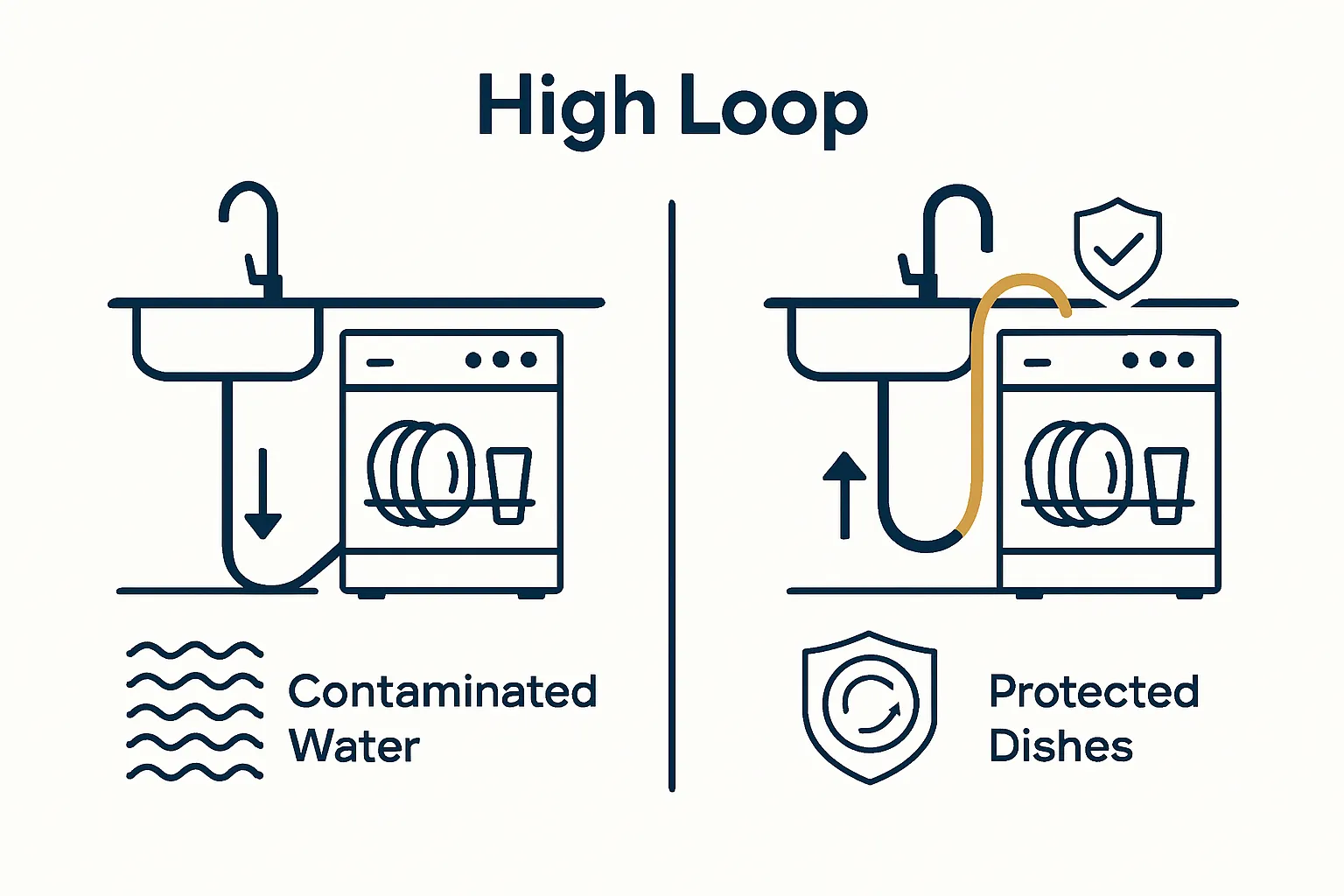
The dishwasher’s drain pump pushes water up and over the loop and out into the sink drain. That direction is not the problem. The problem is the other direction, and there are two ways water tries to go there.
Siphoning. When the pump stops, the hose is full of water. If the hose runs downhill from the dishwasher tub to the drain, that column of water keeps flowing by gravity and can pull the tub’s standing water out with it, then keep pulling. The loop breaks the siphon because the water on the dishwasher side has to be lifted to the top of the loop before it can fall to the drain, and nothing is lifting it once the pump is off.
Backflow from the sink. If the sink drain clogs, or the disposer is run with a full basin, the water in the sink and trap is pushed back through the tailpiece connection. With a low hose, that water runs straight into the dishwasher and sits in the bottom of the tub. With a high loop, the sink water would have to rise to the underside of the counter, which is above the sink’s spill rim, before it could reach the dishwasher. It overflows the sink first, which is unpleasant but visible.
That is the whole mechanism. The loop is not a valve and has no moving parts. It is a piece of geometry that makes gravity work for you instead of against you, and it is why the code specifies a height rather than a device.
How do I check it myself in 30 seconds?
- Open the sink base cabinet and move the trash can. Use your phone light.
- Find the corrugated or smooth rubber hose coming through the cabinet wall from the dishwasher side. It is usually the only flexible hose under there that is not a braided steel supply line.
- Follow it. Correct: it climbs to the underside of the countertop, is held there by a clamp, strap, or zip tie screwed to the cabinet, then drops to the tailpiece or disposer. Wrong: it lies along the cabinet floor and connects at the bottom, or it rises partway and is held up by nothing.
- While you are there, look at the connection. A spring clamp or worm-drive clamp on a barbed fitting is right. Electrical tape is not.
- If the hose runs through the countertop to a chrome cap next to the faucet, that is an air gap, and you are done.
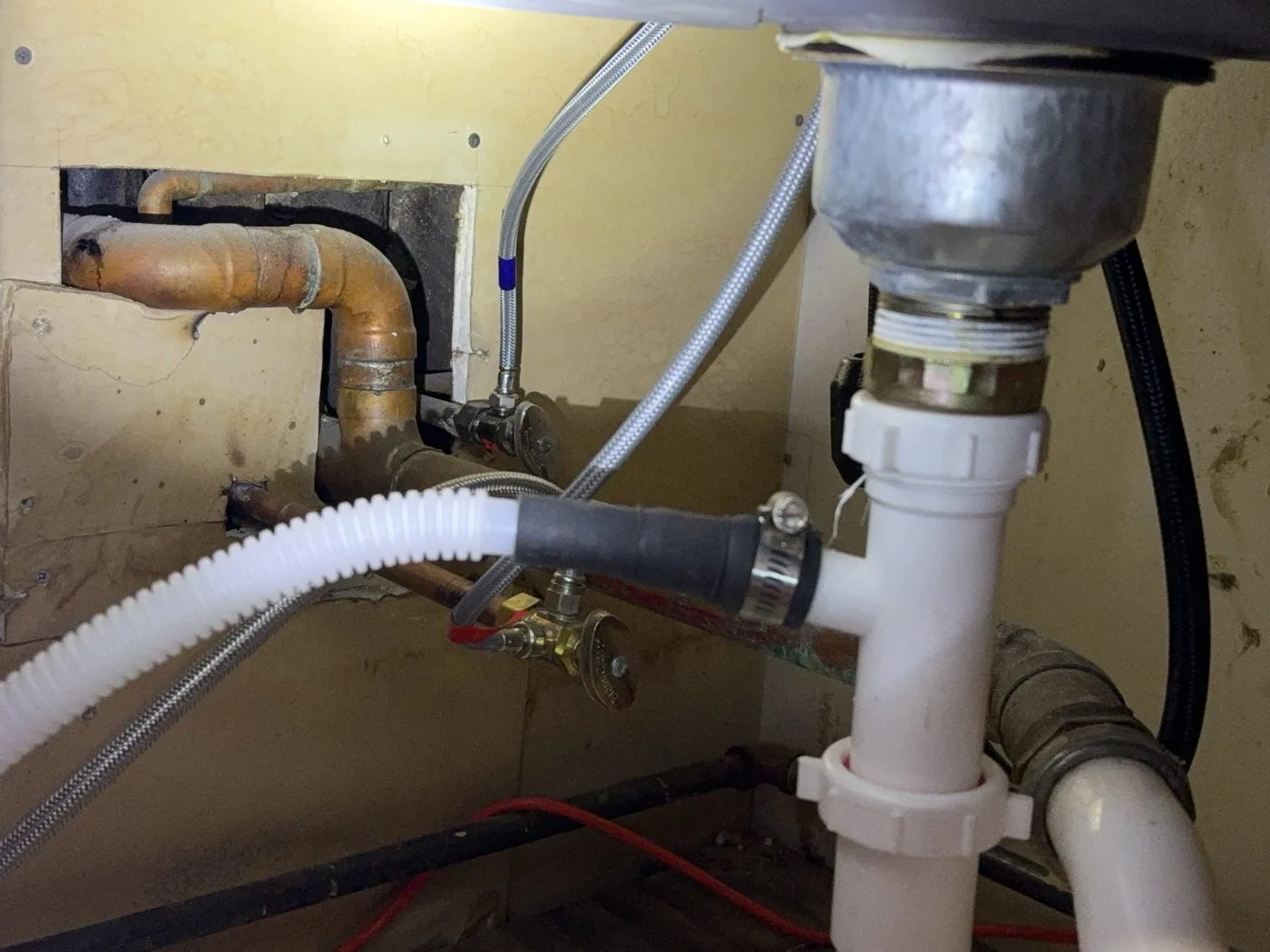
The fix, for a handy seller or the buyer on move-in day, is a pipe strap or a large zip tie and one screw into the cabinet side just below the counter. Pull enough slack from the dishwasher side to reach, secure the hose at its highest point, and reconnect. If the hose is too short to reach the counter and drop back down, a longer hose is a standard part at any plumbing supply. Any plumber can do it in the same visit as anything else on the list.
Is this a negotiation item?
No. We put it in the report because it is a real deviation from the code and the manual, and because a buyer who owns the house next week should know how the kitchen is plumbed. We do not put it in the report so that it can be traded for a credit, and an agent who builds a repair request around it is spending negotiating capital on the cheapest item on the list.
Ask the seller to correct it if there is already a repair request going over for other reasons; it costs them nothing to say yes. Otherwise do it yourself. A missing high loop will not fail a lender’s appraisal, will not stop a closing, and will not be the reason your dishwasher dies. Save the argument for the things below.
How is this different from the drain problems we actually push on?
Under the same sink, and in the same chapter of the report, there are findings we write with a different weight. These are the ones to carry into the repair request.
| Finding | Why it matters | Who fixes it |
|---|---|---|
| S-trap under the sink | An S-trap has no vent between the trap and the drop, so a full-bore discharge can siphon the trap dry and let sewer gas into the kitchen. Illinois plumbing code prohibits them; the correct fitting is a P-trap with a vent, or an approved air admittance valve where a vent cannot be reached. | Licensed plumber. Often means opening the wall or cabinet back. |
| Missing or inaccessible cleanout | A kitchen branch with no cleanout means the first clog gets cleared through the trap, or through a hole somebody cuts later. Older Chicago kitchens with the drain buried in plaster are the usual case. | Licensed plumber. |
| Corroded galvanized steel drain | Galvanized drains close up from the inside with rust scale and eventually leak at the threads. Slow drains, stains on the cabinet floor, and a drain line that looks swollen at the joints are the signs. This is a replacement, not a repair. | Licensed plumber; scope grows if the line runs inside a wall. |
| Open wire splices under the sink | Found in a Chicago two-flat, July 2026: the disposer’s wiring spliced outside any covered junction box, beneath a sink. That is an electrical finding, not a plumbing one, and it goes in the summary. | Licensed electrician. |
| Braided supply line past its service window | Found leaking at the dishwasher connection in a northwest suburban condo, 2026. Manufacturers give braided lines a limited service life, and a failed one runs until someone comes home. | Anyone; it is a hand-tight part. |
If the sink is slow and the report notes it along with older cast iron or clay under the basement floor, the next step is a sewer scope, which we refer to a partner rather than run in-house. That is a separate conversation about a separate pipe and belongs in the repair request on its own line.
What should I do with this line in my report?
Read the kitchen and plumbing sections together and sort them into two piles. The high loop, a loose faucet, a disposer that hums: your pile, handled the first weekend. An S-trap, a galvanized drain, an open splice, a gas leak at the range: the seller’s pile, sent over with the report page attached. Our sample report shows how those two kinds of findings are written differently so the sorting is already half done.
If you are buying a condo, the condo inspection page explains which plumbing is yours and which is the association’s; the dishwasher drain is always yours. Agents who want the finding language and the reasoning in one place for their clients can use the agent resources. And if you have not booked yet, you can schedule online with real-time availability and the price on screen, which most Chicago inspection companies still do not offer. Reports go out the next business day.