

TL;DR:
- Chicago homes commonly contain copper, PEX, galvanized steel, and CPVC pipes, each with different lifespans and resistance to freeze damage. Homeowners should identify pipe materials through visual inspection, magnet testing, and reading stamped markings, considering the home’s construction era. Replacement or repair decisions depend on material age, condition, and failure patterns, especially in older or mixed systems.
The four plumbing pipe types most commonly found inside residential walls are copper, PEX, galvanized steel, and CPVC, each with distinct properties that directly affect your home’s safety, water quality, and maintenance costs. Knowing which material runs through your walls is the first step toward making smart repair and renovation decisions. Chicago-area homes are especially complex because the region’s housing stock spans more than a century, meaning a single bungalow on the Northwest Side may contain two or three different pipe materials installed decades apart. Chicago winters, freeze-thaw cycles, and local water chemistry all accelerate wear on certain materials faster than national averages suggest.
What plumbing pipe types are in your walls?
Identifying your pipe materials without opening walls is straightforward if you know where to look and what to look for. Check exposed pipes under kitchen and bathroom sinks, in the basement, and in any crawlspace. These locations reveal the same materials running through your walls.
Visual identification by material:
- Copper: Reddish-brown metallic pipe, often with a greenish patina on older runs. Rigid and soldered at joints.
- Galvanized steel: Gray metallic pipe with visible threading at connections. Slightly rough surface texture.
- PEX: Flexible plastic tubing, color-coded by function (red for hot, blue for cold, white for either). Bends without fittings.
- CPVC: Rigid plastic pipe in cream or light yellow. Looks similar to PVC but slightly smaller in diameter and marked “CPVC” on the pipe body.
The fastest field test for galvanized steel is a simple magnet. Steel is magnetic; copper, PEX, and CPVC are not. This single test eliminates guesswork in basements where pipes are painted or corroded beyond easy visual identification.
Pro Tip: Check the pipe body for stamped text. Manufacturers print the material type, pressure rating, and sometimes the production year directly on plastic pipes. That stamp is the most reliable identification method for CPVC versus standard PVC.
Your home’s build decade also narrows the options significantly. Residential plumbing follows clear eras: galvanized steel dominated before 1960, copper from the 1960s through the 1990s, and PEX from the early 2000s onward. A 1928 Chicago graystone almost certainly has galvanized steel. A 1975 two-flat in Logan Square almost certainly has copper.
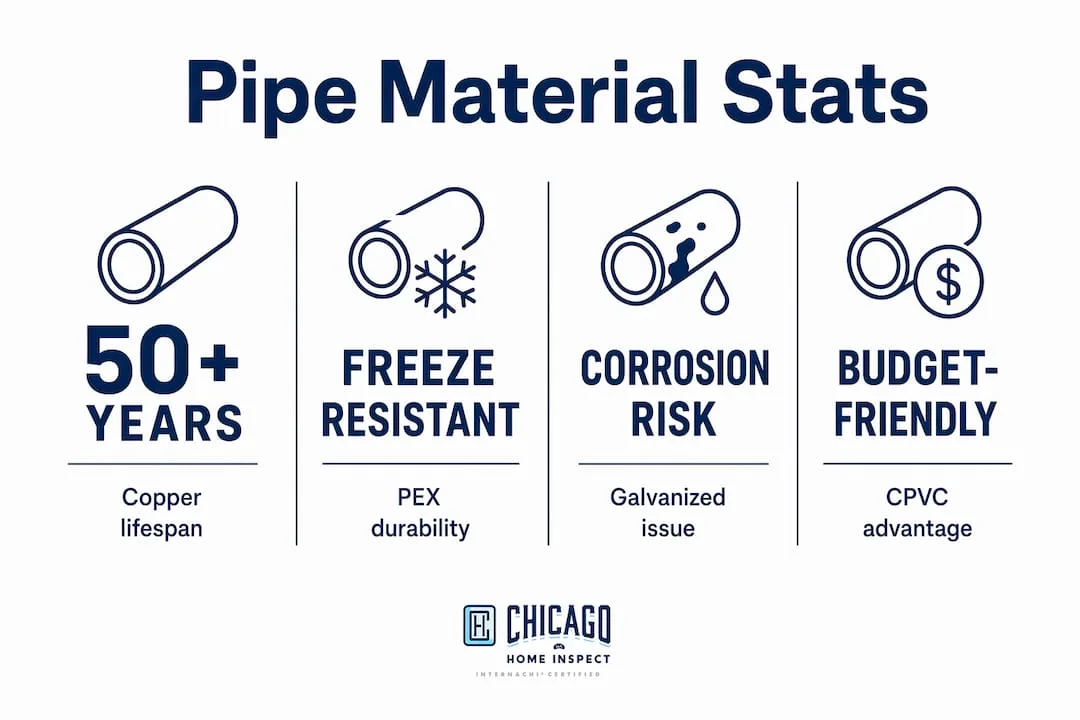
How do copper, PEX, galvanized steel, and CPVC compare?
Each pipe material has a specific performance profile. The table below summarizes the key differences relevant to Chicago homeowners.
| Material | Typical lifespan | Freeze resistance | Key risk | Best use |
|---|---|---|---|---|
| Copper | 50+ years | Low | Pinhole leaks from water chemistry | Supply lines, whole-house |
| PEX | 25–50 years | High | UV degradation | Supply lines, remodels |
| Galvanized steel | 40–70 years installed, often failing at 50 | Low | Internal rust, pressure loss | Legacy systems only |
| CPVC | 50–75 years | Moderate | Brittleness over time | Supply lines, budget builds |
Copper is the benchmark material for residential supply lines. It carries natural antimicrobial properties and handles high pressure reliably. The problem in Chicago is water chemistry. Local water chemistry drives copper pinhole leak risk, and those leaks are invisible externally until a wall is already wet. A greenish patina on copper is normal oxidation and does not signal failure. Internal corrosion is the real threat.
PEX is the preferred material for modern installations and renovations. Its flexibility also means it can expand slightly under freezing conditions without splitting, a meaningful advantage in Chicago’s Climate Zone 5 winters. The one firm limitation: PEX must be protected from UV light, so it cannot be used in exposed outdoor runs or unshaded crawlspaces with natural light.
Galvanized steel was the standard for decades and was genuinely durable when installed. The problem is internal. Steel pipes rust from the inside out, and that rust progressively narrows the pipe’s interior diameter. Homes with galvanized steel often show low water pressure and discolored water long before a visible leak appears. See our detailed breakdown of galvanized pipe risks for a full picture of what replacement involves.
CPVC offers a budget-friendly alternative to copper for supply lines. It handles hot water well and resists corrosion. The liability is brittleness. CPVC can become brittle in fluctuating temperatures, and Chicago’s seasonal extremes accelerate that process in unheated spaces. A brittle CPVC joint does not leak slowly. It cracks suddenly.
Pro Tip: If you have copper pipes and notice a pattern of pinhole leaks, test your water chemistry before repiping. Aggressive water with low pH or high chloramine levels causes the corrosion. Fixing the water chemistry may extend the life of your existing copper significantly. Water quality at home directly affects how long any pipe material lasts.
What pipe materials are typical by Chicago home era?
Chicago’s housing stock is one of the most age-diverse in the Midwest. The pipe material in your walls almost always reflects when your home was built or last renovated.
By construction decade:
- Pre-1960: Galvanized steel supply lines are standard. Some homes in this era also have lead service lines connecting to the city main, which is a separate and serious concern. Drain lines are often cast iron.
- 1960s–1980s: Copper dominates. Well-maintained copper from this era is often still performing, but pinhole leaks become more common as pipes pass 50 years.
- 1978–1995: Some homes used polybutylene, a gray plastic pipe that proved prone to brittleness and failure. Polybutylene replacement costs $8,000–$15,000 and is recommended over repair due to systemic failure risk.
- 1990s: CPVC appears in new construction and additions as a copper alternative.
- 2000s–present: PEX becomes the standard for new builds and renovations across the Chicago suburbs.
| Home era | Most likely supply pipe | Key inspection concern |
|---|---|---|
| Before 1960 | Galvanized steel | Internal rust, pressure loss |
| 1960–1990 | Copper | Pinhole leaks, water chemistry |
| 1978–1995 | Polybutylene (some) | Systemic brittleness |
| 1990–2000 | Copper or CPVC | CPVC brittleness in cold spaces |
| 2000–present | PEX | UV exposure, connection quality |
Chicago bungalows built in the 1920s and 1930s are the most complex cases. Many have had partial updates over the decades, leaving galvanized steel in the walls and copper or PEX under the sinks. Mixed systems require careful evaluation because homes with mixed pipe materials need inspectors to assess each section relative to its age and condition, not just the newest visible material.
When should you repair, monitor, or replace your pipes?
The decision to repair or replace depends on the material, its age, and the specific failure mode you are dealing with.
Galvanized steel showing rust or low pressure: Full replacement is the right call. Spot repairs on internally corroded galvanized pipe do not solve the underlying problem. The rust continues downstream of any patch.
Copper with isolated pinhole leaks: Test your water chemistry first. If the water is aggressive, a whole-house filter or pH adjustment may slow further corrosion. Isolated leaks can be repaired with push-fit fittings, but recurring leaks across multiple locations signal systemic corrosion requiring repiping.
CPVC that is cracked or discolored: Do not attempt to patch brittle CPVC with standard PVC fittings. Mixing CPVC with standard PVC causes cracking and system failure because the materials have different thermal expansion rates and solvent compatibility. Replace the affected section with matching CPVC or convert to PEX using approved transition fittings.
PEX with a failed connection: PEX connections fail at the fitting, not the pipe itself. Push-fit or crimp fittings are DIY-accessible for minor repairs. Full system replacements and any work involving the main supply line require a licensed plumber.
Any pipe in an unheated Chicago crawlspace: Insulate and seal the space before winter. Freeze-thaw cycles in Climate Zone 5 are the fastest way to turn a minor pipe issue into a burst pipe and a flooded basement.
Pro Tip: Before any renovation that opens walls, photograph every pipe you expose. Note the material, approximate diameter, and location. That record becomes invaluable for future repairs and for any home inspection report.
Significant repiping requires licensed professionals with code knowledge, particularly in Chicago where permit requirements apply to supply line replacements. DIY repairs work well for minor PEX fixes, but system-level decisions carry real risk if the wrong materials or fittings are combined.
For a broader view of what inspectors find in Chicago homes, the common plumbing problems we document during inspections reflect exactly these material-specific failure patterns.
What we see in Chicago homes: a field perspective
We inspect homes across Lake, McHenry, DuPage, and northern Cook Counties, and the most consistent finding is mixed pipe systems. A 1955 brick bungalow in Norwood Park may have galvanized steel in the walls, copper under the kitchen sink from a 1980s remodel, and PEX running to a new bathroom addition. Each section needs to be evaluated on its own terms.
The most common homeowner misconception we encounter is that a magnet test alone identifies all pipe types. It identifies galvanized steel. It does not distinguish between PEX, CPVC, standard PVC, and polybutylene. Those materials require a visual read of the pipe markings and a physical flex test. Polybutylene, which is gray and slightly flexible, is still present in some 1980s Chicago-area homes and is frequently misidentified as PEX.
We also see homeowners underestimate the impact of Chicago’s water chemistry on copper. Internal pinhole corrosion is invisible until leaks occur, and a visual inspection of copper that looks clean on the outside tells you very little about what is happening inside. Water testing alongside a professional inspection gives a far more complete picture than either approach alone. We recommend water quality testing as a standard step for any Chicago home with copper pipes older than 40 years.
The freeze-thaw cycle is not theoretical here. We inspect homes every spring where pipes in unheated garages or crawlspaces failed over the winter. The pipe material matters less than whether the space was properly conditioned. That is a detail no amount of pipe upgrading compensates for.
— Chicago Home Inspect LLC
How Chicago Home Inspect LLC evaluates your plumbing system
Understanding your pipe materials is one thing. Knowing their actual condition, especially inside walls and under slabs, requires a trained eye and systematic evaluation. At Chicago Home Inspect LLC, our residential home inspections cover visible and accessible plumbing throughout the home, including supply line materials, drain conditions, water heater connections, and signs of past leaks or repairs. We serve homeowners across Lake, McHenry, DuPage, and northern Cook Counties, with weekend availability for your schedule. Our plumbing inspection photos show exactly what we document and flag during a typical inspection. For a full picture of what a professional inspection covers, review our sample inspection report before you schedule.
FAQ
What is the most common pipe material in Chicago homes?
Copper is the most common supply pipe material in Chicago homes built between 1960 and 1990, which represents a large share of the city’s housing stock. Older homes typically have galvanized steel, while newer construction and renovations use PEX.
How do I know if I have galvanized pipes?
A magnet sticks to galvanized steel pipes. Galvanized pipes also appear gray and metallic with threaded connections, and older runs often show surface rust or discoloration at joints.
Is PEX better than copper for Chicago homes?
PEX offers better freeze resistance and lower installation costs than copper, making it well-suited for Chicago’s climate. Copper remains a reliable choice where water chemistry is not aggressive, but PEX’s flexibility and cost savings give it a practical edge in renovations.
Can I mix CPVC and PVC pipes in a repair?
No. Mixing CPVC with standard PVC causes cracking and failure because the two materials have different thermal expansion rates and require incompatible solvents. Always match the existing material or use approved transition fittings.
When should galvanized pipes be replaced?
Galvanized pipes showing low water pressure, rust-colored water, or visible external corrosion at joints should be replaced rather than repaired. Internal rust narrows the pipe over time, and spot repairs do not stop the corrosion from continuing elsewhere in the system.