
TL;DR:
- Buyers often overlook garage safety and climate-related damage, risking costly repairs and safety hazards. Proper inspections, including safety sensor tests and professional evaluations of mechanical systems, are essential before closing. Recognizing scams and enforcing code-compliant fire doors significantly enhance home safety and long-term value in Chicago.
Most Chicago buyers spend their home inspection mentally measuring furniture placement in the living room. The garage gets a glance. Maybe someone presses the opener button, watches the door go up and down, and calls it done. That oversight can turn into thousands of dollars in repairs or, worse, a genuine safety hazard that was hiding in plain sight. A proper garage inspection in Chicago — what buyers overlook — covers everything from freeze-damaged hardware to fire separation code violations, and understanding these details before closing can change the entire negotiation.
Table of Contents
- What Chicago’s climate does to your garage
- Critical safety features buyers miss
- Mechanical defects that rarely get flagged
- Garage repair scams targeting Chicago buyers
- How to actually evaluate a garage during inspection
- My take on why buyers keep getting this wrong
- Get a thorough garage inspection before you close
- FAQ
What Chicago’s climate does to your garage
Chicago does not go easy on garage doors. The city’s notorious freeze-thaw cycles put mechanical stress on every metal component, and most buyers have no idea how much damage accumulates over a single Chicago winter.
Here is what specifically breaks down faster in this climate:
- Metal springs and cables contract in the cold and expand in summer heat. That constant cycling causes metal fatigue faster than in milder climates, leading to cracks or snapped springs that give no warning before they fail.
- Tracks and rollers warp or bend when ice pushes against the bottom seal. Even a small warp creates enough misalignment to make a door bind or come off track.
- Weather stripping and bottom seals harden and crack when temperatures drop below freezing repeatedly. A failed seal lets moisture into the garage floor, contributing to concrete spalling over time.
- Rust on hardware is accelerated by road salt that gets tracked in from Chicago streets, especially in neighborhoods like Jefferson Park or Bridgeport where cars regularly travel salted roads in winter.
Annual inspection intervals of 6 to 9 months are recommended for high-use garages in Chicago. Most buyers are purchasing homes that have gone years without a single professional check.
Pro Tip: Ask the seller for any records of garage door service or repair. A garage that has never had professional maintenance in a Chicago winter climate is a garage with unknown mechanical condition.
The sellers often don’t know what they don’t know. They press the button every morning and assume everything is fine. That’s not the same as fine.
Critical safety features buyers miss
This is where the stakes get real. Garage doors are among the heaviest moving objects in any home, and the safety systems that control them have been federally mandated for decades. Yet buyers routinely walk past these systems without a second look.
Federal law requires all residential garage door openers manufactured after 1993 to include active safety reversal systems, including photoelectric sensors and auto-reverse mechanisms. That law is over 30 years old. Still, inspectors across Chicago consistently find non-compliant setups or systems that technically exist but no longer function.
What to check on safety sensors:
- Sensor alignment: The two sensors mounted near the floor on each side of the door must face each other directly. A bump from a lawn mower, garbage can, or even a child’s bike can knock them out of alignment. Misaligned sensors break the infrared beam, causing the door to refuse to close or reverse unexpectedly.
- Indicator lights: Both sensors should show steady lights, typically one green and one amber. Blinking lights signal a problem.
- Auto-reverse test: When you place a 2×4 flat on the floor in the door’s path, the door should reverse immediately upon contact. The board must lie flat. Doing this test with the board standing upright can damage door panels and gives a false result.
Beyond the opener itself, the door connecting the garage to the living space carries its own code requirements. IRC codes require a solid or steel door at least 1 and 3/8 inches thick, self-closing and self-latching, between the garage and any living area. Many homes in Chicago’s older neighborhoods have hollow-core interior doors installed as DIY upgrades. Those doors are not fire-rated, and they are not code-compliant.
A non-compliant garage door between living space and garage is not just a code issue. It is a life safety issue. A typical fire in an attached garage gives occupants less than three minutes to escape. A hollow-core door does not buy you that time.
Buyers who skip reviewing the home inspection red flags around garage fire separation are leaving themselves exposed to both physical danger and insurance liability.
Mechanical defects that rarely get flagged
A garage door can look fine and operate just often enough to pass a casual walkthrough. The underlying mechanical condition is a different story entirely. Here are the most commonly missed defects, in order of risk:
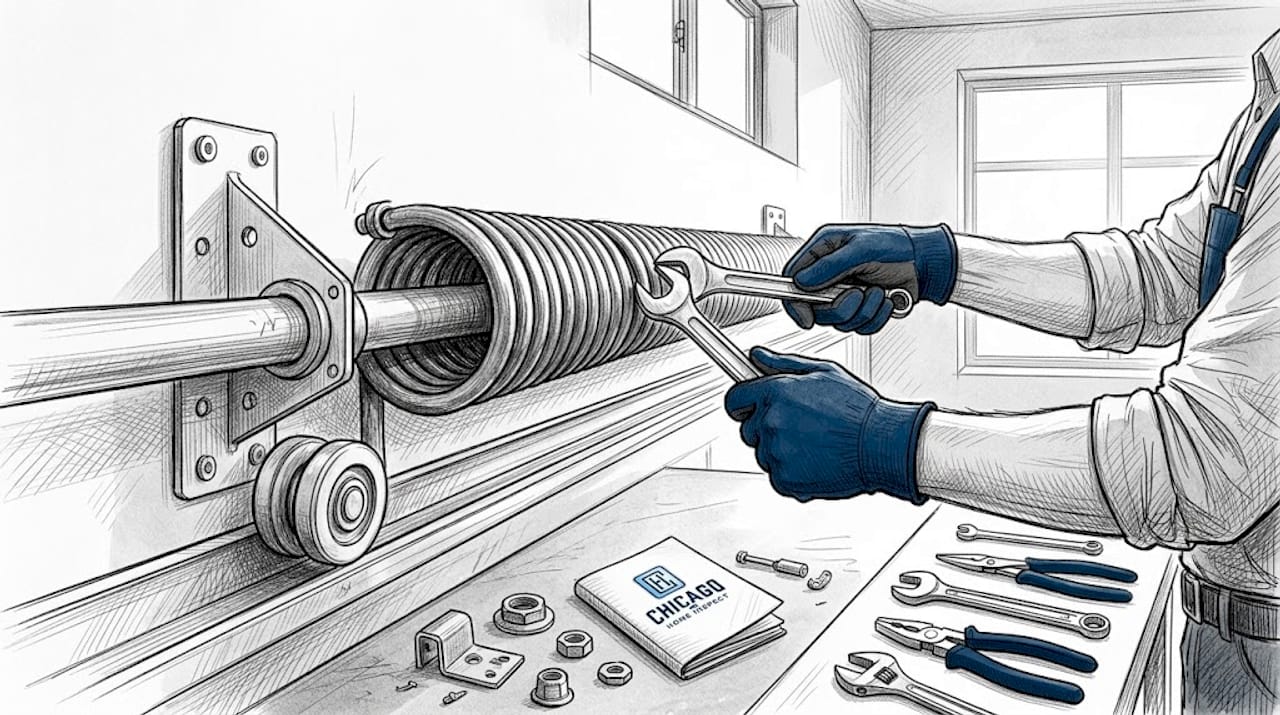
- Broken or worn torsion springs. Springs are under extreme tension. A snapped spring makes a sound like a gunshot and can cause the door to fall. Visual inspection alone cannot detect cable wear inside drums or verify spring tension. You need a professional to measure this properly.
- Track misalignment. Chicago’s soil settling, especially in areas like Wicker Park or Logan Square where older two-flats sit on shifting ground, causes structural shifts that pull garage frames out of square. Structural shifts cause track misalignment requiring professional realignment for safe operation. Buyers often mistake a slightly crooked door for a cosmetic issue.
- Worn rollers. Nylon rollers last 10 to 15 years. Steel rollers wear faster and get loud. Rollers that wobble in their brackets are on the verge of causing the door to jump the track.
- Force setting abuse. When a door is hard to move due to mechanical resistance, some homeowners crank up the opener’s force setting to compensate. Misusing force settings bypasses the auto-reverse safety mechanism entirely, creating a door that will not stop when it should.
- Opener age and electrical condition. Openers older than 15 to 20 years lack current safety technology. Wiring inside the motor unit may be brittle or improperly spliced from a DIY repair.
Pro Tip: Stand inside the garage and watch the door travel its full path while listening carefully. Grinding, popping, or uneven speed tells you more than a visual scan ever will. A smooth, quiet door does not guarantee everything is right, but a noisy one guarantees something is wrong.
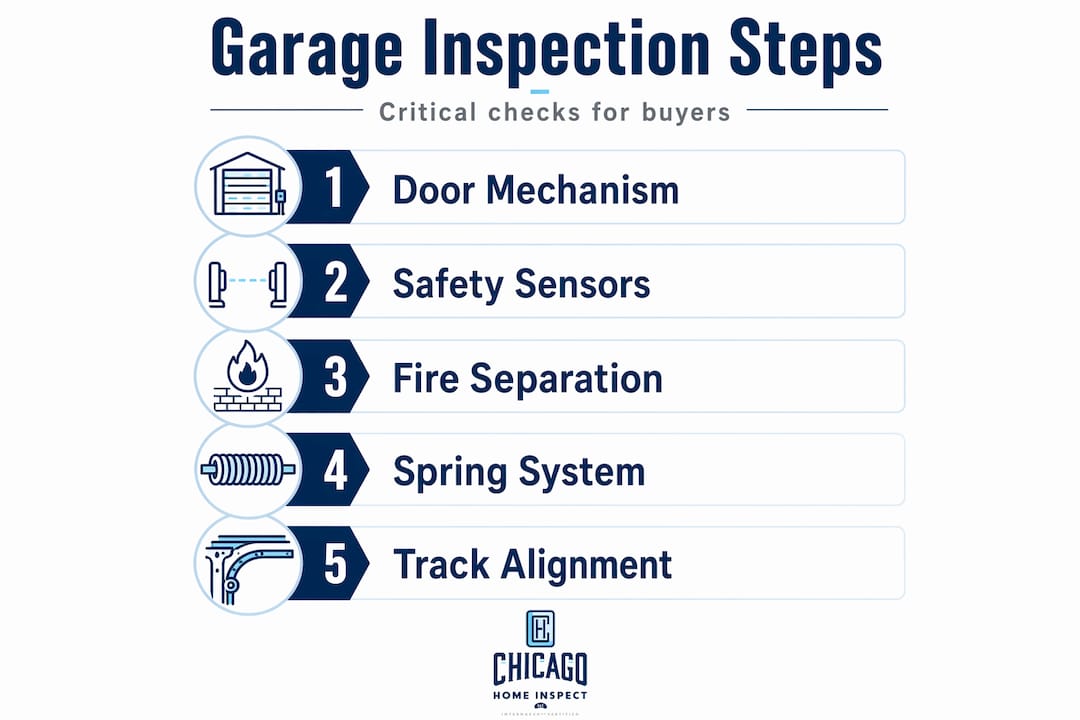
A professional inspection scope covers spring systems, cable condition, track alignment, roller condition, opener safety tests, sensor alignment, and lubrication. Most buyers do not know this is even a category of inspection that exists until they get the repair bill.
Garage repair scams targeting Chicago buyers
Chicago has a documented problem with predatory garage door repair companies, and homebuyers are especially vulnerable because they often do not yet know the neighborhood contractors to trust.
Scam operations in Chicago routinely mark up costs by 300 to 500 percent, often using unsolicited door-to-door offers or fake emergency service calls as entry points.
Red flags to watch for:
- Door-to-door offers. Legitimate repair companies do not canvass neighborhoods looking for business. If someone knocks on your future home’s door before closing offering a “quick tune-up,” walk away.
- Upfront payment demands. Reputable contractors invoice after work is complete or require a small deposit for parts. Demanding full payment before touching the door is a scam signal.
- Vague diagnoses. “You need a full rebuild package” without showing you the specific failed component is a classic tactic. Ask to see the broken part before approving any work.
- No verifiable credentials. Any legitimate Chicago contractor should be licensed, bonded, and insured. Ask for their Illinois contractor license number and look it up.
- Pressure to decide immediately. Manufactured urgency is a manipulation tactic. A door that needs a spring replaced can usually wait 24 hours for you to get a second opinion.
If you are already under contract on a home and a repair is needed, get at least two written estimates before authorizing any work. Cross-check company reviews on the Better Business Bureau and verify their physical address is a real location, not a PO box.
How to actually evaluate a garage during inspection
Standard home inspections are visual and non-invasive. Home inspectors are limited to what they can see and test without moving personal property or disassembling components. That means a garage packed with the seller’s belongings may hide significant defects that only surface after move-in.
Here is how to get more out of the process:
- Attend the inspection. Buyers who are present can point out concerns in real time and ask the inspector to document specific observations. This matters more in the garage than almost anywhere else in the house.
- Run the door yourself. Open and close the door manually with the motor disconnected. It should move smoothly with moderate effort. If it is stiff or falls quickly, the springs are either weak or miscalibrated.
- Test the auto-reverse. Place a 2×4 flat on the floor and close the door. The door must reverse on contact. This is the basic safety check every buyer should perform before closing.
- Hire a specialized technician for older doors. If the home has a pre-2000 opener or any history of DIY repairs, a $75 to $150 specialized garage door inspection pays for itself. This is separate from the general home inspection and goes deeper mechanically.
The common issues inspectors find in Chicago homes consistently include garage-related defects that buyers assumed were minor. Knowing what questions to ask puts you in a better position to negotiate repairs or credits.
My take on why buyers keep getting this wrong
I have walked through hundreds of Chicago homes as an inspector, and the pattern is consistent. Buyers treat the garage like an afterthought because it does not feel like living space. They inspect the kitchen faucet for drips and test every light switch, but they watch the garage door move once and consider it done.
What I have learned is that the garage is actually one of the highest-liability zones in any home. It combines heavy mechanical equipment, electrical components, and fire separation requirements all in one space. When any of those systems fail, the cost is rarely minor. A broken torsion spring repair runs $200 to $400 on average, but a track replacement or opener upgrade after a fall can cost over $1,000. Fire separation violations found post-closing can require permit-based remediation that sellers would have addressed for free during negotiation.
The buyers who do it right attend the inspection, ask about the garage specifically, and push for a specialized door technician when the system looks worn or old. They also know that safe garage door operation depends on code compliance, not just whether the button makes the door move.
My honest advice: budget for at least a basic garage door tune-up and safety check as part of every Chicago home purchase. Treat it like a dental cleaning for the house. You may find nothing wrong, and that is worth knowing too. But if you skip it and something breaks in February, you will wish you had asked the question before you signed the papers.
— Lyle
Get a thorough garage inspection before you close
Chicagohomeinspector provides pre-purchase inspections tailored to Chicago homes and suburbs, including detailed garage evaluations that cover mechanical systems, safety compliance, and climate-related wear. As an InterNACHI Certified and BBB Accredited inspection company, Chicago Home Inspect LLC documents every finding clearly so you can negotiate with confidence. You can review a sample inspection report to see exactly how garage defects are captured and communicated. Weekend appointments are available, and the team serves buyers across the Chicago area and suburbs. Do not close on a home without knowing what is actually behind that garage door.
FAQ
What do home inspectors check in a Chicago garage?
A standard inspection covers the door mechanism, opener function, auto-reverse safety systems, fire separation, and visible structural condition. Inspectors cannot test internal spring tension or cable wear inside the drum, so a specialized garage technician may be needed for older systems.
How do I test a garage door’s safety sensor before closing?
Place a 2×4 flat on the floor in the door’s path and press close. The door must reverse on contact. Check that both sensors show steady indicator lights and are free of dirt or physical damage from bumps.
Are garage door safety sensors required by law?
Yes. Federal law mandates that all residential garage door openers manufactured after 1993 include photoelectric sensors and an auto-reverse mechanism. Older openers without these features are non-compliant and should be replaced.
What is the most expensive garage defect buyers overlook?
Torsion spring failure and track misalignment are among the costliest surprises. When combined with Chicago’s freeze-thaw damage or structural settling, full track and spring replacement can exceed $1,000, not counting labor to address any related structural issues.
How do I spot a garage repair scam in Chicago?
Walk away from unsolicited door-to-door offers, upfront payment demands, and vague diagnoses without showing you the broken part. Always verify an Illinois contractor license number and get at least two written estimates before authorizing any repair work.
| Key Takeaway | Details |
|---|---|
| Climate damage is cumulative | Chicago’s freeze-thaw cycles degrade springs, tracks, and seals faster than buyers expect. Annual professional checks are the standard, not a luxury. |
| Safety sensors are federally required | Any opener made after 1993 must have photoelectric sensors and auto-reverse. A non-functioning system is both a code violation and a physical hazard. |
| Fire separation doors are non-negotiable | The door between garage and living space must be solid-core, self-closing, and self-latching per IRC code. Hollow-core replacements are unsafe and non-compliant. |
| Standard inspections have real limits | Visual inspections cannot confirm spring tension or cable wear. Buyers of older Chicago homes should add a specialized garage technician to their due diligence. |
| Scam contractors target buyers | Unsolicited repair offers and pressure tactics are common in Chicago. Verify licenses, get multiple estimates, and never pay in full before work is done. |